


Major Minor Exotic Currency Pairs Explained
BY TIOmarkets
|November 12, 2026Major, minor and exotic currency pairs are the three tiers into which the foreign exchange (forex) market sorts currency pairs by how heavily each one trades. Majors combine the US dollar with another leading currency, minors combine two leading currencies without the dollar, and exotics combine a leading currency with an emerging-market or less-traded one. The split into major minor exotic currency pairs is a market convention, not an official classification, and each label is only a proxy for liquidity and cost.
This explainer sets out what places a pair in each group, how global turnover data underpins the ranking and what the label signals about spreads, swaps and gap risk, for retail traders who want to test whether a pair's actual conditions match its label.
What Are Major, Minor and Exotic Currency Pairs?
Each pair has a base currency and quote currency, and its price states how many units of the second buy one unit of the first. EUR/USD, a major, prices the euro in US dollars. EUR/GBP, a minor, prices the euro in sterling, while USD/ZAR, an exotic, prices the US dollar in South African rand.
The group describes the market for a pair, not the merit of either currency. It signals liquidity, meaning how easily a trade can be filled near the quoted price. Liquidity in turn sets the bid-ask spread, the gap between the sell and buy prices, so the group gives a first estimate of cost before any quote is checked.
Who Decides Which Currency Pairs Are Majors?
The labels follow turnover, measured by the BIS Triennial Central Bank Survey, which the Bank for International Settlements (BIS) has run every three years since 1986. The 2025 survey covered April of that year, with final results published in June 2026. Central banks and other authorities in 52 jurisdictions collected its data from more than 1,100 banks and other dealers.
Dealers report trades in 24 currencies, and the 2025 survey measured turnover in 47 currency pairs. Figures are net-net, adjusted so that trades between reporting dealers are not counted twice, and are given as daily averages in April. Over-the-counter (OTC) foreign exchange trading, conducted directly between counterparties rather than on an exchange, averaged $9.6 trillion per day, up 28% from $7.5 trillion in 2022.
The dollar defines the majors: it was on one side of 89.2% of all trades in April 2025, with the euro at 28.9%, the yen at 16.8% and sterling at 10.2% (each trade involves two currencies, so the shares add up to 200%). All ten of the most traded pairs involve the dollar, the vehicle currency through which other currencies are commonly exchanged.
By pair, EUR/USD led with 21.2% of turnover, or $2,033 billion a day, ahead of USD/JPY at 14.3% and GBP/USD at 7.6%. USD/CAD held 5.3%, and AUD/USD and USD/CHF 4.9% each. The Canadian and Australian dollars are commodity currencies, whose values tend to track their raw-material exports, and their dollar pairs rank close to the Swiss franc pair. Where a source draws the line between majors and the rest is therefore a choice on a continuous ranking, not the application of a rule.
What Is a Minor Currency Pair?
A minor currency pair, also called a cross, combines two leading currencies without the US dollar, as EUR/GBP, EUR/JPY and GBP/JPY do. The difference between major and minor pairs comes down to whether the dollar is a leg. Individual minor currency pairs differ in their economic drivers but share the way their price is formed.
Because most trading runs through the dollar, a cross rate is derived from its two dollar legs, and this is how cross rates are calculated. Where the dollar is the quote currency in both legs, one rate is divided by the other: EUR/GBP = EUR/USD ÷ GBP/USD, so illustrative rates of 1.1000 and 1.2500 give 0.8800. Where the dollar is the base in one leg, the rates are multiplied: EUR/JPY = EUR/USD × USD/JPY.
A dealer quoting a cross therefore faces the spreads of both legs, while direct turnover in the cross is thin: in April 2025 AUD/JPY accounted for 0.4% of global turnover and GBP/JPY for 0.3%, against 14.3% for USD/JPY. Minors consequently tend to trade with wider spreads than the majors from which they are built.
What Makes a Currency Pair Exotic?
A pair is exotic when it combines a major currency with an emerging market currency, the currency of a developing economy with a smaller, less open financial market. Exotic currency pair examples include USD/ZAR, USD/TRY, USD/MXN and EUR/TRY. The rand, lira and peso are among the 24 currencies dealers report to the BIS, so their turnover is measured alongside that of the majors.
Liquidity explains why exotic pairs have wider spreads. Fewer dealers make prices, and a dealer who takes on a position may wait longer to offset it, so the cost of that risk is built into the bid-ask spread. Higher volatility, the size and speed of price moves, widens the spread further when local news breaks.
Swaps follow the interest rate differential, the gap between the two currencies' interest rates. A swap rate is the overnight financing charge or credit on a position held past the daily rollover, and whether it is a charge or a credit depends on the differential and the position's direction. Where an emerging-market currency carries rates well above the dollar's, a long USD/TRY or USD/ZAR position, which sells that currency, pays a large charge each night.
Capital controls restrict how freely a currency crosses borders, and local holidays thin trading while other centres stay open. Both raise the chance of a market gap, a jump between prices with no trading in between, typically over a weekend or after an unexpected policy decision. A stop order caught in a gap fills at the next available price, and that difference is slippage.
Major Minor Exotic Currency Pairs Compared
The three groups differ along one underlying variable, turnover, and each practical difference follows from it. Activity also shifts across trading sessions: majors trade heavily through the London and New York sessions, crosses are most liquid when both home centres are open, and exotics during their home session. These are typical conditions, not fixed properties of every pair in a group.
| Group | Typical examples | Liquidity | Spread and swap | Main risk |
| Major | EUR/USD, USD/JPY, GBP/USD, USD/CHF | Deepest: the ten most traded pairs all involve the US dollar | Narrowest spreads; swaps set by gaps between developed-market rates | Sharp moves around central bank decisions and data releases |
| Minor (cross) | EUR/GBP, EUR/JPY, GBP/JPY, AUD/JPY | Moderate: direct turnover is a small share of the total | Wider than the majors, as prices derive from two dollar legs | Spreads widen when one of the two home centres is closed |
| Exotic | USD/ZAR, USD/TRY, USD/MXN, EUR/TRY | Thin: fewer dealers, trading concentrated in the home session | Widest spreads; swaps reflect large interest rate differentials | Market gaps, capital controls and local holidays |
Worked Example: Comparing Trading Costs Across the Three Groups
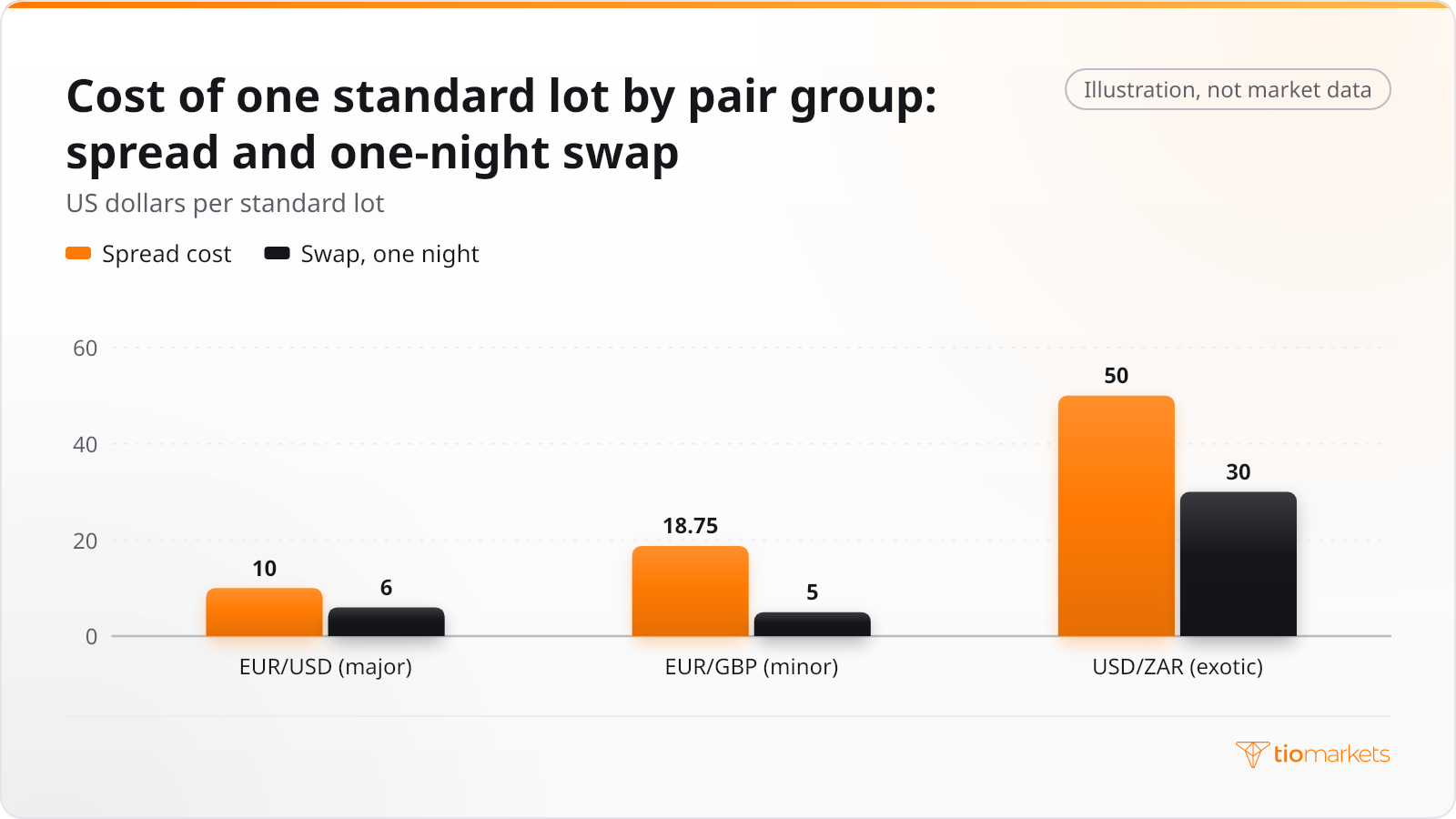
The label's practical meaning becomes clear when one position size is priced across the groups. The example takes one standard lot, 100,000 units of the base currency, on EUR/USD, EUR/GBP and USD/ZAR, with a pip, the smallest standard price move, of 0.0001 on each. Every spread, exchange rate and swap in it is assumed, not a market quote. The comparison takes five steps:
- Read the spread in pips. The example assumes 1.0 pip on EUR/USD, 1.5 pips on EUR/GBP and 100 pips on USD/ZAR.
- Find the pip value in the quote currency. Multiplying 0.0001 by 100,000 gives 10 units of the quote currency: $10, £10 and ZAR 10.
- Convert each pip value to US dollars. At an assumed GBP/USD rate of 1.2500 and USD/ZAR rate of 20.0000, £10 is $12.50 and ZAR 10 is $0.50.
- Multiply the spread by the pip value. The spread costs $10 on EUR/USD, $18.75 on EUR/GBP and $50 on USD/ZAR.
- Add one night's swap and compare the totals. Assumed charges of $6, $5 and $30 bring the totals to $16, $23.75 and $80.
On these assumptions, the exotic position costs $80 to open and hold for one night, five times the major's $16, and the spread accounts for most of the difference. Real spreads and swaps change with the session, the news and the trade's direction. Costs are also small beside price risk: a 100-pip move on one standard lot of EUR/USD changes the position's value by $1,000. Such positions are usually opened with leverage, which magnifies losses as well as gains; losses can build quickly when prices move fast or gap, and traders can lose all the money they deposit.
Where the Labels Break Down
Turnover does not always respect the labels. USD/CNY, whose figures include offshore renminbi trading commonly denoted CNH and which is usually listed as exotic, took 8.1% of global turnover in April 2025, up from 6.6% in 2022 and above GBP/USD at 7.6%. USD/HKD, also outside the usual majors, rose to 3.6% from 2.4%. Both far exceed the yen crosses classed as minors.
Liquidity also depends on where a pair trades. In Australia's results from the 2025 survey, AUD/USD remained the most traded pair in the local market, with 41 per cent of turnover, and NZD/USD ranked fourth. Because the global totals also include forwards and FX swaps, a high ranking does not by itself mean narrow spot spreads.
A major can also trade like an exotic for a time. Around a shock, an official intervention or a holiday, dealers withdraw, spreads widen and even EUR/USD or USD/JPY can gap. The label is therefore a starting assumption, not a measurement; a pair's quoted spread, its long and short swap rates and its trading hours, listed in the platform's contract specifications, show whether it fits the pattern at that moment.
Conclusion
Major, minor and exotic amount to a ranking by turnover expressed in three words. Its value lies in a first estimate: a major usually brings deep liquidity and a narrow spread, a cross adds the cost of two dollar legs, and an exotic adds thin liquidity, large swaps and gap risk. Where turnover and conditions part company with the label, as they do for USD/CNY, the conditions, not the label, decide what a trade costs.
The label describes a group, not the spread, swap or session behaviour of one pair at one moment, and it offers no protection against a shock. Trading any currency pair on margin, with a deposit covering only part of the position's value, carries a high risk of loss: leverage magnifies losses as well as gains, losses can mount rapidly when a market moves sharply or gaps, and a trader can lose the entire deposit.
Trade from anywhere with the TIOmarkets Trading and Investing Mobile App
Trade over 950 instruments with built-in TradingView charts and competitive spreads, all from your phone, in real time.
Trading is risky
FAQ
Risk disclaimer: CFDs are complex instruments and come with a high risk of losing money rapidly due to leverage. You should consider whether you understand how CFDs work and whether you can afford to take the high risk of losing your money. Never deposit more than you are prepared to lose. Professional client’s losses can exceed their deposit. Please see our risk warning policy and seek independent professional advice if you do not fully understand. This information is not directed or intended for distribution to or use by residents of certain countries/jurisdictions including, but not limited to, USA & Countries included in the OFAC sanction list. The Company holds the right to alter the aforementioned list of countries at its own discretion.
TIOmarkets offers an exclusively execution-only service. The views expressed are for information purposes only. None of the content provided constitutes any form of investment advice. The comments are made available purely for educational and marketing purposes and do NOT constitute advice or investment recommendation (and should not be considered as such) and do not in any way constitute an invitation to acquire any financial instrument or product. TIOmarkets and its affiliates and consultants are not liable for any damages that may be caused by individual comments or statements by TIOmarkets analysis and assumes no liability with respect to the completeness and correctness of the content presented. The investor is solely responsible for the risk of his/her investment decisions. The analyses and comments presented do not include any consideration of your personal investment objectives, financial circumstances, or needs. The content has not been prepared in accordance with any legal requirements for financial analysis and must, therefore, be viewed by the reader as marketing information. TIOmarkets prohibits duplication or publication without explicit approval.
Join us on social media


Authors BIO

Behind every blog post lies the combined experience of the people working at TIOmarkets. We are a team of dedicated industry professionals and financial markets enthusiasts committed to providing you with trading education and financial markets commentary. Our goal is to help empower you with the knowledge you need to trade in the markets effectively.