


What Is the Spread in Forex? A Complete Guide for Traders
BY Maria K.
|September 29, 2026The spread in forex is the difference between the bid price (selling price) and the ask price (buying price) of a currency pair. This difference, measured in pips, represents the primary transaction cost for forex traders. Understanding what is the spread in forex helps traders accurately calculate their trading costs and make informed decisions about when and what to trade.
Once you understand what is the spread in forex, you can recognize that spreads function as the built-in cost of executing forex trades, paid each time a position opens. The width of the forex spread varies based on market liquidity, volatility, and the specific currency pair being traded. Major pairs like EUR/USD typically offer narrower spreads than exotic pairs due to higher trading volumes.
This article covers what is the spread in forex in detail, including how spreads work, calculation methods, different spread types, and factors that influence spread width throughout trading sessions.
How Does Spread Work in Forex Trading?
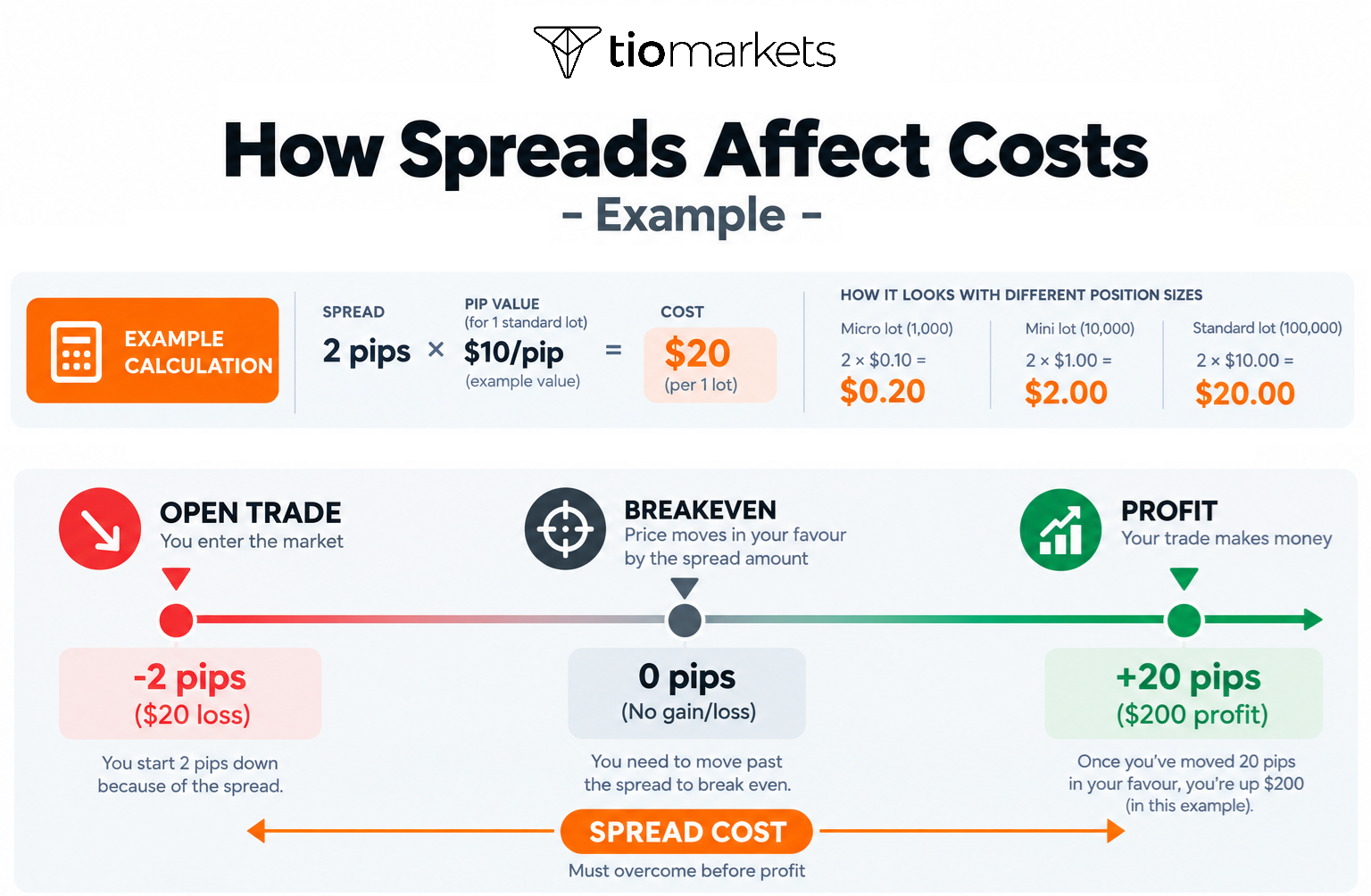
The forex spread creates a price difference between buying and selling prices, meaning traders start each position at a small “loss” equal to the spread amount. Knowing what is the spread in forex helps traders anticipate this initial cost. A trade must move favorably by at least the spread before reaching breakeven.
In forex markets, two prices exist for every currency pair: the bid price and the ask price. Understanding what is the difference between bid and ask in forex is essential, as the bid price represents what buyers offer to pay for a currency, while the ask price shows what sellers want to receive. The bid ask spread forex traders encounter reflects this natural gap between supply and demand.
Market makers and liquidity providers set spreads based on their assessment of risk and current market conditions. These entities facilitate trading by always being ready to buy or sell, and the spread compensates them for this service and the risk they assume.
So why is there a spread in forex? The spread exists as the primary revenue model for many forex brokers, particularly those offering commission-free trading. Rather than charging a separate fee per trade, these brokers widen the spread slightly from the interbank rate.
| Price Type | EUR/USD Example | What It Means |
| Bid Price | 1.1000 | Price to sell EUR |
| Ask Price | 1.1002 | Price to buy EUR |
| Spread | 0.0002 (2 pips) | Transaction cost |
How Do You Calculate the Spread in Forex?
After understanding what is the spread in forex, let’s move to calculating the forex spread. To calculate the spread in trading you subtract the bid price from the ask price. If EUR/USD displays a bid of 1.1000 and an ask of 1.1002, the spread equals 0.0002, or 2 pips.
What Are Pips and How Do They Relate to Spreads?
A pip (percentage in point) represents the smallest standard price movement in most forex pairs. For most currency pairs, a pip equals the fourth decimal place (0.0001), though Japanese yen pairs use the second decimal place (0.01) as the standard pip measurement.
Spreads are universally quoted in pips across the forex industry, making comparison between different pairs and brokers straightforward. This standardization makes answering what is the spread in forex consistent regardless of the trading platform used. Many brokers also display fractional pips, called pipettes, which add an additional decimal place for more precise pricing.
Step-by-Step Spread Calculation Examples
| EUR/USD Example | Bid: 1.10500 • Ask: 1.10520 • Spread: 1.10520 • 1.10500 = 0.00020 = 2 pips |
| GBP/USD Example | Bid: 1.27350 • Ask: 1.27380 • Spread: 1.27380 • 1.27350 = 0.00030 = 3 pips |
| USD/JPY Example (Yen Pair) | Bid: 149.250 • Ask: 149.270 • Spread: 149.270 • 149.250 = 0.020 = 2 pips |
How to Convert Spread into Actual Trading Costs
The monetary cost of a spread depends on position size and pip value. For most USD-quoted pairs, one pip equals $10 per standard lot (100,000 units), $1 per mini lot (10,000 units), or $0.10 per micro lot (1,000 units).
Formula: Spread Cost = Spread in Pips × Pip Value × Number of Lots
Example Calculations:
- 2-pip spread on 10,000 units (mini lot) = 2 × $1 = $2
- 2-pip spread on 100,000 units (standard lot) = 2 × $10 = $20
- 2-pip spread on 5 standard lots = 2 × $10 × 5 = $100
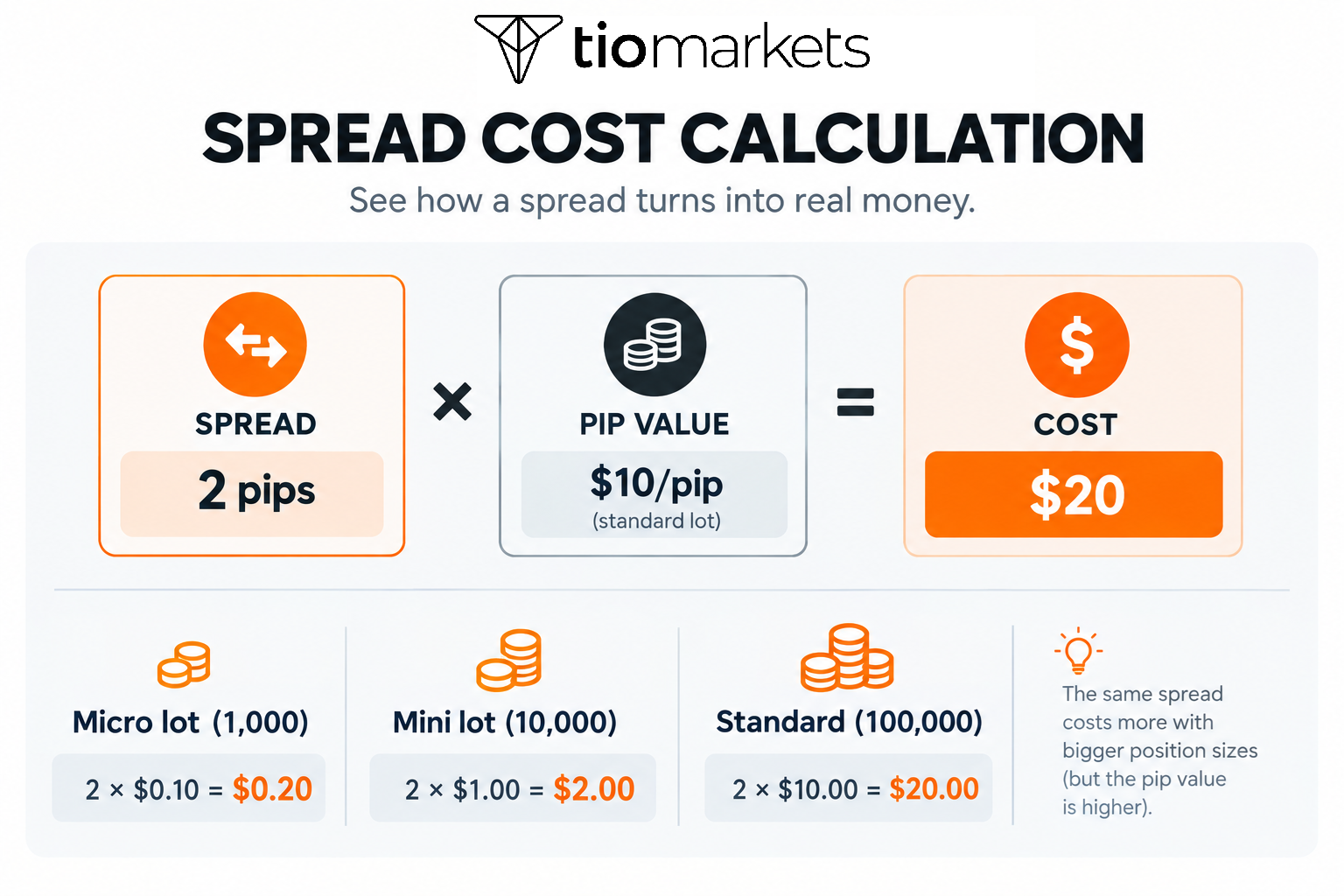
A forex spread calculator can automate these calculations across different position sizes and currency pairs.
What Types of Spreads Exist in Forex Trading?
When exploring what is the spread in forex further, traders discover that forex brokers typically offer two spread types: fixed and variable. Fixed spreads remain constant regardless of market conditions, and variable (floating) spreads change based on liquidity and volatility.
What Are Fixed Spreads in Forex?
Fixed spreads maintain the same width throughout trading hours, providing cost predictability. Dealing desk brokers, who act as counterparties to client trades, typically offer this spread type since they control the pricing environment.
Fixed spreads generally remain stable during normal market conditions, though some brokers may temporarily widen them during extreme volatility or low liquidity periods. Typical fixed spreads for major pairs range from 1.5 to 3 pips, depending on the broker and account type.
What Are Variable Spreads in Forex?
Variable spreads fluctuate continuously based on real-time market conditions. Non-dealing desk brokers, who pass orders directly to liquidity providers, offer variable spreads that reflect actual interbank market rates.
These spreads narrow during high-liquidity periods when many market participants trade actively. Conversely, they widen when liquidity decreases or volatility increases, such as during major news announcements or outside peak trading hours.
Fixed vs Variable Spreads: Key Differences
| Factor | Fixed Spreads | Variable Spreads |
| Cost Predictability | High | Lower |
| Lowest Possible Spread | Generally higher | Can be very tight |
| News Event Behavior | May have requotes | Spreads widen |
| Trading Style Suitability | News trading, beginners | Scalping, active trading |
Understanding what is the spread in forex includes recognizing these structural differences. For example, at TIOmarkets we offer variable spreads that come directly from our liquidity providers.
Via a hybrid trade execution model, we strategically combine internal liquidity matching with Straight Through Processing (STP) to external liquidity providers. This approach helps maintain tight spreads during normal conditions while ensuring reliable order execution even during periods of high volatility.
Trade with tight variable spreads
TIOmarkets offers variable spreads directly from our liquidity providers
Trading is risky
What Is Spread Markup and How Does It Work?
Spread markup is the additional cost brokers add to raw interbank spreads to generate revenue. If the interbank spread is 0.5 pips and the displayed spread is 1.5 pips, the 1-pip difference represents the broker's markup.
Typical markup ranges in retail forex vary from 0.5 to 2 pips above raw spreads. Different account types at the same broker often feature different markup levels, with premium accounts generally having lower markups. The no-commission trading model relies entirely on spread markup for broker revenue.
How Do Spreads Affect Your Trading Profitability?
Knowing what is the spread in forex becomes crucial when examining profitability, as spreads create an immediate cost that trades must overcome before generating profit. A 2-pip spread means the market must move 2 pips in the trader's favor just to reach breakeven, effectively raising the threshold for profitable outcomes.
Calculating Spread Impact on Individual Trades
When a trader opens a long EUR/USD position with a 2-pip spread, they immediately start 2 pips down from their entry. If their profit target is 20 pips, the market needs to move 22 pips total; 2 to cover the spread and 20 for profit.
Similarly, stop-loss orders need to account for the spread. A stop loss placed 10 pips from entry actually triggers after an 8-pip adverse movement when including the 2-pip spread cost.
Cumulative Spread Costs for Active Traders
Forex transaction costs accumulate significantly for active traders. A scalper executing 20 trades daily with an average 2-pip spread on mini lots pays approximately $40 daily in spread costs, totaling around $800 monthly in forex trading costs.
Account type selection significantly impacts cumulative costs. A trader executing 100 lots monthly would pay substantially different amounts depending on whether they use a zero-commission account with wider spreads or a raw spread forex account with per-trade commissions.
Spread Considerations for Different Trading Styles
- Scalping: Tight spreads are critical since profit targets are typically 5-10 pips. What is considered a tight spread in forex generally falls below 1-2 pips for major pairs.
- Day Trading: Moderate spread sensitivity with targets of 20-50 pips
- Swing Trading: Reduced spread impact with targets of 100+ pips
- Position Trading: Minimal spread relevance when holding for weeks or months
What Factors Influence Forex Spread Width?
A complete understanding of what is the spread in forex requires knowing that forex spread width primarily depends on market liquidity, trading volume, volatility, time of day, and the currency pair being traded. Higher liquidity generally correlates with tighter spreads.
How Does Market Liquidity Affect Spreads?
When learning what is the spread in forex, liquidity plays a central role. Market liquidity in forex refers to the volume of orders available at various price levels. High liquidity means many buyers and sellers compete for trades, which naturally tightens the gap between bid and ask prices.
The London-New York session overlap (approximately 8 AM to 12 PM EST) typically features the highest liquidity and tightest spreads. The Asian session and holiday periods often experience lower liquidity and wider spreads.
How Does Volatility Impact Forex Spreads?
Volatility measures how much and how quickly prices change. During high-volatility periods, spreads widen because liquidity providers face increased risk of price changes between when they quote and when they fill orders.
Economic data releases like Non-Farm Payrolls, central bank decisions, and unexpected geopolitical events can cause spreads to widen dramatically within seconds. Spreads may expand from 2 pips to 10+ pips during major announcements.
Why Do Different Currency Pairs Have Different Spreads?
A forex spread comparison across pair categories reveals significant differences:
| Pair Category | Example Pairs | Typical Spread Range |
| Major Pairs | EUR/USD, GBP/USD | 0.5 - 3 pips |
| Minor Pairs | EUR/GBP, AUD/NZD | 2 - 5 pips |
| Exotic Pairs | USD/TRY, USD/ZAR | 10 - 100+ pips |
Trading volume serves as the primary differentiator, with major pairs processing trillions in daily volume compared to significantly lower volumes for exotic pairs.
What Is Slippage and How Does It Relate to Spreads?
Slippage occurs when trades execute at different prices than requested, typically during fast-moving markets. While related to spreads, slippage represents a separate cost that can occur even with fixed spreads when prices change rapidly.
Slippage differs from spread widening because it affects the actual execution price rather than the quoted spread. During extreme volatility, traders may experience both wider spreads and slippage simultaneously, increasing total forex transaction costs.
How Do Spreads Vary Throughout the Trading Day?
Forex spreads are typically tightest during the London-New York overlap (8 AM to 12 PM EST) and widest during low-liquidity periods like late Sunday openings and major holidays.
- Tokyo Session (7 PM - 4 AM EST): Moderate spreads, tightest for JPY pairs
- London Session (3 AM - 12 PM EST): Generally tight spreads across most pairs
- New York Session (8 AM - 5 PM EST): Tight spreads, especially during London overlap
- Session Overlaps: Tightest spreads of the day
- Weekends/Holidays: Widest spreads, particularly at Sunday market open
What Are Raw Spreads in Forex Trading?
Raw spreads represent actual interbank market spreads without broker markup, with brokers charging separate commissions per trade instead of widening the spread. This structure offers another perspective on what is the spread in forex and how costs can be structured differently.
Raw spread forex accounts may show spreads starting from 0.0 pips during high-liquidity periods. However, traders pay a commission per lot traded, typically ranging from $3 to $7 per round turn (opening and closing).
For example, TIOmarkets’ Raw account features raw variable spreads starting from 0.0 and commission of $6 per lot, while our standard account offers spreads starting from 1.1 pips with zero commission. Traders can compare and determine which structure suits their trading goals after calculating total costs.
Spreads During Major News Events
Forex spreads typically widen significantly during major economic announcements, reflecting increased risk and reduced liquidity as market participants react to new information.
Before major announcements, spreads often begin widening as liquidity providers reduce their exposure. During the announcement itself, spreads may expand dramatically, sometimes by 5 to 20 times normal levels, depending on the event's importance.
Spread normalization typically occurs within minutes to hours after news releases, though unexpected outcomes may extend periods of elevated spreads. High-impact events include central bank interest rate decisions, employment reports, GDP releases, and inflation data.
What Are the Spreads on Low Spread Forex Pairs?
Major currency pairs offer the tightest spreads due to high liquidity. When considering what is a good spread in forex, EUR/USD typically features spreads of 0.5 to 2 pips, making it among the low spread forex pairs.
- EUR/USD: 0.5 - 2 pips (most liquid pair)
- GBP/USD: 1 - 3 pips
- USD/JPY: 0.5 - 2 pips
- AUD/USD: 1 - 3 pips
- USD/CHF: 1 - 3 pips
Minor pairs like EUR/GBP or AUD/NZD typically show 2-5 pip spreads, while exotic pairs like USD/TRY may exceed 20-50 pips during normal conditions.
How Can You Monitor Forex Spreads?
After learning what is the spread in forex, traders can monitor spreads directly on trading platforms, which display live bid and ask prices for each currency pair. The difference between these prices represents the current spread, updating in real-time.
Most trading platforms show spread information in the market watch window or directly on price charts. Some platforms offer dedicated spread indicators that display the current spread as a numerical value or overlay.
Comparing spreads across brokers before opening an account can reveal significant cost differences. Many brokers publish typical spread information on their websites, though actual trading conditions may vary.
Conclusion
Understanding what is the spread in forex - and what does spread mean in forex - provides the foundation for calculating true trading costs. The spread varies based on currency pair liquidity, market volatility, and trading session timing.
Spreads accumulate with each trade, making spread awareness particularly important for active traders. Whether choosing fixed or variable spreads, or comparing raw spread accounts with standard offerings, traders should know how these costs impact their overall trading results.
Key Takeaways
- What is the spread in forex? The difference between bid and ask prices, representing the primary forex trading cost
- Spreads are measured in pips and vary based on liquidity and volatility conditions
- Major currency pairs typically have tighter spreads than minor or exotic pairs
- Fixed spreads remain constant while variable spreads fluctuate with market conditions
- Spread costs accumulate with trading frequency, significantly impacting active traders

FAQ
Risk disclaimer: CFDs are complex instruments and come with a high risk of losing money rapidly due to leverage. You should consider whether you understand how CFDs work and whether you can afford to take the high risk of losing your money. Never deposit more than you are prepared to lose. Professional client’s losses can exceed their deposit. Please see our risk warning policy and seek independent professional advice if you do not fully understand. This information is not directed or intended for distribution to or use by residents of certain countries/jurisdictions including, but not limited to, USA & Countries included in the OFAC sanction list. The Company holds the right to alter the aforementioned list of countries at its own discretion.
TIOmarkets offers an exclusively execution-only service. The views expressed are for information purposes only. None of the content provided constitutes any form of investment advice. The comments are made available purely for educational and marketing purposes and do NOT constitute advice or investment recommendation (and should not be considered as such) and do not in any way constitute an invitation to acquire any financial instrument or product. TIOmarkets and its affiliates and consultants are not liable for any damages that may be caused by individual comments or statements by TIOmarkets analysis and assumes no liability with respect to the completeness and correctness of the content presented. The investor is solely responsible for the risk of his/her investment decisions. The analyses and comments presented do not include any consideration of your personal investment objectives, financial circumstances, or needs. The content has not been prepared in accordance with any legal requirements for financial analysis and must, therefore, be viewed by the reader as marketing information. TIOmarkets prohibits duplication or publication without explicit approval.
Join us on social media



Authors BIO

Maria is a writer and content strategist with over 10 years of experience in the finance industry. She specializes in developing research-backed articles that help financial professionals navigate complex market topics with confidence. Her expertise spans forex, stocks, CFDs and global markets, creating insightful content that educates readers and supports informed decision-making.