What Time Do the Forex Markets Open? Complete Guide
BY Maria K.
|September 17, 2026| The forex market opens Sunday at 10:00 PM GMT when Sydney trading begins and closes Friday at 10:00 PM GMT when New York ends. The market runs continuously for 120 hours each week through four sessions: Sydney, Tokyo, London, and New York. The busiest period is the London-New York overlap (1:00 PM - 5:00 PM GMT). |
The forex market operates on a 24-hour, 5-day trading structure that differs fundamentally from stock exchanges because it lacks a central physical location for transactions. Instead of a single opening bell, currency trading flows continuously through four major trading sessions based in Sydney, Tokyo, London, and New York as business hours rotate around the globe.
When traders ask what time do the forex markets open, the answer depends on understanding that "open" refers to when significant trading activity returns rather than a physical door unlocking. Each session represents a period when banks, institutions, and retail traders in that region are most actively participating in the currency markets.
All times referenced throughout this article use GMT, which is equivalent to UTC for practical trading purposes.
Quick Reference Table: Forex Trading Session Times
| Session | Opens (GMT) | Closes (GMT) | Key Currency Pairs | Share of Daily Volume |
| Sydney | 10:00 PM (Sun-Thu) | 7:00 AM | AUD/USD, NZD/USD | ~4% |
| Tokyo | 12:00 AM | 9:00 AM | USD/JPY, AUD/JPY | ~6% |
| London | 8:00 AM | 5:00 PM | EUR/USD, GBP/USD | ~35% |
| New York | 1:00 PM | 10:00 PM | USD/CAD, USD/CHF | ~16% |
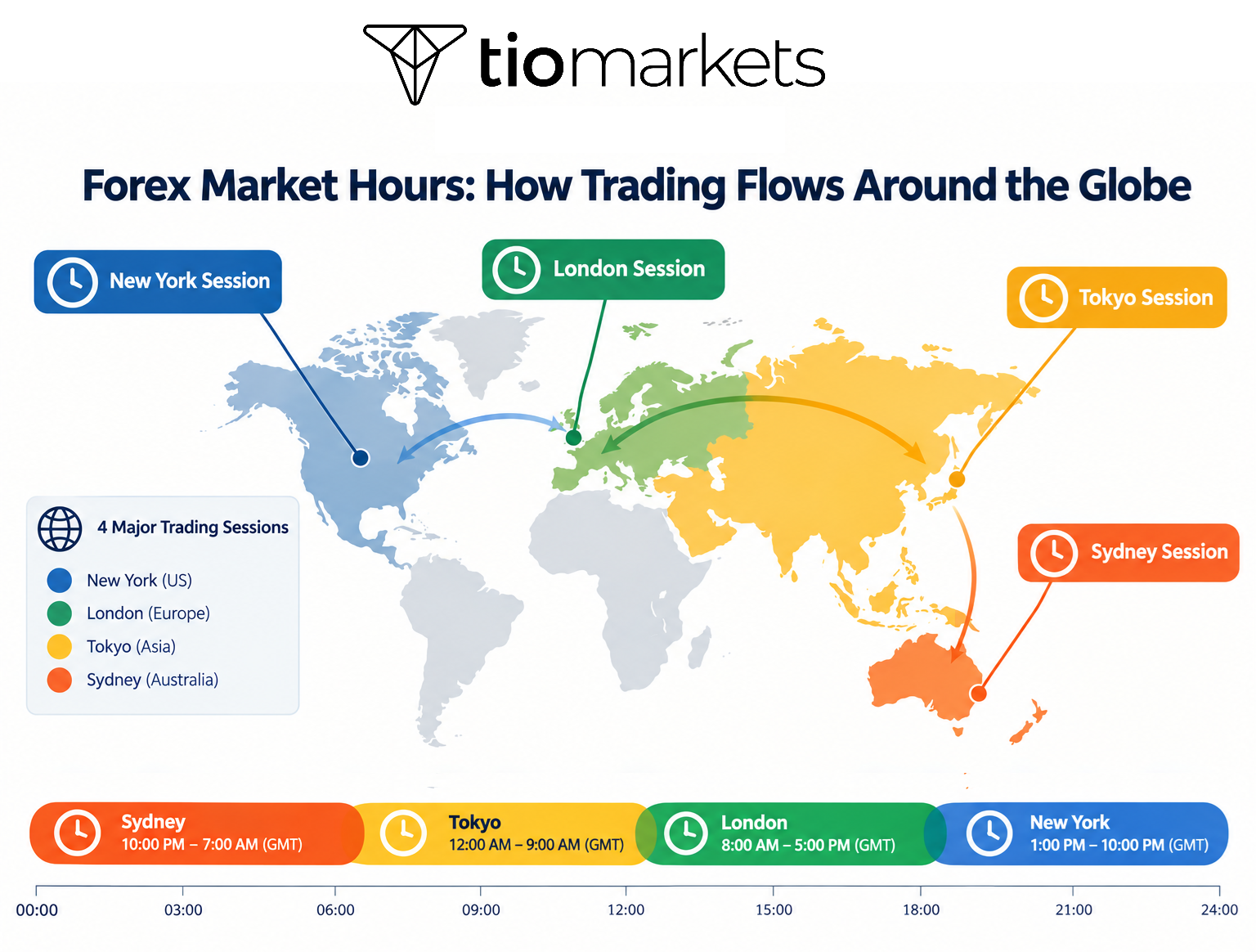
Times shift by one hour during Daylight Saving Time periods.
What Time Do the Forex Markets Open and Close Each Week?
Forex trading begins Sunday at 10:00 PM GMT when Sydney opens and ends Friday at 10:00 PM GMT when New York closes, leaving the market closed for approximately 48 hours each weekend.
The forex market opening times follow a consistent weekly pattern that traders can rely on for planning purposes. The weekly open occurs at Sunday 10:00 PM GMT, which corresponds to 5:00 PM EST in the United States and Monday morning in Australia where the Sydney session initiates global trading.
The forex market closes on weekends primarily because central banks and major financial institutions cease operations during Saturday and Sunday in most jurisdictions around the world. Without these key participants providing liquidity and setting reference rates, the interbank market that underpins forex trading effectively pauses until the following week begins in the Asia-Pacific region.
Traders who hold positions over the weekend face what the industry terms "gap risk," which occurs when prices open Sunday at a different level than Friday's closing price. Significant news events, geopolitical developments, or economic announcements occurring during the weekend closure can cause prices to jump dramatically when trading resumes, potentially bypassing stop-loss orders or creating unexpected profit-and-loss scenarios.
What Are the Four Major Forex Trading Sessions?
The forex market operates through four sequential sessions based in Sydney, Tokyo, London, and New York, and as one session winds down, the next begins, creating continuous trading as the day moves around the globe.
Sydney Session (10:00 PM - 7:00 AM GMT)
The Sydney session opens the trading week each Sunday evening GMT, marking the return of forex market activity after the weekend closure period. This session represents the lowest volume period of the four major sessions, accounting for approximately 4% of daily trading activity across the global forex market.
The most active currency pairs during the Sydney session include AUD/USD, NZD/USD, and AUD/JPY, reflecting the regional economic significance of Australia and New Zealand during these hours. Trading characteristics during this period typically include quieter conditions with wider spreads compared to busier sessions, as fewer market participants means less competition among liquidity providers.
The Sydney session overlaps with the Tokyo session for approximately 7 hours, creating a continuous flow of Asian-Pacific trading activity throughout the overnight period for European and American traders.
Tokyo Session (12:00 AM - 9:00 AM GMT)
The Tokyo session, also commonly called the Asian session, provides the first major liquidity injection of each trading day and accounts for roughly 6% of daily forex volume. This session encompasses trading activity from multiple Asian financial centers including Japan, China, Hong Kong, and Singapore, though Tokyo serves as the primary reference point.
The most active currency pairs during Tokyo hours include USD/JPY, EUR/JPY, and AUD/JPY, with the Japanese yen featuring prominently due to the session's geographic center. Japanese economic data releases, including employment figures, trade balance reports, and Bank of Japan announcements, often occur during this session and can create significant price movement in yen pairs.
The Tokyo session overlaps briefly with the London session from 8:00 AM to 9:00 AM GMT, providing a short transitional window where Asian and European traders participate simultaneously in the market.
London Session (8:00 AM - 5:00 PM GMT)
The London session, also referred to as the European session, represents the highest volume single session in forex trading, accounting for approximately 35% of daily trading activity. This concentration of volume reflects London's historical role as the world's primary foreign exchange hub, with additional participation from Frankfurt, Paris, Zurich, and other European financial centers.
The most active currency pairs during London hours include EUR/USD, GBP/USD, EUR/GBP, and USD/CHF, with European currencies dominating trading activity during this period. Traders often experience the tightest spreads during the London session due to the high liquidity environment created by numerous competing market makers and institutional participants.
European Central Bank announcements, along with economic data releases from the United Kingdom, Germany, and other major European economies, typically occur during London session hours. The session overlaps with New York from 1:00 PM to 5:00 PM GMT, creating the peak trading hours of the entire forex trading day.
New York Session (1:00 PM - 10:00 PM GMT)
The New York session, also called the North American session, ranks as the second highest volume session with approximately 16% of daily trading activity. This session includes participation from Canada and Mexico alongside the United States, though New York-based institutions drive the majority of volume and price direction.
The most active currency pairs during New York hours include EUR/USD, USD/CAD, and GBP/USD, with the US dollar featuring in nearly all major trading activity given America's economic significance. US economic data releases and Federal Reserve announcements can create substantial volatility across all dollar-denominated pairs during this session.
The overlap with London from 1:00 PM to 5:00 PM GMT creates the busiest trading period of the day, combining liquidity from both major financial centers. As the final major session before the market quiets down, New York's close at 10:00 PM GMT marks the transition into the lower-volume Sydney session.
Why Does the Forex Market Trade 24 Hours a Day?
Forex operates continuously because it has no central exchange; instead, banks and brokers connect electronically across different time zones, allowing trading to shift from one financial center to the next as the Earth rotates.
The forex market functions as an over-the-counter (OTC) market without a physical trading floor where all transactions must occur during specified hours. This decentralized structure means that as business hours conclude in one region, they simultaneously begin in another further west.
Currency markets evolved this way because international businesses and financial institutions require the ability to exchange currencies at any hour for global commerce. However, knowing what time do the forex markets open is only part of the equation. 24-hour trading does not mean all hours are equally active. Volume, spread costs, and price movement vary substantially depending on which sessions are currently active.
When Do Forex Sessions Overlap and Why Does It Matter?
Session overlaps occur when two major financial centers trade simultaneously, creating higher volume and tighter spreads, and the London-New York overlap (1:00 PM - 5:00 PM GMT) is the most significant, accounting for over 50% of daily trading.
Session Overlap Table
| Overlap | Time (GMT) | Duration | Significance |
| Sydney-Tokyo | 12:00 AM - 7:00 AM | 7 hours | Moderate; good for AUD and JPY pairs |
| Tokyo-London | 8:00 AM - 9:00 AM | 1 hour | Brief transition period |
| London-New York | 1:00 PM - 5:00 PM | 4 hours | Highest volume; tightest spreads |
The London-New York overlap represents the most significant trading window because it combines liquidity from the two largest financial centers simultaneously. During these four hours, traders in London complete their afternoon activity while New York participants engage in morning trading, creating exceptional depth in major currency pairs.
More participants trading simultaneously produces tighter bid-ask spreads, reducing overall trading costs. Most major US and European economic releases occur during this window. Traders focusing on EUR/USD, GBP/USD, and USD/CHF often prefer this overlap, while the Sydney-Tokyo overlap benefits those trading Asia-Pacific pairs.
What Is the Best Time to Trade Forex?
Once you understand what time do the forex markets open, the next question is when to trade.
The London-New York overlap (1:00 PM - 5:00 PM GMT) generally offers conditions many traders consider favorable due to high liquidity and tight spreads, though the optimal time also depends on which currency pairs you trade.
This overlap presents the highest liquidity levels of the trading day, consistently tight spreads across major pairs, and sufficient price movement for trading opportunities. EUR/USD and GBP/USD typically see their most active periods during the London session and subsequent New York overlap.
USD/JPY remains active during both Tokyo and New York sessions, while AUD/USD and NZD/USD pairs tend to show the most movement during the Sydney-Tokyo overlap when regional economic data releases occur.
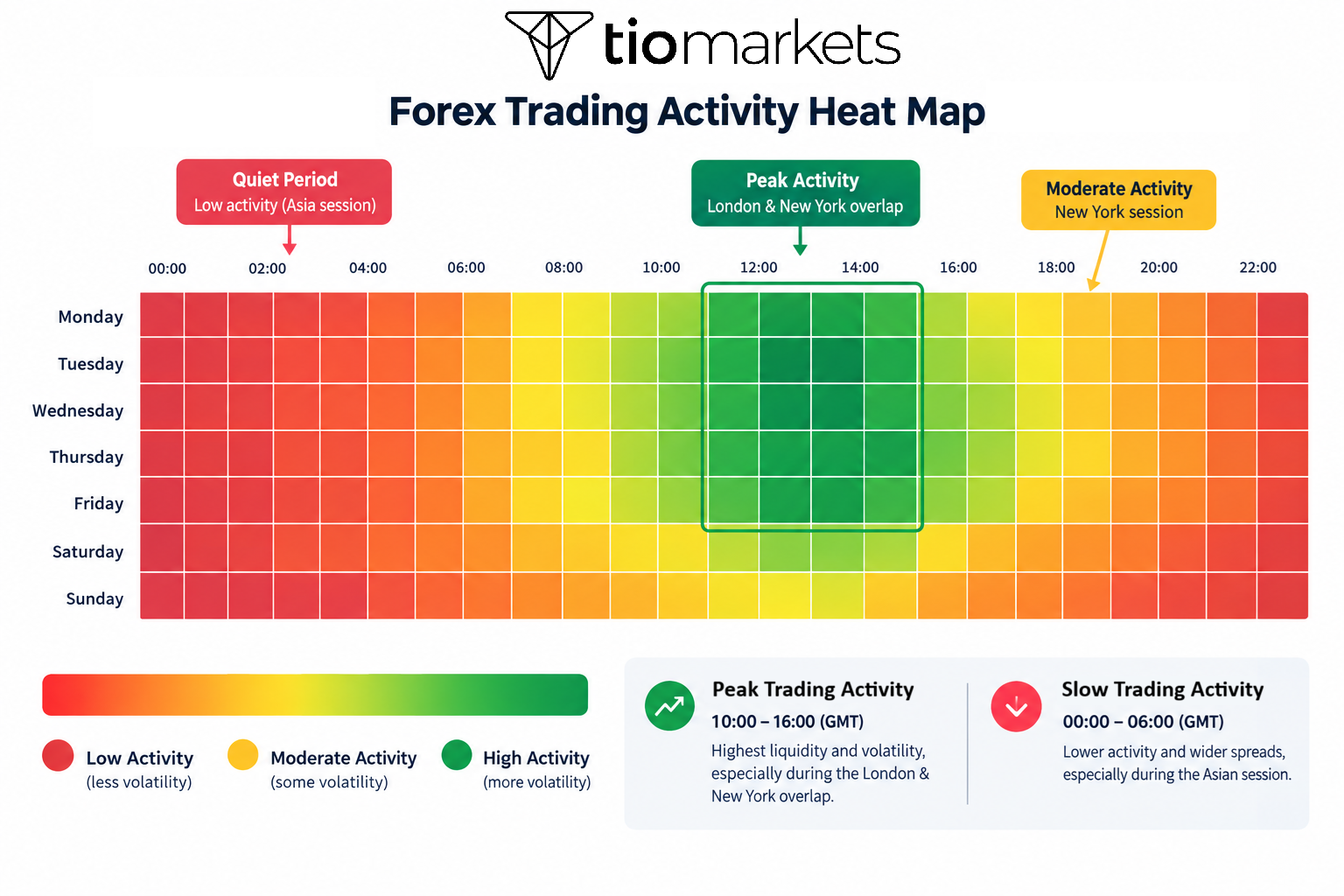
Mid-week trading periods, particularly Tuesday through Thursday, often display more consistent volume patterns compared to Monday openings and Friday closings. Friday afternoons frequently see declining volume as traders close weekly positions before the weekend.
What Is the Quietest Time in the Forex Market?
The quietest period typically occurs between the New York close (10:00 PM GMT) and Tokyo open (12:00 AM GMT), as well as throughout the Sydney session overall, when spreads widen and price movement slows. While knowing what time do the forex markets open is essential, understanding when they're quietest matters too.
The gap between the New York close and Tokyo open sees minimal activity because no major financial center operates at full capacity during this approximately two-hour window.
In addition, Friday afternoon volume typically declines progressively as traders close their weekly positions to avoid holding exposure over the weekend closure.
Quieter periods mean wider spreads because fewer market makers compete for order flow, and those providing quotes factor in additional risk due to lower liquidity conditions. Lower liquidity can also cause slippage on larger orders, as insufficient volume exists at quoted prices to fill entire positions without price movement.
How Does Daylight Saving Time Affect Forex Hours?
Daylight Saving Time shifts session times by one hour in affected regions, and the US, UK, and Australia observe DST on different schedules, creating periods where relative session times change temporarily. Traders wondering what time do the forex markets open during these transitions should account for temporary schedule variations.
Daylight Saving Time Schedule
| Region | DST Begins | DST Ends | Effect on Session |
| US | Second Sunday in March | First Sunday in November | New York opens/closes 1 hour earlier (GMT) |
| UK | Last Sunday in March | Last Sunday in October | London opens/closes 1 hour earlier (GMT) |
| Australia | First Sunday in October | First Sunday in April | Sydney opens/closes 1 hour later (GMT) |
Japan does not observe Daylight Saving Time, which means Tokyo session times relative to GMT remain constant throughout the calendar year regardless of clock changes in other countries. This consistency makes the Tokyo session a stable reference point during transitional periods.
For approximately 2-3 weeks each spring and autumn, the United States and United Kingdom change their clocks on different dates, creating short periods where the relative timing of sessions shifts temporarily. During these transitional weeks, the London-New York overlap duration and timing may differ from the standard schedule until both regions complete their clock adjustments.
Most trading platforms adjust their displayed times automatically based on the server’s time settings.
Conclusion
Understanding what time do the forex markets open helps traders plan when to engage with the market and when conditions may be less favorable for their strategies. The forex market opens Sunday at 10:00 PM GMT and closes Friday at 10:00 PM GMT, providing a 120-hour trading window each week.
The four major sessions - Sydney, Tokyo, London, and New York- create continuous trading as activity flows from one financial center to the next around the globe. The London-New York overlap from 1:00 PM to 5:00 PM GMT typically offers the highest liquidity and tightest spreads for major currency pairs.

FAQ
Risk disclaimer: CFDs are complex instruments and come with a high risk of losing money rapidly due to leverage. You should consider whether you understand how CFDs work and whether you can afford to take the high risk of losing your money. Never deposit more than you are prepared to lose. Professional client’s losses can exceed their deposit. Please see our risk warning policy and seek independent professional advice if you do not fully understand. This information is not directed or intended for distribution to or use by residents of certain countries/jurisdictions including, but not limited to, USA & Countries included in the OFAC sanction list. The Company holds the right to alter the aforementioned list of countries at its own discretion.
TIOmarkets offers an exclusively execution-only service. The views expressed are for information purposes only. None of the content provided constitutes any form of investment advice. The comments are made available purely for educational and marketing purposes and do NOT constitute advice or investment recommendation (and should not be considered as such) and do not in any way constitute an invitation to acquire any financial instrument or product. TIOmarkets and its affiliates and consultants are not liable for any damages that may be caused by individual comments or statements by TIOmarkets analysis and assumes no liability with respect to the completeness and correctness of the content presented. The investor is solely responsible for the risk of his/her investment decisions. The analyses and comments presented do not include any consideration of your personal investment objectives, financial circumstances, or needs. The content has not been prepared in accordance with any legal requirements for financial analysis and must, therefore, be viewed by the reader as marketing information. TIOmarkets prohibits duplication or publication without explicit approval.
Join us on social media



Authors BIO

Maria is a writer and content strategist with over 10 years of experience in the finance industry. She specializes in developing research-backed articles that help financial professionals navigate complex market topics with confidence. Her expertise spans forex, stocks, CFDs and global markets, creating insightful content that educates readers and supports informed decision-making.