


UK Unemployment Rate Preview: Will the Rate Reach 5%?
BY Ahmed Osama
|October 19, 2026The UK unemployment rate is forecast to rise to 5.0% in the three months to August, from 4.9%,when the Office for National Statistics (ONS) publishes its October labour market report at 06:00 UTC on Tuesday 20 October. With the Bank of England split between holding interest rates and raising them, wage growth, payrolls and vacancies may matter as much as the headline rate for the pound.
UK Unemployment Preview in brief
- The ONS publishes the UK Labour Market: October 2026 report at 06:00 UTC on Tuesday 20 October.
- Economists expect the UK unemployment rate to rise to 5.0% from 4.9%. The rate has held at 4.9% for four consecutive releases, and the September report beat the same 5.0% forecast.
- The Bank of England held Bank Rate at 3.75% on 17 September in a 6–3 vote, with three members voting for a rise to 4.00% as inflation climbed to 3.1% and energy prices increased.
- GBP/USD was trading near 1.3320 at the time of writing, after rebounding from about 1.3165 on 14 October. A stronger jobs report could support the pound and push GBP/USD higher.
- UK inflation data follow at 06:00 UTC on 21 October, and the Bank of England announces its next decision at 12:00 UTC on 5 November.
What is the UK jobs report and when is it released?
The UK Labour Market report is a monthly ONS release that shows the unemployment rate, the number of people in work, wage growth, payrolled employees and job vacancies. It is one of the most closely watched UK data releases for traders of the British pound.
The October report is due at 06:00 UTC (07:00 UK time) on Tuesday 20 October, as shown on our economic calendar. The headline unemployment rate covers the three months to August, while payroll data run to September as an early estimate.
One point helps with reading the numbers: the unemployment rate only counts people actively looking for work. If more people start looking for jobs, unemployment can rise even when employment is growing.
What is expected from the UK unemployment rate?
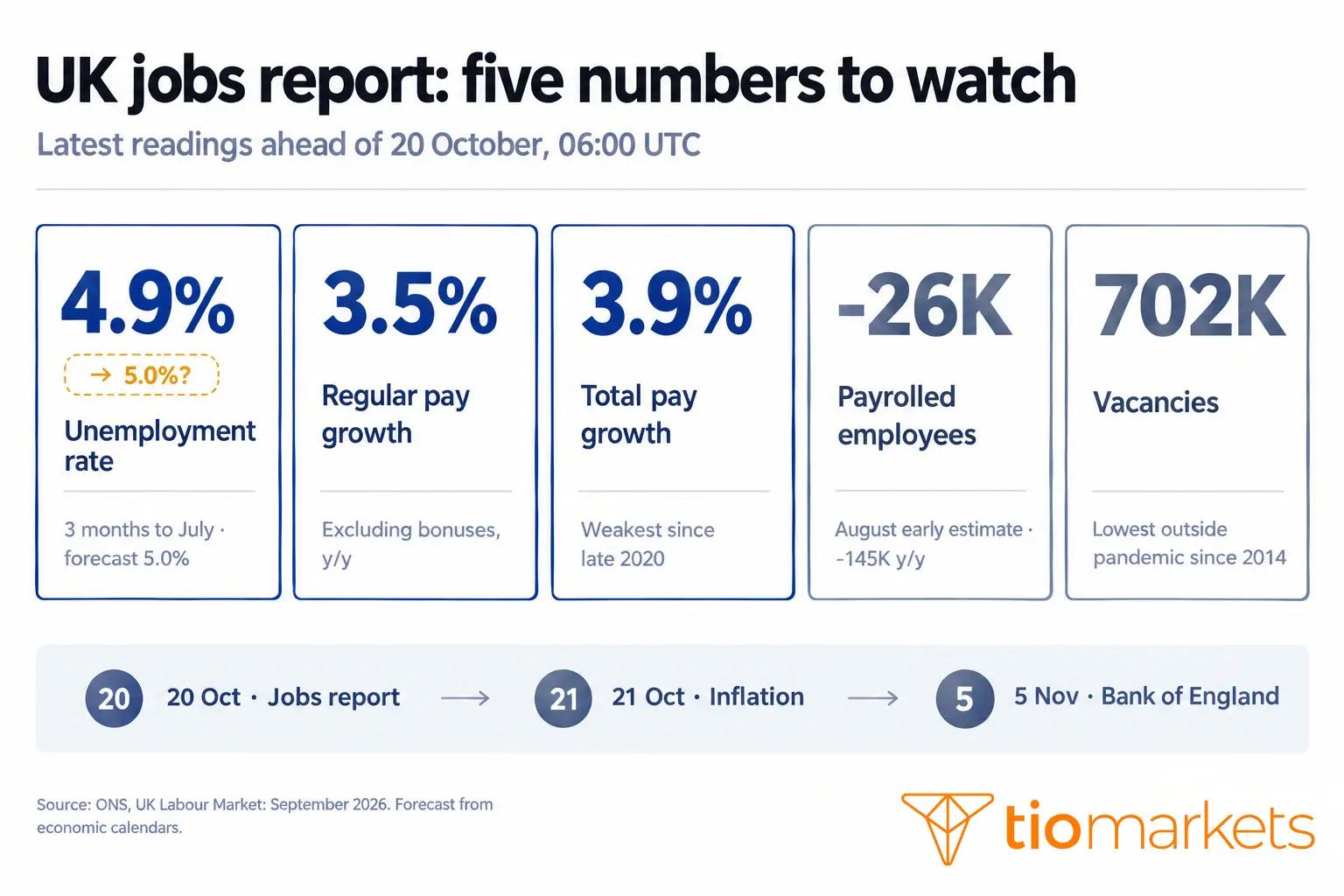
Economic calendars show a consensus of 5.0% for the three months to August, up from 4.9%. Forecasts can change before the release, and the last report is a reminder that the rate can surprise: economists expected 5.0% in September, and the ONS reported an unchanged 4.9%.
| Indicator | Previous | Expectation | What it tests |
| Unemployment rate (3 months) | 4.9% | 5.0% | How much spare capacity there is in the labour market |
| Regular pay growth, year on year | 3.5% | No firm consensus | Domestic inflation pressure |
| Total pay growth, year on year | 3.9% | No firm consensus | Household income, including bonuses |
| Payrolled employees (monthly, early estimate) | -26,000 (August) | No firm consensus | Whether job losses are continuing |
| Vacancies (3 months) | 702,000 | No firm consensus | Demand for workers |
What the September jobs report showed
The UK unemployment rate held at 4.9% in the three months to July for a fourth consecutive period, below the 5.0% forecast but up from 4.7% a year earlier. The number of unemployed people stood at 1.778 million.
The survey data were steadier than the payroll figures. Employment rose by about 67,000 over the quarter, the employment rate held at 75.1% and the inactivity rate fell to 20.9%. The timelier payroll data, however, showed the number of employees falling by an estimated 26,000 in August and by 145,000 over the year, while July's decline was revised to 19,000. Vacancies fell to 702,000 in June to August, the lowest level outside the pandemic since the three months to October 2014.
Pay growth also cooled. Regular pay, excluding bonuses, rose 3.5% year on year, while total pay growth slowed to 3.9% from 4.2%, its weakest since the three months to November 2020.
Why this jobs report matters for the Bank of England
The Bank of England held Bank Rate at 3.75% on 17 September, but the vote was split 6–3. Six members judged that tight financial conditions and slack in the economy would continue to restrain inflation. Three members voted to raise rates to 4.00%, pointing to stronger activity, the possibility that labour market slack is stabilising and the risk that higher energy prices feed into wages and prices.
Inflation is the main complication. Consumer price inflation rose to 3.1% in August, and the Bank now expects it to climb to around 3.75% in the final quarter of 2026 and slightly above 4% in early 2027 as energy costs rise. At the same time, the economy has proved stronger than expected: GDP grew 0.7% in the three months to August, above the Bank's 0.4% projection, although monthly growth slowed to 0.1% in August.
In simple terms: a firm jobs report with steady pay growth could strengthen the case for a rate rise. A weak report, with rising unemployment and falling payrolls, could make a hike harder to justify and support the majority view to hold.
Four parts of the report deserve attention
The unemployment rate is the headline, but the internal balance of the release may carry more information than a tenth-of-a-percentage-point move.
- Unemployment and employment: Check whether a change in unemployment reflects fewer people working, a larger labour force, or both. The participation and inactivity rates help explain the movement.
- Regular pay: Annual regular earnings growth was 3.5% in the three months to July. A renewed acceleration would matter for domestic inflation concerns, while further slowing would support the view that wage pressure is easing.
- PAYE payrolls and vacancies: The ONS currently regards PAYE Real Time Information as its most reliable measure of employees. Another fall in payrolls, combined with weak vacancies, would reinforce the cooling signal.
- Claimant Count: The count rose to 1.692 million in August, but it is provisional, subject to revision and not equivalent to Labour Force Survey unemployment.
How the UK unemployment rate could move GBP/USD
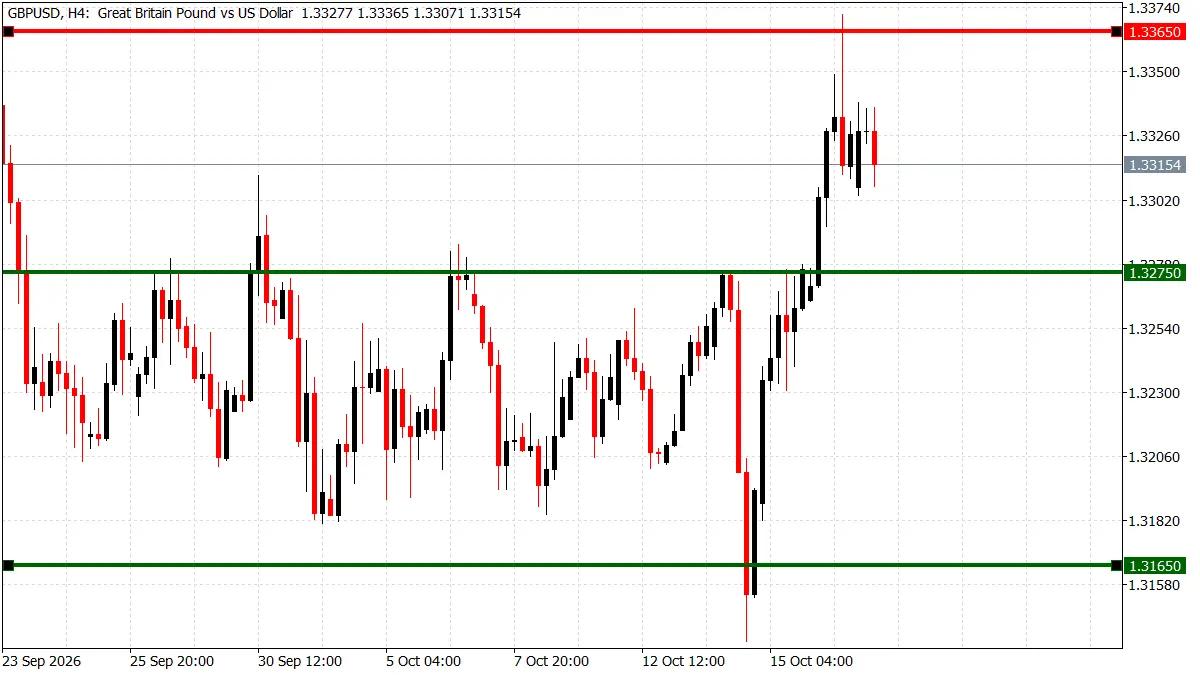
GBP/USD fell from around 1.3500 in mid-September to the 1.3200 area, where it traded in a range for most of late September and early October. The pair briefly dipped to about 1.3165 on 14 October, then rebounded sharply to a high near 1.3375 before easing back towards 1.3320.
Because GBP/USD shows how many US dollars one British pound buys, a rising pair means a stronger pound. The pair has been trading in a broad 1.3200–1.3450 range. Reference levels traders are watching:
- 1.3500: the mid-September high
- 1.3450: the area where the September decline accelerated
- 1.3365: the 16 October high area
- 1.3275: the top of the late September and early October range
- 1.3200: the floor of that range
- 1.3165: the 14 October low
A stronger-than-expected report could support the pound and lift GBP/USD towards 1.3365 and 1.3450. A weaker report could weigh on sterling and pull the pair back towards 1.3275 and 1.3200. US data and the broader dollar trend can outweigh UK news on the day, so the reaction may not follow the UK figures alone.
All levels are context markers, not entry or exit points, and should be checked against a live price feed.
Monitor and Trade UK Markets with TIOmarkets
Monitor and trade GBP pairs, the FTSE 100, and UK Gilts with TIOmarkets under competitive trading conditions on MT4, MT5, and the TIOmarkets mobile app.
Trading is risky
What the data could mean across markets
The scenarios below describe possible market interpretations, not forecasts or trading recommendations. Actual reactions will depend on the full data set, positioning, global risk sentiment and the inflation report due the next day.For UK shares, a stronger pound can weigh on FTSE 100 companies that earn much of their revenue overseas, while lower gilt yields can support more domestically focused companies.
| Scenario | Possible market implication | What would weaken it |
| Better than expected: Unemployment at 4.9% or lower, steady or faster pay growth and stabilising payrolls | Sterling and short-dated gilt yields could rise if markets reduce expectations for near-term easing. A stronger pound may be a headwind for some internationally exposed FTSE 100 companies. | Soft wage details, downward revisions, or weak payrolls would make the headline less convincing. |
| As expected: Unemployment at 5.0% with mixed details | GBP pairs may turn choppy rather than establish a lasting move. Attention may shift quickly to CPI on 21 October. | A large surprise in a secondary component could dominate the unchanged headline narrative. |
| Worse than expected: Unemployment at 5.1% or higher, slower pay growth and another fall in payrolls | Sterling and short-dated gilt yields could fall as markets consider more policy support. UK equities could receive some valuation support from lower yields, although domestic cyclicals may reflect growth concerns. | Sticky pay growth, stronger employment or a high CPI print the next day could offset the dovish interpretation. |
The data-quality issue traders should not ignore
The unemployment rate comes from the Labour Force Survey, which has faced long-running response problems. An operational issue earlier this year means recent estimates, including May to July, are subject to greater imputation, so a single month's change should be read with caution. That is why traders often check whether payrolls, vacancies and pay growth point in the same direction before drawing conclusions.
What comes next: inflation and the Bank of England
The jobs report is only the first of three key UK events in the next three weeks:
- September inflation (21 October, 06:00 UTC): CPI rose to 3.1% in August, and the Bank expects it to climb further as energy costs rise. A high reading the day after the jobs data could quickly change the market's first reaction. Our UK CPI preview will cover what to expect.
- Bank of England decision (5 November, 12:00 UTC): Policymakers will have both the labour and inflation data, along with a new Monetary Policy Report. Follow our Bank of England preview on the TIOmarkets blog ahead of the meeting.
Key dates to watch
- Tuesday 20 October, 06:00 UTC: UK Labour Market: October 2026
- Wednesday 21 October, 06:00 UTC: UK consumer price inflation for September
- Thursday 5 November, 12:00 UTC: Bank of England rate decision and Monetary Policy Report
Risks and uncertainties
Consensus estimates can change before the release. The unemployment rate is a rolling three-month estimate that may be revised, and survey volatility means the different labour market measures can send conflicting signals. Global risk sentiment, energy prices and US interest-rate expectations may also dominate UK-specific news. Prices can jump and spreads can widen around 06:00 UTC.
Conclusion
The question on 20 October is not simply whether the UK unemployment rate reaches 5.0%. The more useful test is whether unemployment, pay, payrolls and vacancies together show a labour market that is loosening, or one that is stabilising. With three Bank of England policymakers already voting for a rate rise and inflation expected to climb, a firm jobs report could revive hike expectations and support the pound, while a weak one could keep the Bank on hold. That reading will then need to be checked against inflation data less than 24 hours later.

FAQ
Risk disclaimer: CFDs are complex instruments and come with a high risk of losing money rapidly due to leverage. You should consider whether you understand how CFDs work and whether you can afford to take the high risk of losing your money. Never deposit more than you are prepared to lose. Professional client’s losses can exceed their deposit. Please see our risk warning policy and seek independent professional advice if you do not fully understand. This information is not directed or intended for distribution to or use by residents of certain countries/jurisdictions including, but not limited to, USA & Countries included in the OFAC sanction list. The Company holds the right to alter the aforementioned list of countries at its own discretion.
TIOmarkets offers an exclusively execution-only service. The views expressed are for information purposes only. None of the content provided constitutes any form of investment advice. The comments are made available purely for educational and marketing purposes and do NOT constitute advice or investment recommendation (and should not be considered as such) and do not in any way constitute an invitation to acquire any financial instrument or product. TIOmarkets and its affiliates and consultants are not liable for any damages that may be caused by individual comments or statements by TIOmarkets analysis and assumes no liability with respect to the completeness and correctness of the content presented. The investor is solely responsible for the risk of his/her investment decisions. The analyses and comments presented do not include any consideration of your personal investment objectives, financial circumstances, or needs. The content has not been prepared in accordance with any legal requirements for financial analysis and must, therefore, be viewed by the reader as marketing information. TIOmarkets prohibits duplication or publication without explicit approval.
Join us on social media


Authors BIO

An experienced financial analyst and educator with over 8 years of expertise covering gold, forex, and global financial markets. Ahmed specializes in blending price action analysis with macroeconomic data to accurately interpret market movements, providing readers with comprehensive educational insights into trading and the financial world.