


USD/JPY Explained: The Rate Gap and Intervention Risk
BY TIOmarkets
|November 9, 2026USD/JPY is the exchange rate between the US dollar and the Japanese yen, quoted as the number of yen that one dollar buys. In early November 2026 two separate forces were driving it: the interest rate gap between the Federal Reserve and the Bank of Japan, and the risk that Japan intervenes to support the yen. The first moves with US data. The second is a policy decision that no data release can settle.
Written for readers in Asia who follow the yen, the analysis covers why the pair rose after the US payrolls report of 6 November and slipped back on Monday 9 November. It sets out what the jobs data measures, how it shifted Fed rate expectations, why intervention risk also weighs on EUR/JPY and GBP/JPY, and which releases are scheduled next. It describes current drivers only, without price levels, an outlook or scenarios.
USD/JPY News Today: From the Payrolls Rally to Monday's Pullback
As of Monday 9 November 2026, USD/JPY was trading lower, approaching 158.00, as the US dollar retreated against major currencies. The decline reversed part of Friday's gains. On 6 November, the day the October employment report was published, the US Dollar Index, which measures the dollar against a basket of major currencies, gained about 0.7%.
Monday's move came without any new US data. It reflected a broad dollar retreat and profit-taking, as market participants closed positions opened around the payrolls release. For reference, the noon buying rate was 157.47 yen per dollar on 30 October, the day the Bank of Japan held its policy rate. Such quotes record history only, and past performance is not a reliable indicator of future results. A reversal within a single session shows how quickly exposure to the pair can change.
Why Did USD/JPY Rise After NFP?
The US Bureau of Labor Statistics published its Employment Situation report for October 2026 at 8:30 a.m. (ET) on Friday 6 November. Total non-farm payrolls rose by 165,000, well above the average monthly gain of 48,000 over the prior 12 months. The unemployment rate was little changed at 4.1%, inside the 4.1% to 4.3% range it has held since March.
The report combines two monthly surveys. The establishment survey of employers measures non-farm employment, hours and earnings by industry, while the household survey measures labour force status, including unemployment. In October, professional and business services added 70,000 jobs, health care 42,000, transportation and warehousing 25,000 and manufacturing 19,000. How the payrolls report as a whole moves markets is covered in what non-farm payrolls mean for markets.
The report also covered pay. Average hourly earnings on private payrolls rose by 14 cents, or 0.4%, to $38.00, an increase of 3.1% over 12 months, while the average workweek held at 34.4 hours. Wage growth can feed into inflation, which the Federal Reserve's October statement described as elevated.
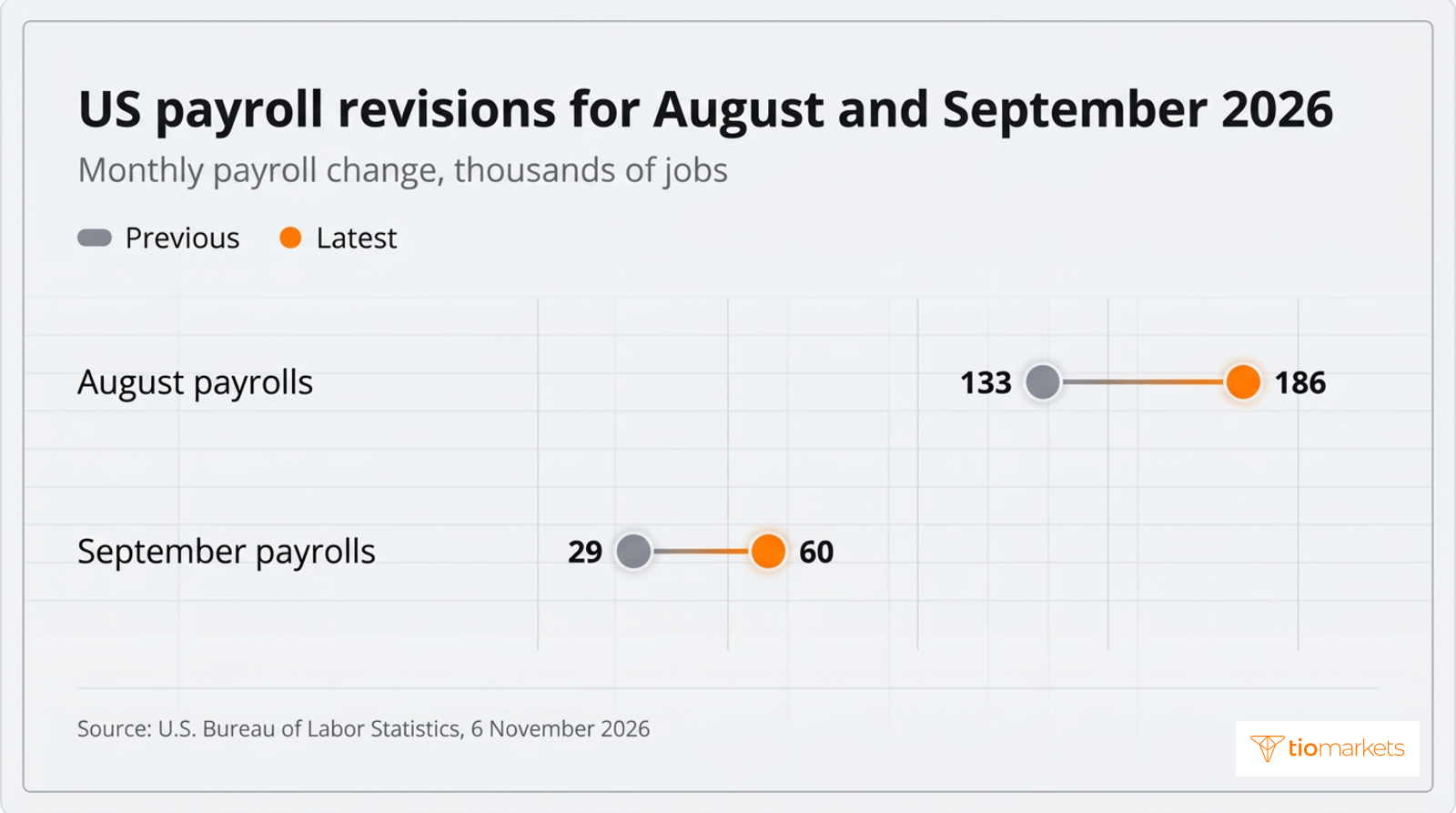
Revisions made the report firmer still. August payrolls were revised from +133,000 to +186,000 and September from +29,000 to +60,000, leaving employment across the two months 84,000 higher than first reported. A stronger labour market weakens the case for lower US rates. That is the channel through which the report lifted the dollar against the yen.
What Is the CME FedWatch Tool?
The CME FedWatch tool converts fed funds futures prices into implied probabilities for each possible rate outcome at upcoming Federal Open Market Committee (FOMC) meetings. Traders refer to these probabilities as Fed hike odds or cut odds. They summarise how the market is priced on a given day rather than forecast a decision, and they change as new data arrives.
The federal funds rate is the overnight rate at which US banks lend reserves to one another. On 28 October 2026 the FOMC kept its target range at 3-3/4 to 4 percent by a 10–2 vote. Lisa D. Cook and Beth M. Hammack dissented in favour of a 1/4 percentage point increase, and the statement said inflation remains elevated.
Those two dissents frame how Fed hike odds affect USD/JPY at present: the market starts from a committee already debating an increase. A payrolls report far above its 12-month average, with earnings up 0.4% in the month, can raise the implied probability of a hike. Expectations of higher US rates tend to lift US Treasury yields, the returns on US government debt, and widen the advantage of dollar assets over yen assets.
The Fed-BoJ Rate Gap and the Carry Trade
The interest rate differential, the gap between the two countries' policy rates, is the structural reason the yen is weak against the dollar. The Bank of Japan kept its overnight call rate at around 0.75% at its January, March and April 2026 meetings, the April decision by a 6-3 vote. It then raised the rate to around 1.0% on 16 June, effective 17 June, and defeated a proposal for 1.25% at its July meeting.
By the meeting of 30 October the policy rate stood at 1.25%, and the BoJ held it there by an 8-1 vote, with Hajime Takata dissenting. Even at that level, the Japanese rate sits well below the Fed's target range of 3-3/4 to 4 percent. That distance, rather than any single month's data, is the backdrop against which each US release is priced.
Japanese government bond yields form the other side of the comparison. The BoJ bought about 2.9 trillion yen of government bonds a month in March 2026, then cut purchases by about 200 billion yen, to about 2.7 trillion yen a month, in April. Smaller central bank purchases leave more bonds for private investors to absorb. That is one route by which Japanese yields can rise and the gap with US Treasury yields can narrow.
The same gap sustains the carry trade, in which a position borrows in a low-yielding currency such as the yen to hold a higher-yielding one such as the dollar. The interest difference accrues slowly, whereas a sudden yen rally can outweigh months of it within a single session. Carry positions are often leveraged, and leverage magnifies losses as well as gains. When the yen strengthens abruptly, losses can build quickly, and traders can lose all the money they deposit.
Who Decides Yen Intervention?
Yen intervention is the official buying or selling of the yen in the foreign exchange market to change its value. When the yen is weak, Japan sells dollars from its foreign reserves and buys yen. The decision rests with Japan's Ministry of Finance, and the Bank of Japan carries out the trades as the ministry's agent. This is how Japan intervenes in the yen: a government decision, executed by the central bank, with no published date.
Actual intervention is usually preceded by verbal intervention, in which officials state that currency moves are excessive or one-sided and that they are watching the market closely. Such statements alone can make market participants reluctant to add to positions that sell the yen.
At this point USD/JPY stops answering to data alone. A strong payrolls report can widen the expected rate gap, yet a decision to buy yen can push the pair down regardless, because intervention is a policy act rather than a market price. The market reaction to a past yen intervention shows how abruptly the pair can reprice once the authorities act.
| Force | Who sets it | How it reaches the yen | Pairs affected |
| Fed-BoJ rate gap | Market expectations of Fed and BoJ policy | US data such as payrolls and CPI shift expected rates and yields | USD/JPY directly; yen crosses through the yen leg |
| Intervention risk | Japan's Ministry of Finance | Official yen buying, often preceded by warnings from officials | All yen pairs, including EUR/JPY and GBP/JPY |
| Profit-taking | Market participants | Positions closed after a rally, as on 9 November 2026 | Pairs that moved most in the preceding rally |
What Drives EUR/JPY and GBP/JPY Alongside the Dollar
EUR/JPY and GBP/JPY are yen crosses, pairs that price the yen against a currency other than the dollar. Each carries its own rate gap: the European Central Bank against the Bank of Japan for EUR/JPY, and the Bank of England against the Bank of Japan for GBP/JPY. A cross is also tied to the dollar pairs, since EUR/JPY is approximately EUR/USD multiplied by USD/JPY.
Yen-side events act on the whole group at once. A Bank of Japan rate change, a shift in its bond purchases or a Ministry of Finance intervention moves the yen itself, so the effect tends to appear in all three pairs together. That shared exposure is why intervention risk weighs on every yen pair, even when euro area or UK data point elsewhere. US payrolls, by contrast, reach the crosses only indirectly, through the yen and global bond yields.
What Is Scheduled Next: US CPI and the Japanese Yen
The US consumer price index (CPI) measures the change in prices paid by urban consumers for a basket of goods and services; the method behind it is explained in how the US CPI basket is built. For the yen, CPI matters through the Fed. Firmer inflation can raise hike odds and widen the expected rate gap, while softer readings can narrow it.
The September report, released on 14 October, showed the CPI-U up 0.6% on a seasonally adjusted basis, after 0.4% in August. Over 12 months, all items rose 3.7%, from 3.4% in the year to August, and the index excluding food and energy rose 2.6%, from 2.4%. Gasoline rose 9.1% in the month and accounted for over half of the monthly increase. Energy was up 20.4% over 12 months.
The October 2026 CPI is due on 10 November 2026 at 8:30 a.m., and release times are listed on the TIOmarkets economic calendar. Further US releases and the next Bank of Japan decision fall between early December and mid-January.
| Date | Release or decision | What it measures or sets |
| 10 Nov 2026 | US CPI, October 2026 (8:30 a.m.) | Consumer prices, headline and excluding food and energy |
| 4 Dec 2026 | US Employment Situation, November 2026 (8:30 a.m. ET) | Payrolls, unemployment rate and average hourly earnings |
| 10 Dec 2026 | US CPI, November 2026 (8:30 a.m.) | Consumer prices for November |
| 18 Dec 2026 | Bank of Japan rate decision | Short-term policy rate, at 1.25% after the October meeting |
| 13 Jan 2027 | US CPI, December 2026 | Consumer prices for December |
No date can be listed for intervention. That asymmetry, a published timetable for the data behind the rate gap and none for the Ministry of Finance, is the defining feature of the yen's current drivers.
Conclusion
USD/JPY responds to two forces of a different kind. The rate gap is priced by the market and shifts with each payrolls report, CPI release and central bank meeting, as the 6 November rally and the 9 November pullback showed. Intervention risk is a decision by Japan's Ministry of Finance, and it can move USD/JPY, EUR/JPY and GBP/JPY together whatever the latest data say. A strong US release and a firm currency policy can therefore pull the yen pairs in opposite directions at the same time.
Neither force can be read with certainty. Market-implied rate probabilities describe pricing rather than outcomes, and data can be revised, as August and September payrolls were. Intervention arrives without notice, so yen pairs can reprice sharply within a session. In leveraged products on these pairs, leverage magnifies losses as well as gains, losses can mount quickly during such moves, and a trader can lose the entire deposit.
Trade USD/JPY and EUR/JPY with TIOmarkets
Take your position on global markets via CFDs. Enjoy tight spreads, fast execution, and fast, flexible funding options.
Trading is risky
FAQ
Risk disclaimer: CFDs are complex instruments and come with a high risk of losing money rapidly due to leverage. You should consider whether you understand how CFDs work and whether you can afford to take the high risk of losing your money. Never deposit more than you are prepared to lose. Professional client’s losses can exceed their deposit. Please see our risk warning policy and seek independent professional advice if you do not fully understand. This information is not directed or intended for distribution to or use by residents of certain countries/jurisdictions including, but not limited to, USA & Countries included in the OFAC sanction list. The Company holds the right to alter the aforementioned list of countries at its own discretion.
TIOmarkets offers an exclusively execution-only service. The views expressed are for information purposes only. None of the content provided constitutes any form of investment advice. The comments are made available purely for educational and marketing purposes and do NOT constitute advice or investment recommendation (and should not be considered as such) and do not in any way constitute an invitation to acquire any financial instrument or product. TIOmarkets and its affiliates and consultants are not liable for any damages that may be caused by individual comments or statements by TIOmarkets analysis and assumes no liability with respect to the completeness and correctness of the content presented. The investor is solely responsible for the risk of his/her investment decisions. The analyses and comments presented do not include any consideration of your personal investment objectives, financial circumstances, or needs. The content has not been prepared in accordance with any legal requirements for financial analysis and must, therefore, be viewed by the reader as marketing information. TIOmarkets prohibits duplication or publication without explicit approval.
Join us on social media


Authors BIO

Behind every blog post lies the combined experience of the people working at TIOmarkets. We are a team of dedicated industry professionals and financial markets enthusiasts committed to providing you with trading education and financial markets commentary. Our goal is to help empower you with the knowledge you need to trade in the markets effectively.





