End-of-Day Trading: What It Is & How It Works (Updated Guide)
BY Maria K.
|August 5, 2026End-of-day trading is a Forex trading strategy where traders analyze daily charts and place trades after the market closes, typically around 5:00 PM EST. EOD trading represents a strategic approach to market close trading for those looking to engage with the markets on a schedule that aligns with the close of the trading session. This market close trading method offers a blend of flexibility and potential efficiency for traders who prefer to analyze and execute trades after the market has settled from the day's volatility.
In this comprehensive guide, we'll explore the nuances of end-of-day trading, its benefits, and how it contrasts with other trading strategies. By the end, you will be able to understand:
- What end-of-day trading is and how it works
- The key benefits and risks of an EOD trading strategy
- How to develop an end-of-day trading strategy
- Real examples and actionable tips to get started
END-OF-DAY TRADING AT A GLANCE
Definition: Trading based on daily chart close
Time Required: 30-60 minutes/day
Holding Period: 1-10+ days
Best Analysis Time: After 5:00 PM EST
Best For: Part-time traders, beginners
What Is End-of-Day Trading ? (EOD Trading Defined)
End-of-day trading, as the name suggests, involves making trading decisions near the close of the market. Also called EOD trading or daily chart trading, this strategy is particularly favored by part-time traders and those who wish to avoid the stress and rapid pace of intraday trading.
Definition and Key Features
End-of-day trading refers to the practice of looking for trading opportunities in the last hour of the trading session or after the market has closed. Traders analyze the day's price movements, economic news, and other relevant factors to make informed decisions for the next trading day.
Key features of this trading strategy include less need for constant market monitoring, reduced trading costs due to fewer transactions, and the ability to use more comprehensive analysis methods.
| Feature | Description |
| Timeframe | Daily charts (D1) primarily |
| Time Commitment | 30-60 minutes per day |
| Trade Duration | 1-10+ days typically |
| Analysis Timing | After daily candle close |
| Best For | Part-time traders, busy professionals |
Benefits of End-of-Day Trading
One of the primary advantages of end-of-day trading is the ability to make trading decisions without the pressure of real-time market fluctuations. This can lead to more thoughtful and well-researched trade setups. Additionally, this strategy can be more compatible with the schedules of those who cannot dedicate entire days to trading. Another benefit is the potential for reduced stress and emotional trading, as decisions are made with a clearer mind and a broader perspective on market movements. EOD traders may capture potential overnight returns by holding positions through the close, though overnight gaps present additional risk.
In summary, the benefits of end-of-day trading are:
- requires less screen time
- reduces emotional trading
- lower trading costs
- higher quality setups
- better work-life balance
End-of-Day Orders Explained
Successful EOD trading relies heavily on understanding and using the right order types. Placing the correct orders before or at market close ensures your trades execute as planned—even when you're not watching the screen.
Market Orders
A market order executes immediately at the best available price. EOD traders use market orders when they want to enter or exit a position quickly before the session closes.
Traders may consider market orders when:
- You need guaranteed execution before close
- The market is liquid with tight spreads
- Speed matters more than exact price
During volatile market closes, you may experience slippage, the difference between your expected price and the actual fill price. This is more common in fast-moving markets or with less liquid instruments.
Limit Orders
A limit order specifies the exact price at which you're willing to buy or sell. The order only executes if the market reaches your target price before the session ends.
Traders often use limit orders when:
- You want price certainty over execution certainty
- You've identified a specific entry level on your chart
- You're willing to miss the trade if price doesn't reach your level
Example: You identify support at 1.0850 on EUR/USD. You place a buy limit order at 1.0855. If price drops to that level before close, your order fills. If not, the order expires unfilled (for EOD orders) or remains active (for GTC orders).
Stop Orders (Stop-Loss Orders)
A stop order triggers a market order when price reaches a specified level. EOD traders primarily use stop orders for risk management, automatically exiting a position if it moves against them.
Types of stop orders:
- Stop-loss order: Closes a losing position at a predetermined level
- Stop-entry order: Opens a new position when price breaks through a key level (used for breakout strategies)
Stops are essential for EOD traders because since you're holding positions overnight, unexpected news or gaps can move prices significantly. A stop-loss order protects your capital while you sleep.
EOD Orders vs Good-'Til-Cancelled (GTC) Orders
Understanding the difference between EOD orders and GTC orders prevents unexpected outcomes:
| Feature | End-of-Day (EOD) Order | Good-'Til-Cancelled (GTC) Order |
| Expiry | End of current trading session | Remains open until filled or cancelled |
| Best for | Session-specific trades | Longer-term price targets |
| Execution | Must fill before close or expires | Can fill any time, days or weeks later |
| Risk | May not fill if price isn't reached | Can fill unexpectedly during volatile conditions |
| Control | High; you reassess daily | Requires monitoring to avoid forgotten orders |
When to use EOD orders:
- You want to reassess the market each day
- Your analysis is specific to the current session
- You prefer tighter control over active orders
When to use GTC orders:
- You're targeting a price level that may take several days to reach
- You're using a swing trading approach alongside EOD analysis
- You want to "set and forget" an order at a key technical level
How End-of-Day Trading Works
End-of-day trading involves a routine of analyzing the market's movements at the end of the trading day, identifying potential trading opportunities, and planning actions for the next trading day.
Daily Chart Analysis for EOD Trading
Successful end-of-day traders rely primarily on daily chart analysis to make informed decisions. This involves reviewing D1 timeframe charts, economic news, and key market indicators to gauge the market's direction. Usually looking for
- Price action signals (pin bars, engulfing candles, inside bars)
- Key support and resistance levels
- Trend direction using moving averages (e.g., 20 EMA, 50 EMA)
- Confluence factors that strengthen the setup
Technical analysis tools like moving averages, support and resistance levels, and candlestick patterns are commonly used to identify potential trades. Additionally, reviewing economic calendars for upcoming events can help traders anticipate market movements and adjust their strategies accordingly.
EOD Trade Execution: Timing & Order Placement
Market close trading involves preparing your positions before the session ends. While actual trade execution may occur during the next trading day, end-of-day traders prepare by setting entry and exit points, stop-loss orders, and take-profit levels based on their analysis. This trading at market close approach allows for quick and decisive action when the market opens.
Traders may also use pending orders to automate their trade entries at specific prices, ensuring they don't miss opportunities even if they're not actively monitoring the market at the time.
How to Apply Your EOD Trading Strategy Step-by-Step
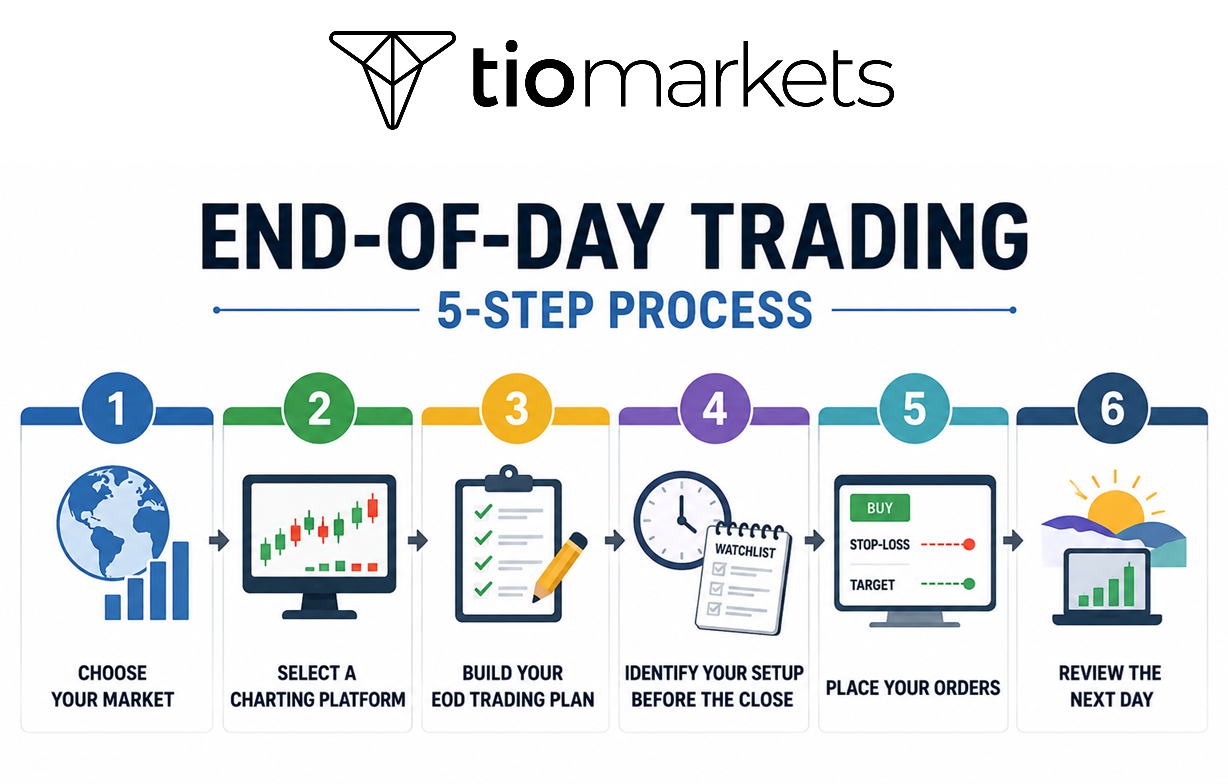
Step 1: Choosing Your Market: Stocks are the most popular market for EOD trading due to fixed trading hours Forex and commodities can work but require adjustments due to 24-hour trading
Step 2: Selecting a Charting Platform: You need access to daily charts and real-time end-of-day data
Step 3: Building EOD Trading Plan: Define markets, indicators, entry and exit criteria, and maximum risk per trade
Step 4: Identifying Your Setup Before the Close: Spend 30–45 minutes before market close reviewing your watchlist
Step 5: Placing Orders: Some traders enter positions near the close with predefined stop-loss and profit target levels
Step 6: Review the Next Day: Check your position the following morning. Adjust stop-loss or exit
Global Market Hours & the Power Hour Concept
The "end of day" means different things depending on which market you're trading. Knowing your market's closing time is essential for placing EOD orders correctly and conducting timely analysis.
Stock Market Closing Times
If you're trading stocks or indices, each exchange has fixed trading hours.
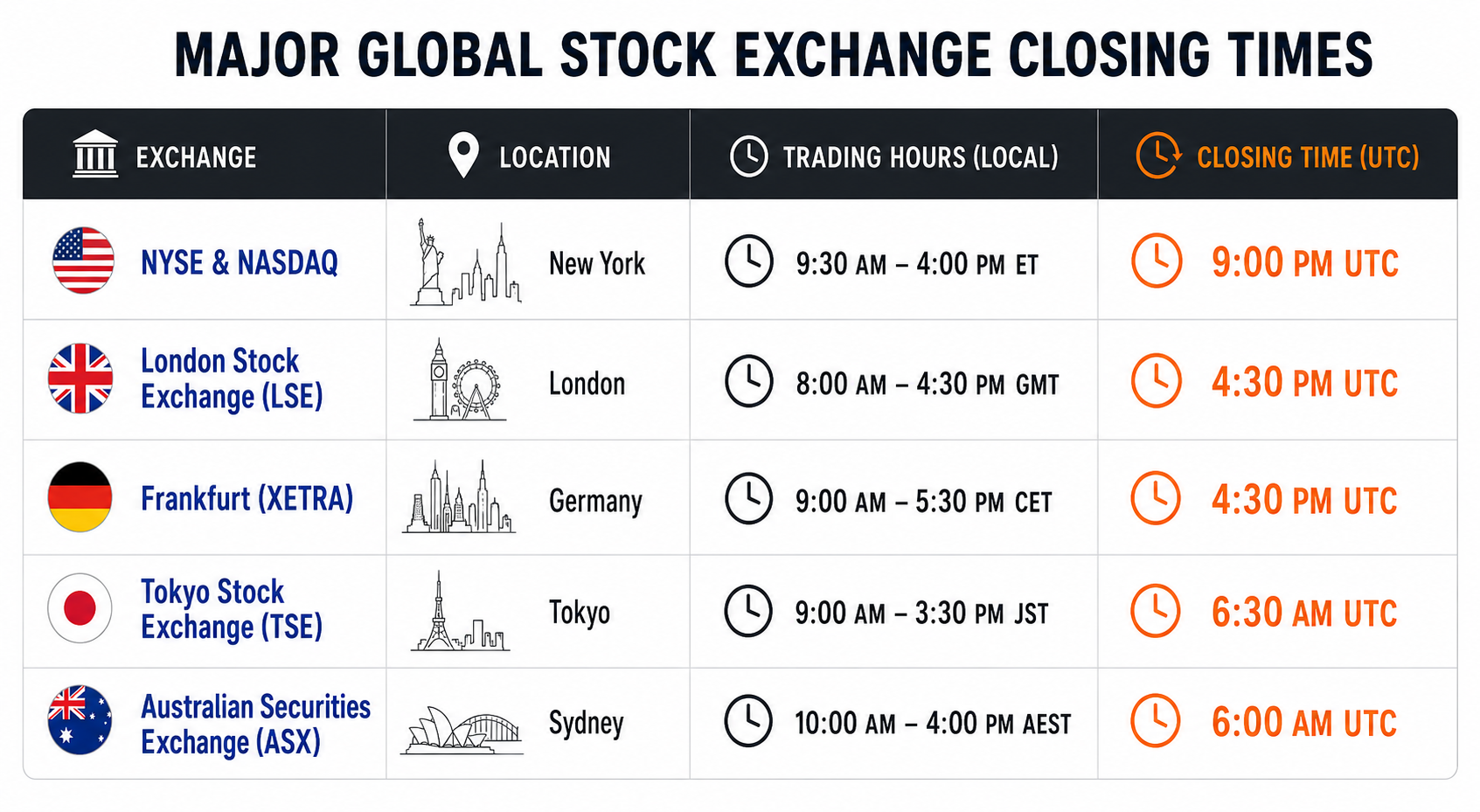
For stock traders, EOD analysis window is typically the final 30-60 minutes before each exchange closes. Orders placed as "day orders" or "EOD orders" will expire when the session ends.
Forex Market Hours
The Forex market operates 24 hours a day, five days a week, so there's no official "close." However, EOD forex traders need a consistent reference point for their daily analysis. The standard EOD reference for Forex: 5:00 PM Eastern Time (New York Close). This time marks:
- The end of the New York trading session
- The daily candle close on most broker platforms
- The rollover period when positions are carried to the next day
Why 5:00 PM ET matters: Most forex brokers align their daily charts with the New York close. When you see a "daily candle" on your MT4, MT5, or TradingView chart, it typically represents the 24-hour period ending at 5:00 PM ET.
Forex Session Overview
While forex trades 24/5, it moves through distinct sessions with varying activity levels:
| Session | Hours (ET) | Characteristics |
| Sydney | 5:00 PM – 2:00 AM | Lower volatility, AUD/NZD pairs active |
| Tokyo | 7:00 PM – 4:00 AM | JPY pairs active, moderate volatility |
| London | 3:00 AM – 12:00 PM | Highest volume session, major pairs very active |
| New York | 8:00 AM – 5:00 PM | High volatility, USD pairs active |
| London-New York Overlap | 8:00 AM – 12:00 PM | Peak liquidity and volatility |
For EOD forex traders, the New York close (5:00 PM ET) is an anchor point. Conducting analysis after this time ensures you're working with complete daily candles.
What Is "Power Hour" in Trading?
Power hour trading refers to the strategy of focusing on the final 60 minutes before a major market closes, typically the most active and volatile period of the trading day. Many EOD traders incorporate power hour trading techniques into their analysis, as this window often produces the clearest signals.
Power hour times by market
- US Stocks (NYSE/NASDAQ): 3:00 PM – 4:00 PM ET
- London Stocks (LSE): 3:30 PM – 4:30 PM GMT
- Forex (New York session): 4:00 PM – 5:00 PM ET
Why power hour matters for EOD traders
- Increased volume: Institutional investors, hedge funds, and index funds execute large orders near the close
- Clearer price action: Higher volume creates more decisive candle formations
- Sets the tone: Closing price often influences the next day's opening direction
- Breakout confirmation: Breakouts during power hour may be considered more significant by some traders due to higher volume
Comparing End-of-Day Trading to Other Strategies
End-of-day trading is just one of many strategies traders can employ. And it surely differs from an after-hours trading strategy, which involves executing trades during extended market hours. Understanding how it compares to other methods can help traders choose the best approach for their goals and lifestyle.
Intraday Trading vs EOD: Key Differences
The debate around intraday trading vs EOD comes down to time commitment and trading style. Intraday trading involves opening and closing positions within the same trading day, requiring constant market monitoring and rapid decision-making.
While intraday trading vs EOD is often framed as a competition, many traders find EOD more sustainable long-term due to reduced screen time and emotional strain.
Swing Trading
Swing trading is another strategy that, like end-of-day trading, does not require constant market monitoring. Swing traders hold positions for several days or weeks, capitalizing on expected market moves.
End-of-day trading and swing trading both allow for thorough analysis and a more relaxed trading pace, but swing trading involves holding positions through overnight and potentially weekend market closures, introducing different risk factors.
| Factor | EOD Trading | Day Trading | Swing Trading |
| Time Required | 30-60 min/day | 4-8+ hours | 1-2 hours |
| Trades/Month | 5-20 | 50-200+ | 10-30 |
| Holding Period | 1-10 days | Same day | Days-weeks |
| Stress Level | Low | High | Medium |
Pros and Cons of End-of-Day Trading
Pros
- Allows for comprehensive market analysis
- Reduces the need for constant market monitoring
- Can be more compatible with a part-time trading schedule
- May lead to reduced stress and emotional trading
Cons
- May miss out on profitable intraday movements
- Requires patience and discipline to wait for the right trading opportunities
- Potential for overnight market changes affecting trade setups
Comparison with Long-Term Investing
Another strategy often contrasted with end-of-day trading is long-term investing. Long-term investors typically buy and hold assets for an extended period, aiming to benefit from the overall growth of the market or specific sectors.
While end-of-day trading focuses on short-term price movements, long-term investing involves a more passive approach, relying on the fundamental strength of investments over time.
Long-term investing requires a different mindset and level of commitment compared to the more active trading style of end-of-day trading. It is essential for investors to align their strategy with their financial goals and risk tolerance.
Risk Management in End-of-Day Trading
Effective risk management is crucial in end-of-day trading to protect capital and minimize losses. Traders often use stop-loss orders to automatically exit a trade if it moves against them beyond a certain point.
Diversification is another key aspect of risk management, spreading investments across different assets to reduce the impact of a single asset's performance on the overall portfolio.
Additionally, position sizing, setting realistic profit targets, and continuously evaluating and adjusting risk management strategies are common practices for successful end-of-day trading.
Psychological Considerations in End-of-Day Trading
The psychological aspect of trading plays a significant role in the success of end-of-day traders. Emotions such as fear, greed, and overconfidence can influence decision-making and lead to impulsive actions. Some traders find that developing a trading plan with clear rules helps them manage emotional decision-making.
Regularly reviewing trades, analyzing performance, and seeking feedback from mentors or peers can also contribute to improving psychological resilience and decision-making in end-of-day trading.
Backtesting and Strategy Development
Backtesting involves testing a trading strategy using historical data to evaluate its performance and profitability. End-of-day traders can use backtesting to assess the viability of their strategies under various market conditions.
Continuous strategy development based on backtesting results, market observations, and personal trading experiences is essential for adapting to changing market dynamics and improving trading outcomes over time.
Conclusion
A well-designed EOD trading strategy offers a viable approach for those looking to engage with the Forex market on a more manageable schedule. By focusing on comprehensive daily chart analysis and strategic planning, traders can potentially reduce stress and improve their decision-making process. As with any trading strategy, success in end-of-day trading requires discipline, patience, and a continuous effort to refine and adapt one's approach based on market conditions and personal trading goals.
Key Takeaways
- EOD trading requires just 30-60 minutes per day
- Daily chart signals are often more reliable than lower timeframes
- Many traders use risk management rules (1-2% per trade)
- Patience and discipline are your greatest assets
- Many traders prioritize quality setups over high trade frequency
Understanding the nuances of end-of-day trading can help you make informed decisions and develop a trading strategy that aligns with your financial objectives and lifestyle.
Start Your End-of-Day Trading Journey with TIOmarkets
Ready to take control of your financial future with end-of-day trading? Join over 170,000 traders in more than 170 countries who have chosen TIOmarkets as their trusted forex broker. With access to over 900 instruments across markets, including Forex, indices, stocks, commodities, and futures, you'll enjoy low fees and a robust trading platform designed for success. Enhance your skills with our comprehensive educational resources and step-by-step guides. Don't wait to elevate your trading strategy: create a trading account today and discover the TIOmarkets difference.

FAQ
Risk disclaimer: CFDs are complex instruments and come with a high risk of losing money rapidly due to leverage. You should consider whether you understand how CFDs work and whether you can afford to take the high risk of losing your money. Never deposit more than you are prepared to lose. Professional client’s losses can exceed their deposit. Please see our risk warning policy and seek independent professional advice if you do not fully understand. This information is not directed or intended for distribution to or use by residents of certain countries/jurisdictions including, but not limited to, USA & Countries included in the OFAC sanction list. The Company holds the right to alter the aforementioned list of countries at its own discretion.
TIOmarkets offers an exclusively execution-only service. The views expressed are for information purposes only. None of the content provided constitutes any form of investment advice. The comments are made available purely for educational and marketing purposes and do NOT constitute advice or investment recommendation (and should not be considered as such) and do not in any way constitute an invitation to acquire any financial instrument or product. TIOmarkets and its affiliates and consultants are not liable for any damages that may be caused by individual comments or statements by TIOmarkets analysis and assumes no liability with respect to the completeness and correctness of the content presented. The investor is solely responsible for the risk of his/her investment decisions. The analyses and comments presented do not include any consideration of your personal investment objectives, financial circumstances, or needs. The content has not been prepared in accordance with any legal requirements for financial analysis and must, therefore, be viewed by the reader as marketing information. TIOmarkets prohibits duplication or publication without explicit approval.
Join us on social media



Authors BIO

Maria is a writer and content strategist with over 10 years of experience in the finance industry. She specializes in developing research-backed articles that help financial professionals navigate complex market topics with confidence. Her expertise spans forex, stocks, CFDs and global markets, creating insightful content that educates readers and supports informed decision-making.