


NFP in Trading: What Non-Farm Payrolls Mean for Markets
BY Maria K.
|October 21, 2026NFP in trading is all about how financial markets react to the monthly Non-Farm Payrolls report, a US employment measure released by the Bureau of Labor Statistics. This report counts the number of paid workers added to the US economy, excluding farm, private household, and non-profit workers. Released on the first Friday of each month at 8:30 AM Eastern Time, NFP represents one of the most closely watched economic data prints in global finance.
The Non-Farm Payrolls report influences trading decisions across forex, indices, commodities, and cryptocurrencies. Understanding NFP in trading means recognizing what the data measures, why it creates immediate price movements, and how different market participants approach this high-impact monthly event. This article examines the mechanics of NFP releases and the practical considerations traders face.
What Does NFP Mean in Trading?
NFP stands for Non-Farm Payrolls, a monthly economic report from the US Bureau of Labor Statistics that measures net job changes across the American economy.
In trading contexts, NFP represents both the data itself and the market volatility surrounding its release. The report excludes farm workers due to seasonal fluctuations, along with private household employees and non-profit organization staff. Government employees are included in the count, contrary to some common misconceptions about the report's scope.
The Employment Situation report covers approximately 80% of US employment. The Bureau of Labor Statistics surveys roughly 145,000 businesses and government agencies, encompassing about 697,000 individual worksites. Data collection occurs during the week containing the 12th of each month.
What Are the Core Components of the NFP Report?
Beyond the headline job-addition number, the report includes several data points that traders monitor closely for a complete picture of labor market conditions.
The NFP Report key components include:
- Headline Non-Farm Payrolls: The net change in jobs from the previous month
- US Unemployment Rate: The percentage of the labor force actively seeking work but currently unemployed
- Average Hourly Earnings: Wage growth data that serves as a key inflation indicator
- Prior Month Revisions: Updates to previous figures as more complete data becomes available
Experienced traders typically review all components before forming conclusions. The unemployment rate and wage growth figures can sometimes override the headline number in terms of market impact. Revisions to prior months occasionally shift interpretation of the current release significantly.
When Is the NFP Report Released?
The NFP report is usually published on the first Friday of every month at 8:30 AM Eastern Time, with occasional schedule adjustments around major US holidays.
This timing creates specific trading conditions worth understanding. The release occurs one hour before US stock markets open at 9:30 AM ET, meaning initial reactions happen in futures markets and forex. The 8:30 AM ET window coincides with the overlap between London and New York trading sessions - normally the highest liquidity period for currency trading.
However, despite high session liquidity, the NFP release itself temporarily reduces available liquidity as market makers pull back during uncertainty. Traders can confirm specific release dates through the BLS calendar or major economic calendar platforms, which publish the annual schedule in advance.
Why Does NFP Move Markets?
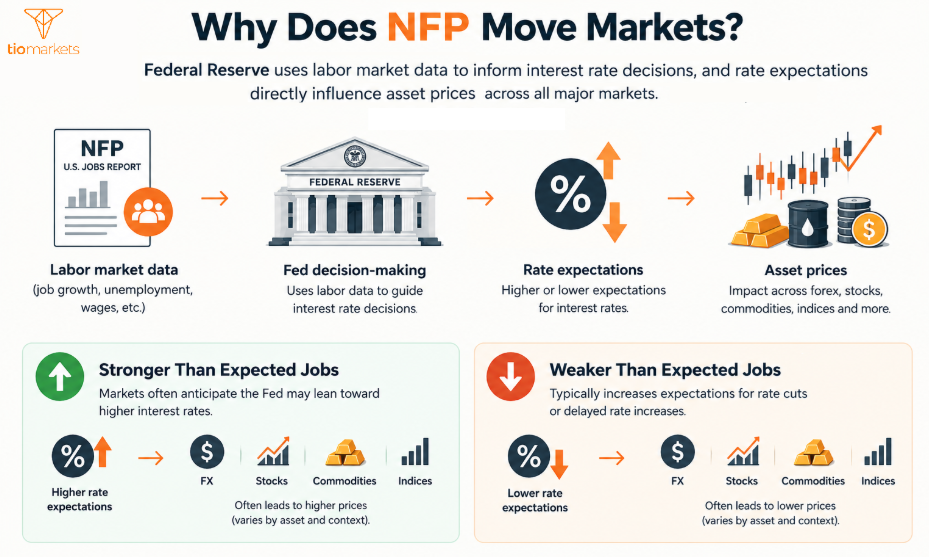
NFP in trading moves markets because the Federal Reserve uses employment data to guide interest rate decisions, and rate expectations directly influence currency values, equity valuations, and commodity prices globally.
The Federal Reserve operates under a dual mandate from Congress: maintain maximum employment and stable prices. Employment data directly informs half of this mandate. When job growth comes in stronger than expected, markets often anticipate the Fed may lean toward higher interest rates. Weaker employment data typically increases expectations for rate cuts or delayed rate increases.
For example, in January 2023, a stronger-than-expected NFP reading of 517,000 jobs (versus 185,000 forecast) sent EUR/USD down approximately 100 pips within minutes and shifted Fed rate expectations significantly higher.
How Do NFP Results Affect Interest Rate Expectations?
The market reaction depends more on the gap between actual results and consensus forecasts than on the absolute number itself.
| NFP Result | Typical Rate Expectation Common | USD Reaction |
| Above consensus | Higher rates more likely | Tends to strengthen |
| Below consensus | Rate cuts more likely | Tends to weaken |
| Matches consensus | Limited policy shift | Often muted reaction |
Significant deviations from consensus, typically 50,000 jobs or more, tend to produce larger price movements. Professional economists publish forecasts before each release, and financial data providers calculate median expectations that serve as the benchmark for "beats" or "misses."
How Does NFP Affect Different Asset Classes?
NFP is one of the most volatile data prints in global finance, moving the US dollar, forex pairs like EUR/USD, GBP/USD, and USD/JPY, gold (XAU/USD), and stock indices within seconds of release.
NFP Forex Trading Impact
Currency pairs involving the US dollar typically show the most immediate and pronounced reactions to NFP data releases across all tradeable markets.
EUR/USD, GBP/USD, and USD/JPY are among the most actively traded pairs during NFP. A stronger-than-expected report has historically tended to support the dollar against other currencies - though reactions vary. Price movements can range from 50 to 200 pips in major pairs within the first few minutes following release. The initial spike may reverse as traders digest the complete report, including unemployment rate and wage data.
NFP Effects on Stock Indices
US stock indices respond to NFP through multiple channels, with the direction depending on current economic context and market focus.
Strong employment growth can signal economic expansion, potentially supporting equity prices. However, if strong growth significantly raises rate hike expectations, higher discount rates can pressure equity valuations. The S&P 500, Dow Jones Industrial Average, and Nasdaq often show correlated movements following NFP, though the direction depends on whether markets are focused on growth concerns or inflation concerns at that particular time.
NFP Influence on Gold and Commodities
Gold typically shows an inverse relationship to the US dollar, making it often responsive to NFP-driven dollar movements.
A stronger dollar following positive NFP data often pressures gold prices lower. Since gold is priced in dollars internationally, dollar strength makes it more expensive for holders of other currencies. XAU/USD can move 1-3% in the hour following significant NFP surprises. Crude oil responds to both dollar movements and growth implications that employment data suggests.
Why Does NFP Matter to Traders? Key Risk Factors
NFP trading carries elevated risks including wider spreads, increased slippage, potential for stop-loss orders to fill at worse prices than set levels, and rapid price reversals that can occur within minutes of the initial move.
What Execution Challenges Does NFP Create?
Bid-ask spreads that normally measure 1-2 pips in major forex pairs can expand to 5-10 pips or more in the seconds surrounding the release. This spread widening reflects reduced liquidity as market makers pull back during high uncertainty. Spreads typically normalize within 5-10 minutes after release.
Stop-loss orders may not execute at specified prices during extreme volatility. A stop set 20 pips from entry might fill 30 or 40 pips away if price gaps through the level. This slippage represents a significant risk factor that position sizing should account for.
What Are the Risks of False Breakouts During NFP?
The initial price move following NFP does not always represent the final direction, creating potential for traders to be caught on the wrong side of reversals.
Historical data shows initial price spikes frequently reverse within 15-30 minutes of the release. This pattern occurs when traders react immediately to the headline number, then adjust positions as they process the unemployment rate, wage data, and revisions to prior months. A strong headline figure accompanied by weak wage growth, for example, may initially push prices one direction before reversing as the full picture becomes clear. This false breakout phenomenon is witnessed across NFP releases and represents a significant risk factor for traders entering during the initial volatility window.
How Do Traders Approach NFP? Common Trading Methods
Common NFP in trading approaches include pre-release positioning with pending orders, post-release trend following based on data deviation, and fading the spike by waiting for initial reactions to exhaust.
What Is Pre-Release Positioning in NFP Trading?
Some traders analyze consensus forecasts versus previous data and place pending orders ahead of NFP, though this approach carries execution risks during volatile conditions.
This straddle or bracket strategy involves placing buy stop orders above current price and sell stop orders below. When price breaks in either direction, one order triggers while the opposing order may serve as a stop-loss. The approach attempts to capture the breakout regardless of whether data beats or misses expectations. However, both orders may trigger during extreme whipsaw movements, and slippage can significantly impact entry prices.
What Is Post-Release Trend Following?
This approach involves waiting for the official 8:30 AM ET print, comparing actual numbers against forecasts, and trading the initial momentum if data deviates significantly from expectations.
The process requires quick analysis: noting the actual NFP figure, comparing it to consensus, assessing whether the deviation is significant (typically 50,000+ jobs difference), and entering in the direction of initial momentum with appropriate risk management. This method demands rapid decision-making while managing spread and slippage conditions that persist in the minutes following release.
What Does Fading the Spike Mean?
Fading the spike involves waiting for the initial knee-jerk reaction to exhaust itself, then analyzing deeper metrics like wage inflation and revisions before potentially trading the reversal.
Data shows initial price spikes following NFP frequently reverse within 15-30 minutes. This occurs when traders initially react to the headline, then adjust positions as they review unemployment rate, wage data, and revisions to prior months. Some traders specifically wait for initial moves to complete before looking for reversal opportunities at technical levels, though this approach carries its own timing and execution challenges.
How NFP Compares to Other Economic Releases?
NFP in trading ranks among the highest-impact events on the economic calendar, alongside CPI (inflation) data and FOMC rate decisions. While GDP and retail sales data also move markets, NFP typically produces more immediate volatility due to its direct connection to Fed policy. Traders often treat NFP, CPI, and FOMC announcements as the three releases requiring the most preparation.
The relative importance can shift based on economic context. During periods of growth concern, GDP data may receive more attention. During inflation-focused periods, CPI may override other releases. NFP maintains consistent importance due to its direct connection to Fed policy.
How Should Traders Prepare for NFP Releases?
NFP preparation involves checking release dates and consensus forecasts, reviewing economic context, deciding on a trading approach in advance, and ensuring platform stability during high-volatility conditions.
Pre-Release Analysis Checklist
Traders approaching NFP in trading typically complete their analysis 15-30 minutes before the release to allow time for platform preparation and final position review.
Key preparation steps include:
- Confirming exact release date and time, checking for holiday adjustments
- Noting consensus forecast and range of economist predictions
- Reviewing previous month's figure and any subsequent revisions
- Checking unemployment rate and wage growth expectations
- Verifying stable internet connection and platform access
Having a predetermined plan, whether to trade actively, reduce exposure, or avoid the release entirely, removes emotional decision-making during volatile moments. The choice depends on risk tolerance, account size, trading style, and any applicable prop firm or institutional rules.
Conclusion
NFP in trading represents both a significant market event and a practical challenge requiring preparation and risk awareness. The monthly Non-Farm Payrolls report provides employment data that influences Federal Reserve policy expectations, affecting the US dollar, forex pairs, gold, and equity indices within seconds of release.
Understanding NFP in trading means recognizing what the data measures beyond the headline number, including unemployment rate, wage growth, and revisions. Whether traders choose to participate actively through pre-release positioning, post-release trend following, or spike fading, the decision benefits from thorough preparation and clear risk parameters. For prop firm traders, verifying specific news trading rules before each release remains essential for account protection.

FAQ
Risk disclaimer: CFDs are complex instruments and come with a high risk of losing money rapidly due to leverage. You should consider whether you understand how CFDs work and whether you can afford to take the high risk of losing your money. Never deposit more than you are prepared to lose. Professional client’s losses can exceed their deposit. Please see our risk warning policy and seek independent professional advice if you do not fully understand. This information is not directed or intended for distribution to or use by residents of certain countries/jurisdictions including, but not limited to, USA & Countries included in the OFAC sanction list. The Company holds the right to alter the aforementioned list of countries at its own discretion.
TIOmarkets offers an exclusively execution-only service. The views expressed are for information purposes only. None of the content provided constitutes any form of investment advice. The comments are made available purely for educational and marketing purposes and do NOT constitute advice or investment recommendation (and should not be considered as such) and do not in any way constitute an invitation to acquire any financial instrument or product. TIOmarkets and its affiliates and consultants are not liable for any damages that may be caused by individual comments or statements by TIOmarkets analysis and assumes no liability with respect to the completeness and correctness of the content presented. The investor is solely responsible for the risk of his/her investment decisions. The analyses and comments presented do not include any consideration of your personal investment objectives, financial circumstances, or needs. The content has not been prepared in accordance with any legal requirements for financial analysis and must, therefore, be viewed by the reader as marketing information. TIOmarkets prohibits duplication or publication without explicit approval.
Join us on social media


Authors BIO

Maria is a writer and content strategist with over 10 years of experience in the finance industry. She specializes in developing research-backed articles that help financial professionals navigate complex market topics with confidence. Her expertise spans forex, stocks, CFDs and global markets, creating insightful content that educates readers and supports informed decision-making.