


UK CPI Preview: Will UK Inflation Rise to 3.7% in October?
BY Ahmed Osama
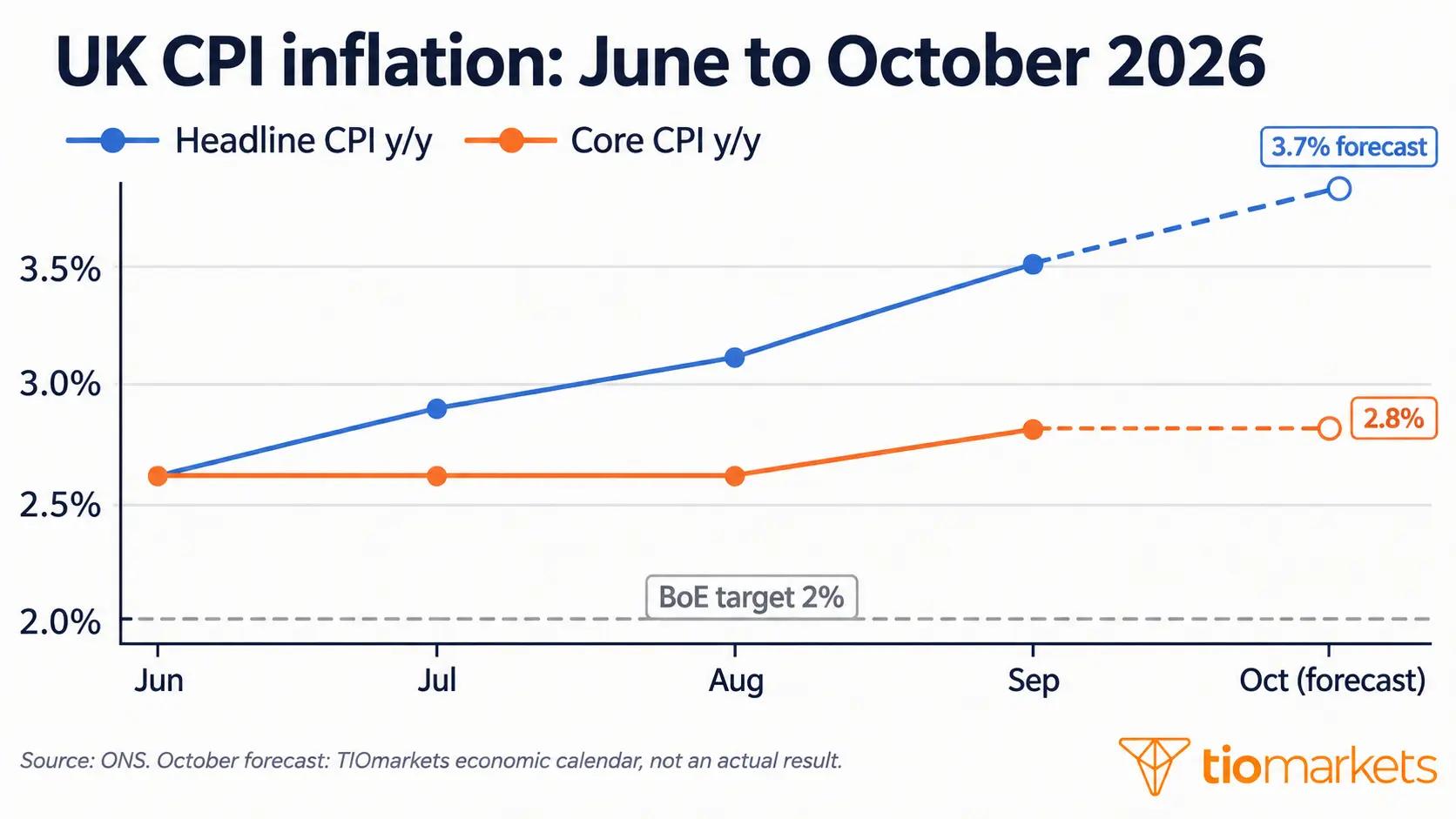
|November 17, 2026The UK CPI report for October is due at 07:00 UTC on Wednesday 18 November. After annual inflation rose to 3.5% in September, forecasts point to a further rise to 3.7%, with prices expected to increase 0.5% on the month and core inflation forecast to hold at 2.8%. It is the first inflation report since the Bank of England (BoE) raised interest rates to 4.00%, and the first to include October's rise in household energy bills. With the pound near a one-month low against the US dollar, the UK CPI data could shape expectations for the BoE's December decision and move GBP/USD and EUR/GBP.
UK CPI report in brief
- The October UK CPI report is due at 07:00 UTC on Wednesday 18 November.
- Forecasts point to annual inflation of 3.7%, up from 3.5% in September, and a 0.5% monthly rise after 0.4%. Core inflation is forecast to hold at 2.8%.
- The BoE raised Bank Rate to 4.00% from 3.75% on 5 November, its first increase since August 2023.
- UK unemployment fell to 4.6% in the three months to September, below the 4.7% forecast, and employment rose by 156,000.
- GBP/USD is trading near a one-month low around 1.3190, while EUR/GBP is moving sideways near 0.8345.
What is the UK CPI report and when is it released?
The Consumer Prices Index, or CPI, measures how quickly the prices of everyday goods and services are rising, from food and fuel to rent and travel. The Office for National Statistics (ONS) publishes it every month, and it is the measure the BoE uses for its 2% inflation target. The report includes headline CPI, which covers all items, and core CPI, which excludes energy, food, alcohol and tobacco because their prices can move sharply. Our guide on how a CPI basket is built explains the method in more detail.
Because inflation is the main reason the BoE changes interest rates, the UK CPI report is one of the most important monthly releases for traders of the British pound. The October report is due at 07:00 UTC on Wednesday 18 November, as shown on our economic calendar.
What the forecasts show for October
| Indicator | Forecast (October) | Previous (September) |
| Headline CPI, annual | 3.7% | 3.5% |
| Headline CPI, monthly | 0.5% | 0.4% |
| Core CPI, annual | 2.8% | 2.8% |
Forecasts vary by source and may change before the release.
In simple terms: forecasters expect headline inflation to rise again in October, mainly because household energy bills went up at the start of the month, while core inflation is expected to stay at 2.8%. If the forecasts are confirmed, UK inflation would be 1.7 percentage points above the BoE's 2% target and would have risen for a fourth month in a row. In other words, the pressure is expected to come mainly from energy rather than from underlying prices.
Why this UK CPI report matters for the Bank of England
The BoE raised Bank Rate by 0.25 percentage points to 4.00% on 5 November. Eight of the nine policymakers voted for the move, while Catherine Mann preferred a larger rise to 4.25%. The Bank's latest forecasts show inflation climbing further, to close to 5% around the middle of 2027, mainly because of higher energy costs. Chief Economist Huw Pill has since said that further rate rises are likely. The next decision is due at 12:00 UTC on Thursday 17 December. Our BoE interest rate decision preview explains the background.
The jobs report on 17 November pointed to a stronger labour market. The unemployment rate fell to 4.6% in the three months to September, from 4.7% in the previous reading and below the 4.7% forecast, while employment rose by 156,000. The number of people claiming unemployment benefits rose by 33,200, slightly more than the 28,100 forecast. Our UK unemployment rate preview explains what each of these measures shows.
That makes this UK CPI report especially important. A higher-than-expected reading could strengthen expectations of another rate rise in December, while a clear slowdown, especially in core and services inflation, could make the BoE more cautious.
How energy bills are feeding UK inflation
Ofgem, the UK energy regulator, raised its price cap by 4% from 1 October, from £1,663 to £1,723 a year for a typical household paying by direct debit. That compares with a smaller rise of around 2% in October 2025. Because UK CPI compares prices with a year earlier, this gap could lift the annual rate. The government's temporary removal of VAT on household electricity, also from 1 October, may partly offset the effect, and some economists also point to higher tobacco duties and fuel prices.
That is why many traders focus on core and services inflation. In September, fuel was the main driver, with goods inflation rising to 3.2% from 2.7%, but core inflation also rose to 2.8% from 2.6% and services inflation reached 3.7% from 3.4%. The BoE cannot lower global energy prices with interest rates, but it can respond if higher energy costs start to push up wages and other prices. You can compare these results with the expectations in our September UK CPI preview.
Four things to watch in the report
1. Headline CPI and energy
A rise to 3.7% is expected because of higher energy bills. A reading of 3.8% or more would suggest inflation is rising faster than forecasters expected.
2. Core CPI
Core inflation is forecast to stay at 2.8%. A rise to 2.9% or more would suggest that price pressure is spreading beyond energy and food.
3. Services inflation
Services inflation reached 3.7% in September. Because it is closely linked to wages and domestic demand, it is the BoE's clearest guide to whether inflation is becoming persistent.
4. BoE speakers and other data
Governor Andrew Bailey is due to speak at 06:30 UTC, just before the data, and again at 15:00 UTC on the same day. UK retail sales for October follow on Friday 20 November.
How the UK CPI report could move GBP/USD
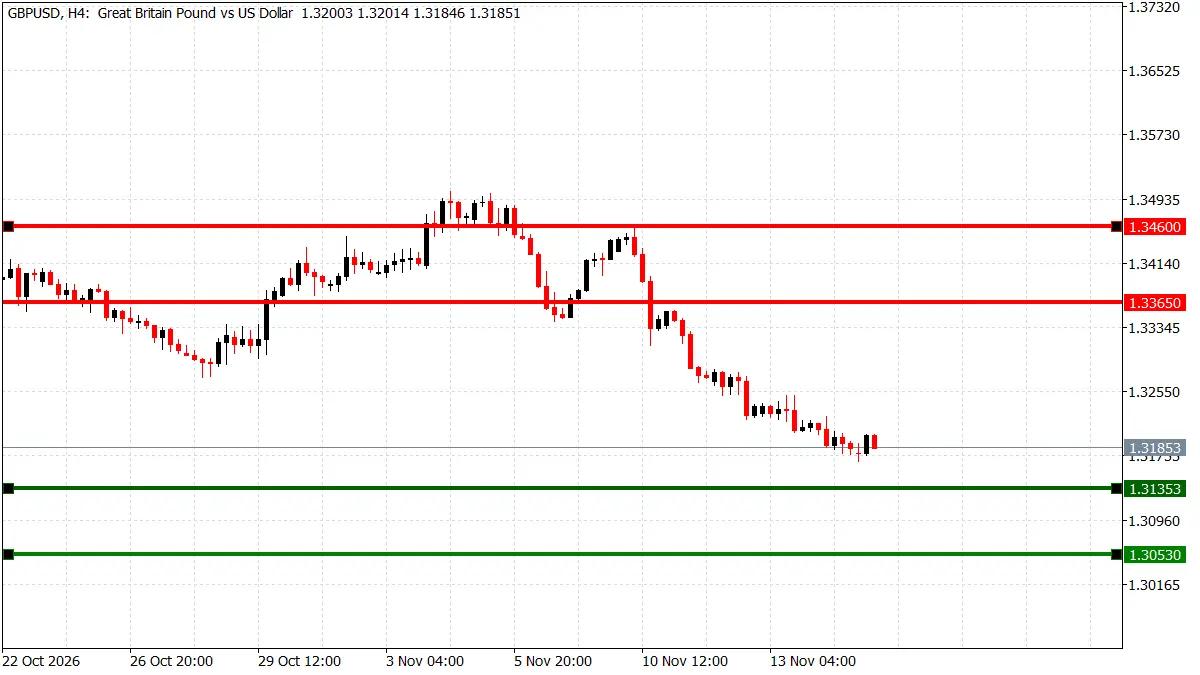
GBP/USD shows how many US dollars one British pound buys, so a rising pair means a stronger pound. The pair has dropped from 1.3458 on 10 November to a one-month low near 1.3170 on 17 November, and was trading around 1.3190 at the time of writing. The main driver has been the US dollar: US consumer prices rose more than expected in October, and markets now widely expect the Federal Reserve to raise interest rates in December. Our US CPI preview covers the dollar side.
The pound itself has held up better than this move suggests. The UK economy grew 0.7% in the third quarter, its fastest pace in two and a half years, and sterling held broadly steady against the euro over the same period. On the 4-hour chart, the pair has formed lower highs since the early-November peak near 1.3500 and has slipped below the 1.3200 to 1.3300 range that held from late September to mid-October.
GBP/USD has been trading in a broad 1.3050 to 1.3460 range. Reference levels traders are watching:
- 1.3460: the 10 November high, where the latest rebound stalled
- 1.3365: an area the pair crossed several times in October and November
- 1.3135: the mid-October low
- 1.3050: an area close to the lowest levels of the past 12 months
A higher-than-expected UK CPI reading could support the pound and lift GBP/USD towards 1.3365 and possibly 1.3460. A lower-than-expected reading could weigh on sterling and pull the pair towards 1.3135 and 1.3050. US data and the Fed minutes on Wednesday evening can also outweigh UK news on the day.
How the UK CPI report could move EUR/GBP
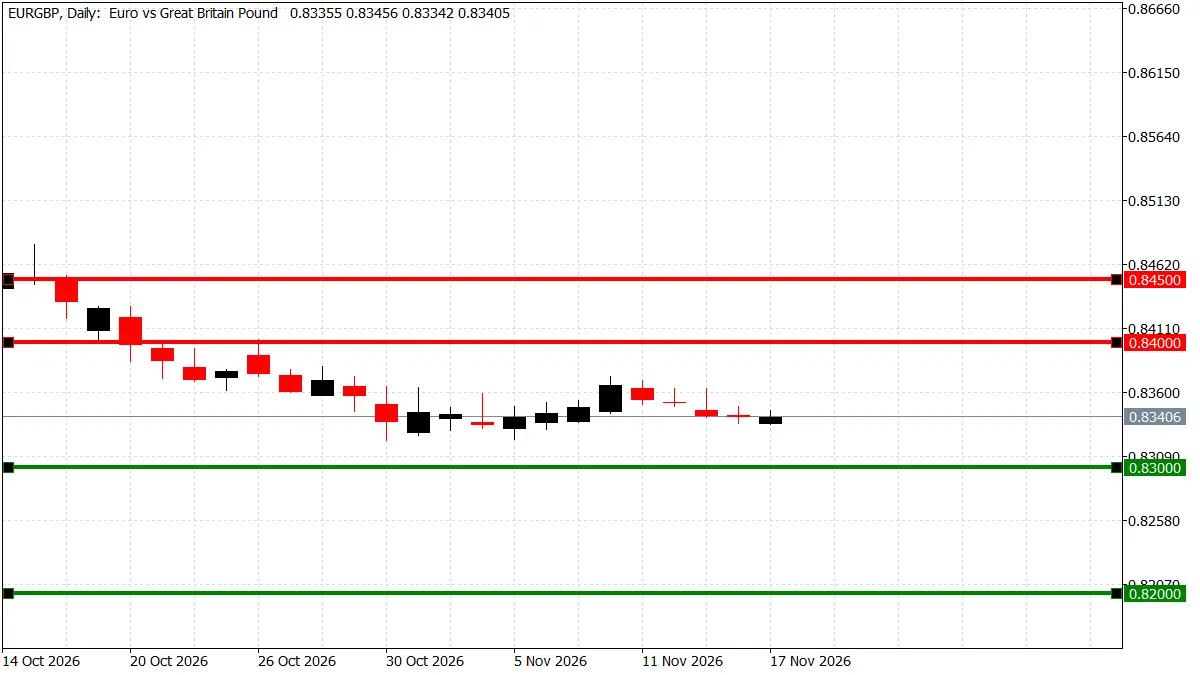
EUR/GBP shows how many British pounds one euro buys, so a falling pair means a stronger pound. Because the US dollar is not part of the pair, it gives a cleaner view of the UK side of the story. The cross has fallen by around 5% over the past year as the pound has outperformed the euro. On the daily chart, it broke below the 2026 low of 0.8452 in early October, then dropped further after September's inflation data came in above expectations on 21 October, reaching around 0.8320 later that month.
Since then, the pair has moved sideways between roughly 0.8320 and 0.8372, and was trading near 0.8345 on 17 November. The euro has struggled because of high energy costs, concerns about French public finances and a stronger US dollar, even though the European Central Bank (ECB) has raised interest rates twice this year and some traders expect another hike in December. ECB President Christine Lagarde is due to speak on Wednesday and Thursday, which could move the euro side of the pair.
EUR/GBP has been trading in a broad 0.8200 to 0.8450 range. Reference levels traders are watching:
- 0.8450: the former 2026 lows from July and early October, now a possible ceiling
- 0.8400: the round number and former congestion area
- 0.8300: the round number just below the late-October low
- 0.8200: the next major round-number support
A higher-than-expected UK CPI reading could strengthen the pound and push EUR/GBP towards 0.8300 and possibly 0.8200. A lower-than-expected reading could lift the pair towards 0.8400 and 0.8450.
All levels are context markers, not entry or exit points, and should be checked against a live price feed.
Trade GBP/USD and EUR/GBP with TIOmarkets
Take your position on major currencies via CFDs. Enjoy tight spreads, fast execution, and fast, flexible funding options.
Trading is risky
Three scenarios: better than expected, as expected or worse than expected
In this table, "better than expected" means lower inflation than forecast, and "worse than expected" means higher inflation than forecast, from the perspective of households and the BoE's 2% target. Higher-than-expected inflation tends to support the pound, which often means a higher GBP/USD and a lower EUR/GBP.
| Scenario | What it could look like | Possible market reaction | What could change the reading |
| Better than expected | Annual inflation at 3.6% or lower, core at 2.7% or lower, or a monthly rise of 0.4% or less | The pound could weaken as expectations of a December rate rise ease; GBP/USD could move towards 1.3135 to 1.3050 and EUR/GBP towards 0.8400 to 0.8450 | Services inflation that keeps rising despite a lower headline figure |
| As expected | Annual inflation near 3.7%, core near 2.8% and a monthly rise of about 0.5% | First moves may be limited, with rate expectations largely unchanged; GBP/USD could stay within 1.3135 to 1.3365 and EUR/GBP within 0.8300 to 0.8400 | The details: services inflation, Governor Bailey's comments and the Fed minutes |
| Worse than expected | Annual inflation at 3.8% or higher, core at 2.9% or higher, or a monthly rise of 0.6% or more | The pound could strengthen as expectations of a December rate rise grow; GBP/USD could move towards 1.3365 to 1.3460 and EUR/GBP towards 0.8300 to 0.8200 | A rise driven only by energy and tobacco, with steady services inflation |
Scenario thresholds are editorial guideposts, not forecasts or trading recommendations.
A mixed report may create the hardest reaction
The most difficult outcome to read is a mixed one, for example a higher headline figure because of energy bills, but a slower rise in core or services inflation. In that case, the first move in the pound may reverse as traders focus on the details. Governor Bailey's speech shortly before the data could also change how the market reads the numbers. Spreads can widen around 07:00 UTC, early in the London session, and prices may move past stop orders.
Key events to watch
- Tuesday 17 November, 13:30 UTC: US retail sales for October (forecast 0.2% after 0.8%)
- Wednesday 18 November, 06:30 UTC: BoE Governor Andrew Bailey speaks
- Wednesday 18 November, 07:00 UTC: UK CPI report for October
- Wednesday 18 November, 14:25 UTC: ECB President Christine Lagarde speaks
- Wednesday 18 November, 15:00 UTC: Governor Bailey speaks again
- Wednesday 18 November, 19:00 UTC: minutes of the Fed's October meeting
- Thursday 19 November, 13:30 UTC: ECB President Lagarde speaks
- Friday 20 November, 07:00 UTC: UK retail sales for October
- Thursday 17 December, 12:00 UTC: the BoE's rate decision
Risks and uncertainties
Inflation data are rounded, and individual components can be volatile from month to month, especially when energy prices are moving. Gas and oil prices remain sensitive to developments in the Middle East, and a sudden move could change the inflation outlook, and with it the BoE's view. Comments from Governor Bailey, ECB President Lagarde and the Fed minutes can quickly outweigh the market's first reaction to the UK CPI data.
Market direction is not mechanical. Positioning, liquidity and global risk sentiment can outweigh the usual relationship between inflation data and the pound, and prices can gap or reverse rapidly around the release. Trading currency CFDs with leverage magnifies both gains and losses.
Conclusion
The October UK CPI report is expected to show inflation rising to 3.7% from 3.5%, mainly because of higher household energy bills, with core inflation forecast to hold at 2.8%. After the BoE's first rate rise since 2023 and a stronger jobs report, the data may decide how firmly markets expect another rise in December. A higher-than-expected reading could support the pound, lifting GBP/USD and weighing on EUR/GBP, while a lower-than-expected one could do the opposite. Core and services inflation are likely to matter more than the headline figure.

FAQ
Risk disclaimer: CFDs are complex instruments and come with a high risk of losing money rapidly due to leverage. You should consider whether you understand how CFDs work and whether you can afford to take the high risk of losing your money. Never deposit more than you are prepared to lose. Professional client’s losses can exceed their deposit. Please see our risk warning policy and seek independent professional advice if you do not fully understand. This information is not directed or intended for distribution to or use by residents of certain countries/jurisdictions including, but not limited to, USA & Countries included in the OFAC sanction list. The Company holds the right to alter the aforementioned list of countries at its own discretion.
TIOmarkets offers an exclusively execution-only service. The views expressed are for information purposes only. None of the content provided constitutes any form of investment advice. The comments are made available purely for educational and marketing purposes and do NOT constitute advice or investment recommendation (and should not be considered as such) and do not in any way constitute an invitation to acquire any financial instrument or product. TIOmarkets and its affiliates and consultants are not liable for any damages that may be caused by individual comments or statements by TIOmarkets analysis and assumes no liability with respect to the completeness and correctness of the content presented. The investor is solely responsible for the risk of his/her investment decisions. The analyses and comments presented do not include any consideration of your personal investment objectives, financial circumstances, or needs. The content has not been prepared in accordance with any legal requirements for financial analysis and must, therefore, be viewed by the reader as marketing information. TIOmarkets prohibits duplication or publication without explicit approval.
Join us on social media


Authors BIO

An experienced financial analyst and educator with over 8 years of expertise covering gold, forex, and global financial markets. Ahmed specializes in blending price action analysis with macroeconomic data to accurately interpret market movements, providing readers with comprehensive educational insights into trading and the financial world.





