


UK CPI Preview: Will Rising Inflation Lift the Pound?
BY Ahmed Osama
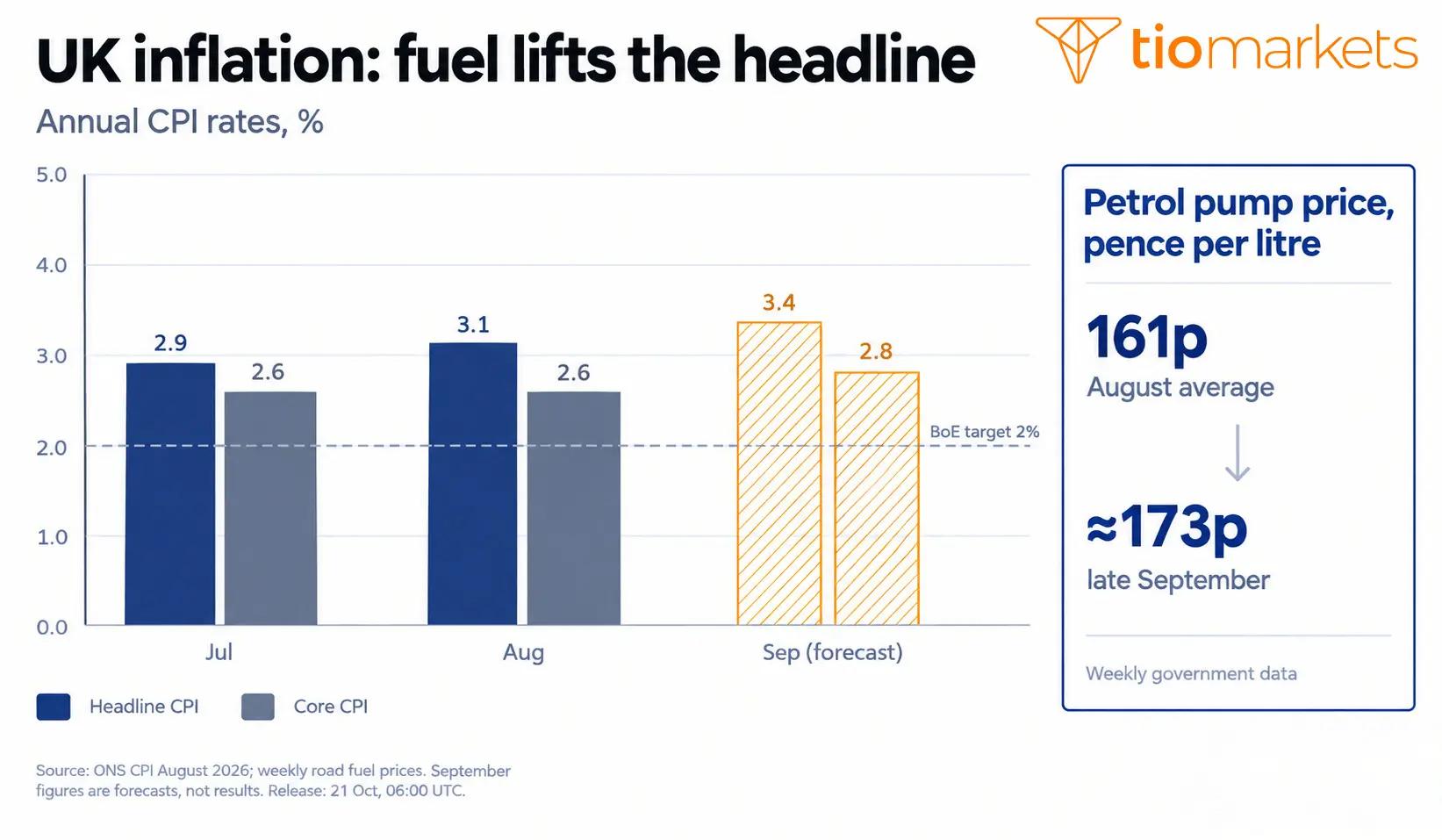
|October 20, 2026The UK's September inflation report is due at 06:00 UTC on Wednesday 21 October. Economic calendars point to headline CPI rising to 3.4% from 3.1%, with core CPI increasing to 2.8% from 2.6%. For the pound and UK interest-rate expectations, the key question is whether UK inflation is still being driven mainly by fuel and energy, or whether it is spreading into services and other underlying prices.
UK CPI Preview in Brief: Key Numbers to Watch
- The ONS publishes UK inflation data for September at 06:00 UTC on Wednesday 21 October.
- Economic calendars point to headline CPI of 3.4% year on year and core CPI of 2.8%, up from 3.1% and 2.6% in August.
- Petrol and diesel prices rose sharply through September, making motor fuels the clearest source of upward pressure.
- The 4% rise in Ofgem's energy price cap took effect on 1 October, so it will not appear directly in this release.
- Labour market data on 20 October showed the unemployment rate falling unexpectedly to 4.7%, while total pay growth slowed to 3.7%, leaving inflation as the next key test for the Bank of England.
- GBP/USD was trading near 1.3350 at the time of writing. A hotter report could support the pound by raising Bank of England rate-hike expectations.
What is the UK CPI report and when is it released?
The Consumer Prices Index (CPI) measures how quickly the prices of everyday goods and services are rising. The ONS publishes it monthly, and it is the measure the Bank of England uses for its 2% inflation target, which makes it one of the most closely watched releases for traders of the British pound.
The September report is due at 06:00 UTC (07:00 UK time) on Wednesday 21 October, as shown on our economic calendar. It includes headline CPI, core CPI (which excludes energy, food, alcohol and tobacco), services inflation and detailed categories such as transport and household energy.
What economists expect from UK inflation
In August, headline CPI rose to 3.1% from 2.9% in July, in line with forecasts, while core CPI held at 2.6% and services inflation was unchanged at 3.4%. That combination showed a gap between a rising headline rate and steady underlying inflation.
| Indicator | August | September expectation | Why it matters |
| Headline CPI, year on year | 3.1% | 3.4% | The overall inflation rate and its distance from the 2% target |
| Core CPI, year on year | 2.6% | 2.8% | Whether price pressure is spreading beyond energy and food |
| Services CPI, year on year | 3.4% | No firm consensus | The closest guide to domestic, wage-driven inflation |
| Monthly CPI | +0.5% | 0.3 % | Fresh momentum, although it can be seasonal |
If the forecasts are confirmed, UK inflation would be 1.4 percentage points above the Bank of England's target and would have risen for a third consecutive month. Forecasts can change before the release, so the composition of any surprise will matter as much as the headline number.
Commonly misunderstood
Ofgem raised the energy price cap by 4% from 1 October, from £1,663 to £1,723 for a typical direct-debit household. Because this release covers September prices, that change should first appear directly in the October CPI data due on 18 November, not in the 21 October report.
Why fuel prices may lift the headline rate
Transport was already the biggest upward driver of the change in CPI in August. The ONS reported that average petrol prices rose to 161.3 pence per litre and diesel to 181.8 pence, with motor fuels making the largest upward contribution to the increase in the annual inflation rate.
The Department for Energy Security and Net Zero’s weekly series then recorded further increases through September. Average petrol rose from 164.40 pence per litre in the week beginning 7 September to 173.46 pence in the week beginning 28 September. Diesel rose from 186.36 pence to 197.58 pence over the same span. Those observations are not a substitute for the ONS calculation, but they make fuel the most visible candidate for another upward contribution.
A fuel-led rise can still squeeze household purchasing power and raise transport costs for companies. Yet it is not the same policy signal as a simultaneous acceleration in labour-intensive services, where prices tend to reflect wages and domestic demand more heavily.
Why core and services inflation matter for the Bank of England
The Bank of England cannot lower global energy prices with interest rates. It can respond, however, if an energy shock starts to push up wages, inflation expectations or the way companies set prices. That is why markets will look beyond the headline figure.
A rise in core CPI from 2.6% towards the 2.8% forecast would suggest the pickup is not only about fuel. Services inflation, at 3.4% in August, is another important check: steady services inflation alongside expensive fuel would suggest domestic price pressure remains under control, while a renewed rise would point to broader persistence.
This matters more after the Bank held Bank Rate at 3.75% in September by a 6–3 vote, with three members preferring a rise to 4.00%. The Bank said risks to the inflation outlook were tilted to the upside and had increased since July. It now expects CPI to climb to around 3.75% in the final quarter of 2026.
The labour market report on 20 October sent mixed signals. The unemployment rate fell unexpectedly to 4.7% in the three months to August from 4.9%, against forecasts for no change, pointing to a firmer jobs market. But total pay growth slowed to 3.7% from 3.9%, below the 3.8% forecast, and the Claimant Count rose by 30,300. Our UK unemployment rate preview explains what each of these measures shows. That mix makes the inflation data more important: lower unemployment supports the case for higher rates, while slower pay growth eases concerns about wage-driven inflation.
In simple terms: a hot report across headline, core and services could strengthen the case for a rate rise. A softer report could make a hike harder to justify and support the majority view to hold.
How UK inflation could move GBP/USD
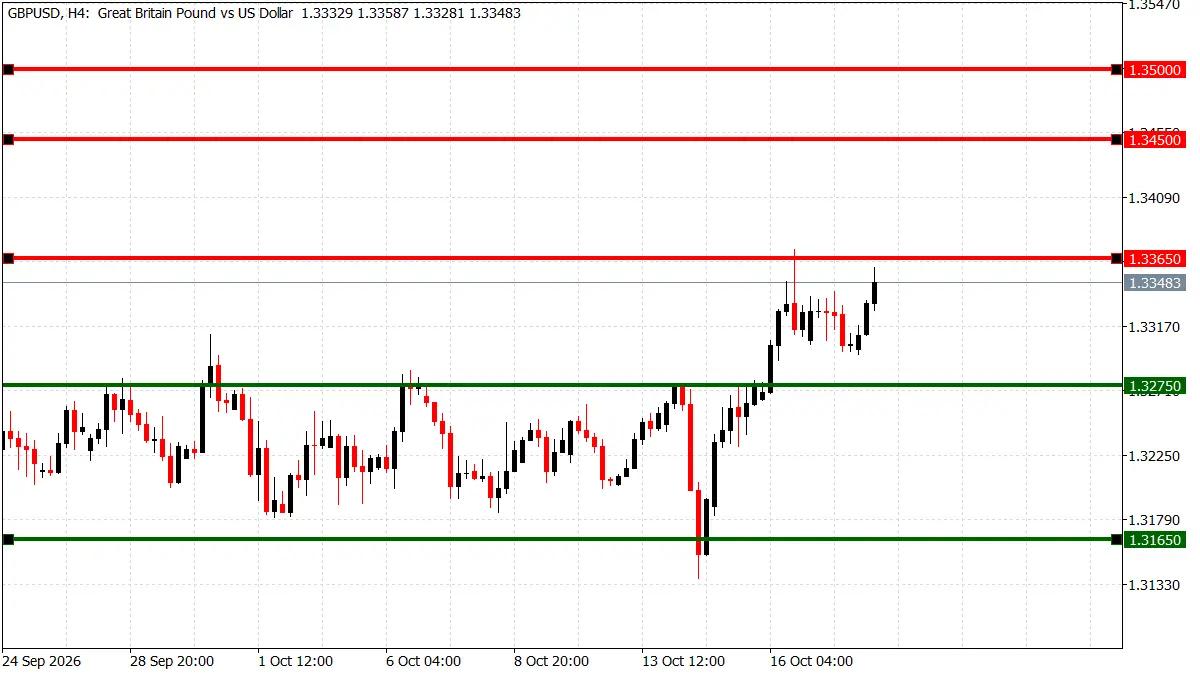
GBP/USD fell from around 1.3500 in mid-September to the 1.3200 area, where it traded in a range for most of late September and early October. The pair dipped to about 1.3165 on 14 October, then rebounded to a high near 1.3375 on 16 October. After a brief pullback, it was trading near 1.3350 at the time of writing, just below that high. The pound edged higher after the jobs data on 20 October.
Because GBP/USD shows how many US dollars one British pound buys, a rising pair means a stronger pound. The pair has been trading in a broad 1.3275–1.3450 range. Reference levels traders are watching:
- 1.3500: the mid-September high
- 1.3450: the area where the September decline accelerated
- 1.3365: the 16 October high area, close to the current price
- 1.3275: the top of the late September and early October range
- 1.3200: the floor of that range
- 1.3165: the 14 October low
A hotter inflation report could support the pound and lift GBP/USD towards 1.3450 and 1.3500. A softer report could weigh on sterling and pull the pair back towards 1.3275 and 1.3200. A headline surprise driven mainly by fuel may produce a shorter-lived move than one where core and services inflation also surprise, so the market may react twice: first to the headline, then to the detail. US data and the broader dollar trend can also outweigh UK news on the day.
All levels are context markers, not entry or exit points, and should be checked against a live price feed.
Monitor and Trade UK Markets with TIOmarkets
Monitor and trade GBP pairs, the FTSE 100, and UK Gilts with TIOmarkets under competitive trading conditions on MT4, MT5, and the TIOmarkets mobile app.
Trading is risky
Three scenarios for the UK CPI release
In this table, "better" and "worse" describe inflation for households and the Bank's 2% target, not the direction of the pound. Higher-than-expected inflation tends to support sterling because it can raise rate-hike expectations.
| Better than expected (lower inflation) | As expected | Worse than expected (higher inflation) |
| What it could look like: Headline at 3.2% or lower, or core at 2.6% or lower with services easing | What it could look like: Headline around 3.3–3.4% and core around 2.7–2.8% | What it could look like: Headline at 3.5% or higher, core at 2.9% or higher and services firming |
| Possible market reaction: The pound could weaken as rate-hike expectations fade; GBP/USD could move towards 1.3275–1.3200, and short-dated gilt yields could fall | Possible market reaction: A limited or choppy first move, with GBP/USD likely to stay within 1.3275–1.3450 as attention shifts to services details and the 5 November decision | Possible market reaction: The pound could strengthen as rate-hike expectations rise; GBP/USD could move towards 1.3450–1.3500, and short-dated gilt yields could rise |
| What could change the reading: Sticky services inflation, strong wage data or renewed energy-price rises | What could change the reading: A large surprise in services or a single component hidden by rounded headline rates | What could change the reading: A rise driven only by fuel, softer services detail or a global risk-off move |
Scenario thresholds are editorial guideposts, not forecasts or trading recommendations.
For UK shares, higher rate expectations can weigh on interest-sensitive domestic companies, while a stronger pound can reduce the sterling value of overseas earnings for some large FTSE 100 companies. A softer report could have the opposite effect.
What comes next: the Bank of England decision
The CPI report is the last major UK data release before the Bank of England announces its November rate decision, alongside new economic forecasts in its Monetary Policy Report, at 12:00 UTC on Thursday 5 November. Policymakers will then have both the latest labour and inflation data. Follow our Bank of England preview on the TIOmarkets market analysis blog ahead of the meeting.
Key dates to watch
- Wednesday 21 October, 06:00 UTC: UK consumer price inflation for September
- Thursday 5 November, 12:00 UTC: Bank of England rate decision and Monetary Policy Report
- Wednesday 18 November, 07:00 UTC: UK consumer price inflation for October, the first release to capture the 1 October Ofgem price cap rise
Risks and uncertainties
Inflation data are rounded and individual components can be volatile, so apparently small surprises may conceal meaningful detail. The working consensus can also change close to release time. Energy prices can affect inflation directly and indirectly, but the size and timing of pass-through are uncertain.
The market's reaction can also depend on positioning, liquidity and global news at the same time, and prices can jump and spreads widen around 06:00 UTC.
Conclusion
The 21 October report is likely to show whether UK inflation in September remained mainly an energy story or started to look broader. Headline CPI will set the first tone, but core and services inflation should decide how lasting that reaction is. With three Bank of England policymakers already voting for a rate rise and unemployment falling unexpectedly to 4.7%, a broad upside surprise could revive hike expectations and support the pound ahead of the 5 November decision, while a softer report could keep the Bank on hold. The Ofgem cap rise belongs to the October data, making the 18 November release the next important test.

FAQ
Risk disclaimer: CFDs are complex instruments and come with a high risk of losing money rapidly due to leverage. You should consider whether you understand how CFDs work and whether you can afford to take the high risk of losing your money. Never deposit more than you are prepared to lose. Professional client’s losses can exceed their deposit. Please see our risk warning policy and seek independent professional advice if you do not fully understand. This information is not directed or intended for distribution to or use by residents of certain countries/jurisdictions including, but not limited to, USA & Countries included in the OFAC sanction list. The Company holds the right to alter the aforementioned list of countries at its own discretion.
TIOmarkets offers an exclusively execution-only service. The views expressed are for information purposes only. None of the content provided constitutes any form of investment advice. The comments are made available purely for educational and marketing purposes and do NOT constitute advice or investment recommendation (and should not be considered as such) and do not in any way constitute an invitation to acquire any financial instrument or product. TIOmarkets and its affiliates and consultants are not liable for any damages that may be caused by individual comments or statements by TIOmarkets analysis and assumes no liability with respect to the completeness and correctness of the content presented. The investor is solely responsible for the risk of his/her investment decisions. The analyses and comments presented do not include any consideration of your personal investment objectives, financial circumstances, or needs. The content has not been prepared in accordance with any legal requirements for financial analysis and must, therefore, be viewed by the reader as marketing information. TIOmarkets prohibits duplication or publication without explicit approval.
Join us on social media


Authors BIO

An experienced financial analyst and educator with over 8 years of expertise covering gold, forex, and global financial markets. Ahmed specializes in blending price action analysis with macroeconomic data to accurately interpret market movements, providing readers with comprehensive educational insights into trading and the financial world.