


What Is OPEC+? Output Targets vs the Barrels Delivered
BY TIOmarkets
|November 4, 2026OPEC+ is the alliance of the Organization of the Petroleum Exporting Countries (OPEC) and ten non-OPEC producers that coordinates oil output under the Declaration of Cooperation of 10 December 2016. The practical answer to what is OPEC+, for traders in WTI and Brent, is a body whose decisions change expected supply, although an announced target is not the oil that actually leaves or enters the market.
What follows covers its members, quota mechanics and meetings, the gap between targets and output, and how to test a statement against data. It is written for traders who follow US Oil (WTI) and UK Oil (Brent) and want to understand the group behind the headlines.
What Is OPEC+? A Supply Alliance Behind WTI and Brent
OPEC+, also written OPEC plus, matters through its size: in 2022, OPEC and OPEC+ countries produced about 59% of global oil output, or 48 million barrels per day (b/d). Its targets shift the expected balance of supply and demand, which is why its meetings feature in any WTI crude oil market analysis. A quota caps output; it does not measure it.
OPEC+ Members, Origins and the Declaration of Cooperation
OPEC, the older body, was set up in 1960 by Iraq, Iran, Kuwait, Saudi Arabia and Venezuela. Its wider alliance took shape after the downturn that began in 2014, when climbing US shale oil production helped push prices lower. Following the Algiers Accord, OPEC agreed on 30 November 2016 to adjust its own production by 1.2 mb/d (million barrels per day) from 1 January 2017.
On 10 December 2016, Vienna hosted OPEC ministers alongside Azerbaijan, Bahrain, Brunei Darussalam, Equatorial Guinea (later an OPEC member), Kazakhstan, Malaysia, Mexico, Oman, Russia, Sudan and South Sudan. The outside producers pledged a combined reduction of 558,000 barrels a day for six months, extendable by six more, and two of them took seats on the Ministerial Monitoring Committee, chaired by Kuwait with Russia as alternate chair. That pact, the Declaration of Cooperation (DoC), is the framework now called OPEC+.
The OPEC vs OPEC+ distinction is organisation versus agreement: non-OPEC signatories coordinate output without joining. Membership counts shift, from 23 OPEC+ countries in December 2022 to 21 in the full group due to meet on 29 November 2026, and Iran and Libya have been exempt from recent quotas.
How OPEC+ Production Quotas Work and When Ministers Meet
Understanding how OPEC+ production quotas work begins with the baseline, the reference level from which each member's cuts or increases are measured. A generous baseline makes a quota look like a deep cut without removing extra oil. A capacity review due in the fourth quarter of 2026 precedes the 2027 baselines that set future quotas.
OPEC+ quotas are handled at two levels. A full ministerial OPEC+ meeting sets group-wide policy, while Saudi Arabia, Russia, Iraq, Kuwait, Kazakhstan, Algeria and Oman manage voluntary adjustments and agreed on 6 September 2026 to meet monthly. On 1 November 2026 they kept September's required production for December, including 10.478 million b/d for Saudi Arabia, 9.949 million b/d for Russia and 4.431 million b/d for Iraq. These are permitted volumes, not measured ones.
Why Does OPEC Cut Production?
Producers cut when they judge the market oversupplied, as in the slump behind the 2016 agreement, and later reverse course. A 1.65 million b/d cut first agreed in 2023 was unwound in stages by September 2026, while about 2 million b/d of cuts covering most members run to the end of 2026. Withheld oil becomes spare capacity.
Quota vs Actual Output: Compliance, Spare Capacity and Voluntary Cuts
OPEC+ compliance with production cuts is judged on estimated output, not pledges. OPEC's Monthly Oil Market Report gives crude production by DoC participants from secondary sources, independent estimates used in place of members' self-reported figures. They can swing widely: about 33.19 mb/d in April 2026, about 33.13 mb/d in May, 36.28 mb/d in June and about 37.66 mb/d in July.

Three mechanisms separate headline from barrels. A member already below its new quota cuts nothing in practice, so part of the reduction exists only on paper. Overproducers dilute the effort, which is why the group seeks compensation cuts: extra reductions offsetting earlier excess output. Voluntary cuts by a subset sit on top of group quotas and unwind on their own timetable.
Spare capacity, output a producer could restore within 30 days and hold for at least 90, sets a further limit; Saudi Arabia has traditionally held the most. A thin cushion tends to add a risk premium to prices and a deep one to calm volatility. A member near its maximum cannot deliver what a higher quota permits.
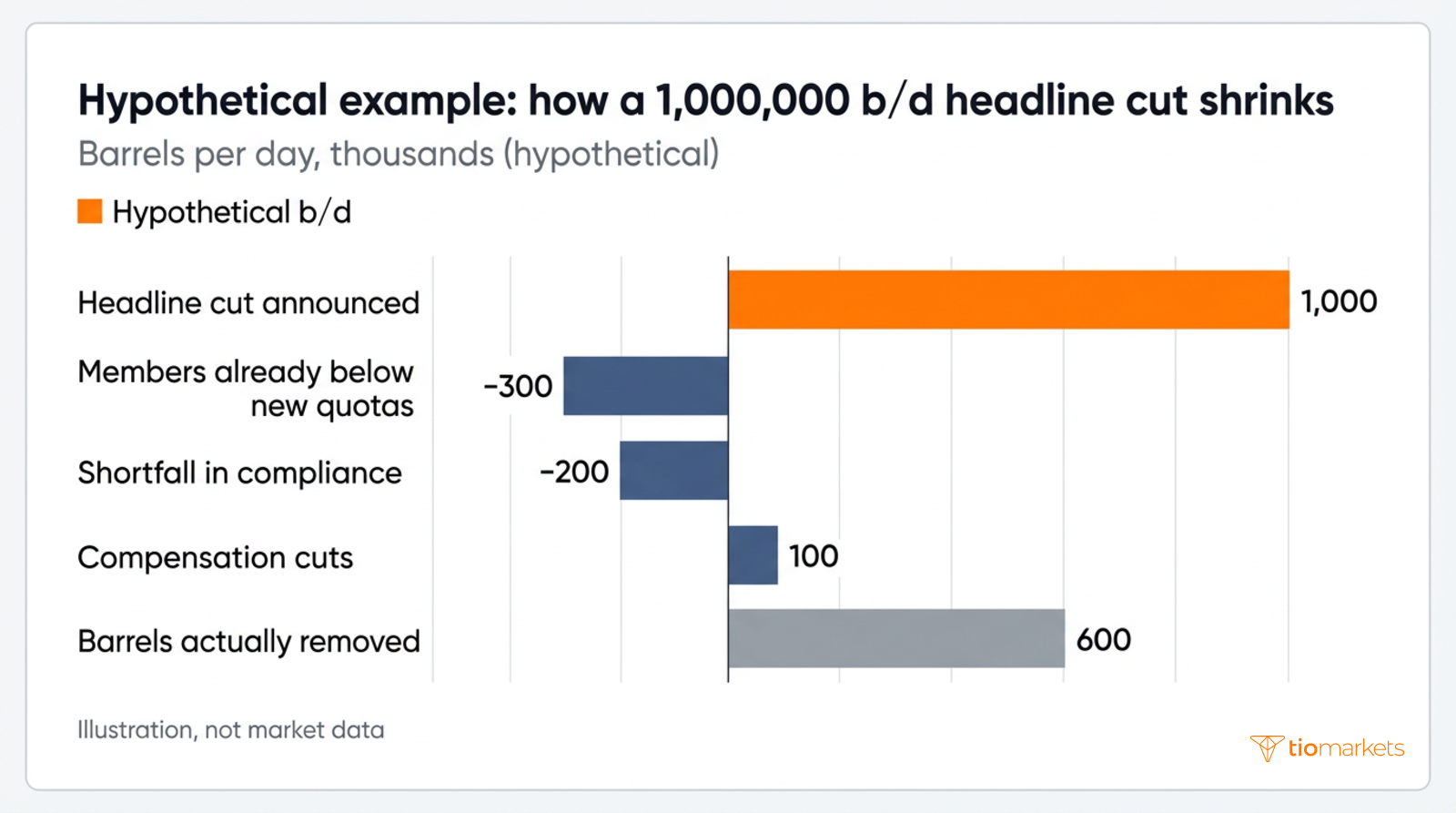
In a hypothetical case, the group announces a 1,000,000 b/d cut. Members accounting for 300,000 b/d were already below their new quotas, and others fall 200,000 b/d short of compliance. Compensation cuts add 100,000 b/d, so 600,000 b/d leaves the market, 60% of the headline.
OPEC+ Cuts and Brent Crude: How a Decision Reaches Prices
How OPEC decisions affect oil prices depends on expected supply and, above all, on surprise: a cut the market anticipated may already be in the price, so the reaction follows the gap between forecast and outcome. Brent, the benchmark for seaborne crude, responds most directly to changes in exported barrels. WTI crude also reflects US shale output and stocks at Cushing, Oklahoma, its delivery hub, so the link between OPEC and oil prices can look weaker there.
| What the chart or market shows | The approach traders use for it | Main risk |
| A cut larger than expected | Checking it against baselines, compliance records and members already below quota | A paper cut removing far fewer barrels than the headline |
| A hold, with required production unchanged | Reading the statement for compensation plans, rollback schedules and the next meeting date | Assuming unchanged quotas mean unchanged output |
| An increase or rollback of earlier cuts | Weighing the added quota against each member's spare capacity | Members adding fewer barrels than announced |
| A voluntary cut by a subset of members | Separating voluntary adjustments from group-wide quotas | Double-counting cuts that overlap earlier pledges |
How to Read an OPEC+ Statement Alongside Inventory Data
A statement declares intentions; data tests them, chiefly the API weekly crude inventory report and the EIA's weekly US stock figures. The API report of 27 October 2026, for the week to 23 October, showed crude stocks down 2.031 million barrels after a 4.931 million draw the week before, with Cushing 453,000 barrels lower.
Checking a meeting statement against that data takes five steps:
- Identify who decided: the full ministerial group or a subset, such as the seven countries managing voluntary adjustments.
- Note each country's required production, the month it covers, and any compensation cuts or phased rollbacks.
- Compare the decision with what the market expected beforehand.
- Check secondary-source output in OPEC's next Monthly Oil Market Report against the quota.
- Follow API and EIA crude stock changes over several weeks, not one release.
The method lags: US stocks also reflect refinery runs, imports and exports, so they register OPEC+ supply only indirectly and weeks after a decision.
Limits of OPEC+ Influence and Common Mistakes
OPEC+ shapes supply but does not set the price. US shale output lies outside any quota, and demand depends on economic activity no producer controls. Most misreadings come from the gap between pledges and barrels:
- Paper cuts. Counting headline OPEC+ production cuts as barrels removed when members were already below quota.
- Ignoring expectations. Judging a decision alone rather than against what was anticipated.
- Over-reading one meeting. The core group revisits quotas monthly, and baselines change after capacity reviews.
- Merging decisions. Treating a subset's voluntary adjustment as a change to every member's quota.
Conclusion
OPEC+ matters because it coordinates a large share of world supply, yet its statements describe intentions rather than delivered barrels. Baselines, compliance, compensation and spare capacity decide the real change, markets price it against what they already assumed, and the verdict arrives weeks later in output estimates and inventory data.
Reading OPEC+ this way explains how a decision becomes supply, not where Brent or WTI will trade, because shale output and demand also move prices and estimates are revised. Oil can gap sharply on a statement. Where exposure comes through leveraged CFDs (contracts for difference), leverage magnifies losses as well as gains, and losses can build quickly in such a gap. Traders can lose all the money they deposit, and the lot size chosen for Brent crude governs how fast that can happen.
FAQ
Risk disclaimer: CFDs are complex instruments and come with a high risk of losing money rapidly due to leverage. You should consider whether you understand how CFDs work and whether you can afford to take the high risk of losing your money. Never deposit more than you are prepared to lose. Professional client’s losses can exceed their deposit. Please see our risk warning policy and seek independent professional advice if you do not fully understand. This information is not directed or intended for distribution to or use by residents of certain countries/jurisdictions including, but not limited to, USA & Countries included in the OFAC sanction list. The Company holds the right to alter the aforementioned list of countries at its own discretion.
TIOmarkets offers an exclusively execution-only service. The views expressed are for information purposes only. None of the content provided constitutes any form of investment advice. The comments are made available purely for educational and marketing purposes and do NOT constitute advice or investment recommendation (and should not be considered as such) and do not in any way constitute an invitation to acquire any financial instrument or product. TIOmarkets and its affiliates and consultants are not liable for any damages that may be caused by individual comments or statements by TIOmarkets analysis and assumes no liability with respect to the completeness and correctness of the content presented. The investor is solely responsible for the risk of his/her investment decisions. The analyses and comments presented do not include any consideration of your personal investment objectives, financial circumstances, or needs. The content has not been prepared in accordance with any legal requirements for financial analysis and must, therefore, be viewed by the reader as marketing information. TIOmarkets prohibits duplication or publication without explicit approval.
Join us on social media


Authors BIO

Behind every blog post lies the combined experience of the people working at TIOmarkets. We are a team of dedicated industry professionals and financial markets enthusiasts committed to providing you with trading education and financial markets commentary. Our goal is to help empower you with the knowledge you need to trade in the markets effectively.





