


BOJ Interest Rate Decision: Hold Expected, December in Focus
BY Ahmed Osama
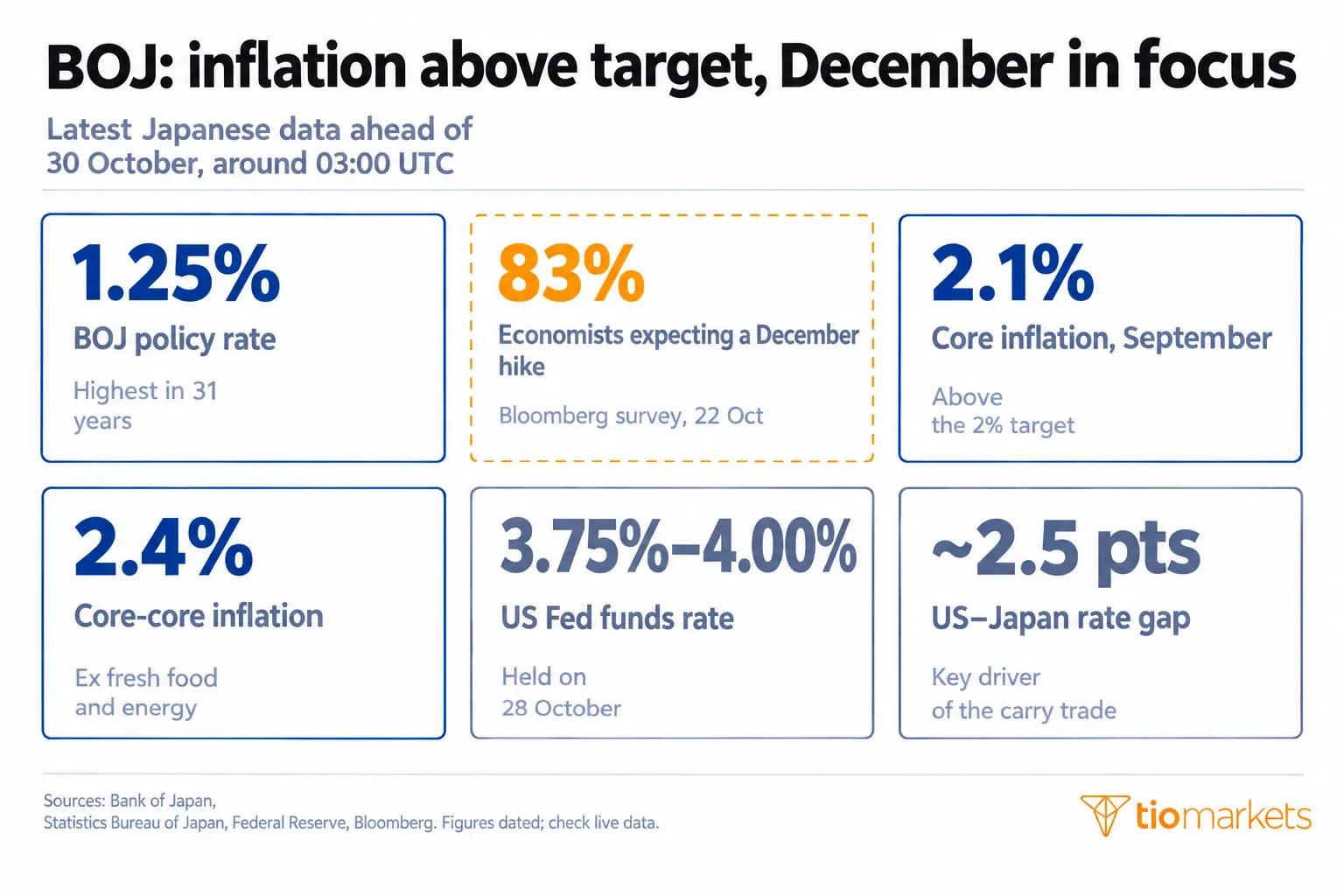
|October 29, 2026The Bank of Japan announces its next interest rate decision on Friday 30 October, around 03:00 UTC, six weeks after raising its policy rate to 1.25%, the highest in 31 years. A hold is widely expected, so the key question for the yen and Japanese stocks is how strongly the BOJ signals a further rise in December, with inflation back above its 2% target, oil above $100 a barrel and USD/JPY trading near 158.
BOJ interest rate decision in brief
- The BOJ concludes its two-day meeting on Friday 30 October and usually announces its decision around 03:00 UTC, as shown on our economic calendar. It also publishes its quarterly Outlook Report, and Governor Kazuo Ueda holds a press conference later the same day.
- None of the economists in a Bloomberg survey published on 22 October expected a rise this week, while 83% expected the next increase in December.
- Japan's core inflation rose to 2.1% in September, above the BOJ's 2% target for the first time since December, while core-core inflation, which also excludes energy, rose to 2.4%.
- The US Federal Reserve kept its rate at 3.75%–4.00% on 28 October in a 10–2 vote, without committing to a December rise.
- USD/JPY has traded mostly between 156 and 159.5 in October, while the Nikkei 225 has rebounded to around 64,600 after a sharp fall in the second half of the month.
What is the BOJ interest rate decision and when is it announced?
The Bank of Japan's Policy Board sets the short-term policy rate, the overnight interest rate that influences borrowing costs across Japan and the value of the yen. Because Japanese rates remain far below those in the United States, the BOJ interest rate decision is one of the most important events for traders of USD/JPY, other yen pairs and the Nikkei 225.
The October meeting runs on 29–30 October. Unlike most central banks, the BOJ does not announce its decision at a fixed time. It is usually released around 03:00 UTC on the final day, as shown on our economic calendar, but it can come earlier or later. This meeting includes the quarterly Outlook for Economic Activity and Prices, with updated growth and inflation forecasts.
What markets and economists expect
A hold is the clear consensus. A Bloomberg survey published on 22 October found that no economists expected a rise this week, while 83% expected the next quarter-point increase, to 1.50%, in December. Analysts polled by Reuters also expect a move in December, followed by a roughly quarterly pace of increases.
The Nikkei reported on 23 October that the BOJ plans to hold, quoting a senior official as saying back-to-back increases were out of the question unless the situation became extremely urgent. Ahead of the BOJ interest rate decision, attention has therefore shifted to how clearly the bank prepares markets for its next move, and whether that comes in December or January.
Why this BOJ interest rate decision matters after the September hike
The BOJ raised its policy rate to 1.25% from 1.00% on 18 September in a 7–2 vote, its second increase in three months and the highest level in 31 years. Governor Ueda said at the time that the focus had shifted from lifting inflation toward 2% to preventing it from overshooting the target.
Inflation data since then support that shift. Japan's core inflation, which excludes fresh food, rose to 2.1% in September from 1.7% in August, back above the BOJ's 2% target for the first time since December. Core-core inflation, which excludes fresh food and energy and is closely watched by the BOJ, rose to 2.4% from 1.9%, above the 2.3% forecast. In Tokyo, which releases data earlier, core inflation reached 2.7% in September.
The BOJ's policy rate is now within the 1.1%–2.5% range its staff estimate for Japan's neutral rate, the level that neither stimulates nor restrains the economy. In simple terms: rates are no longer clearly stimulative, but with inflation above target and lending still strong, most economists expect at least one or two more increases.
How oil prices are feeding Japanese inflation
Japan imports almost all of its oil, so higher crude prices quickly raise costs for households and businesses. Brent crude has held above $100 a barrel and climbed to near six-month highs in late October, as conflict in the Middle East kept supply risks in focus. A weak yen adds to the pressure by making imported energy more expensive in local terms.
Government fuel subsidies have helped limit the impact at the pump, but reports say the government plans to end them by December, which could push inflation higher in the coming months. Japan's trade deficit also widened in September, reflecting higher import bills. That combination of oil, a weak currency and expiring subsidies is one reason the BOJ is watching for an inflation overshoot ahead of the BOJ interest rate decision.
What the Fed decision means for the yen
The Fed kept its target range at 3.75%–4.00% on 28 October in a 10–2 vote, with two dissents underlining a tightening bias. Its statement said more information would help it decide the appropriate policy stance, but it did not commit to raising rates in December, and Chair Kevin Warsh repeated that he does not favour signalling the future path of rates.
For USD/JPY, the gap between US and Japanese interest rates remains wide, at around 2.5 to 2.75 percentage points. A Fed that keeps the door open to another rise, combined with a cautious BOJ, would keep that gap wide and support the dollar against the yen. Our Fed interest rate decision preview explains the background to the US meeting.
The yen carry trade: why rate gaps matter
A carry trade involves borrowing in a low-interest currency, such as the yen, to hold assets in a higher-yielding currency, such as the US dollar. While Japanese rates stay well below US rates, this strategy tends to add steady selling pressure on the yen, which is one reason USD/JPY has stayed high even as the BOJ raised rates.
The risk comes when the gap starts to narrow or markets turn risk-averse. In August 2024, for example, a BOJ rate rise combined with weak US jobs data triggered a rapid unwinding of carry positions, a sharp rise in the yen and a steep fall in Japanese stocks. A more hawkish BOJ interest rate decision, or a softer Fed, could revive that risk. For CFD traders, the rate gap also affects overnight financing: holding a USD/JPY position overnight can earn or cost a swap, depending on its direction.
Four things to watch on 30 October
1. The decision and the vote
A hold at 1.25% is widely expected. Dissents in favour of a rise, as in September, would suggest a December move is more likely.
2. The Outlook Report
The BOJ is expected to signal that inflation has reached a level consistent with its 2% target. Higher inflation forecasts, or language about overshoot risks, would support expectations of further rises.
3. Governor Ueda's press conference
Any hint about December, or about how far rates may need to rise toward neutral, may move the yen and the Nikkei more than the decision itself.
4. Tokyo inflation just before the decision
October inflation data for Tokyo are due at 23:30 UTC on Thursday 29 October, a few hours before the BOJ. A strong reading could add to expectations of a December move.
How the BOJ interest rate decision could move USD/JPY
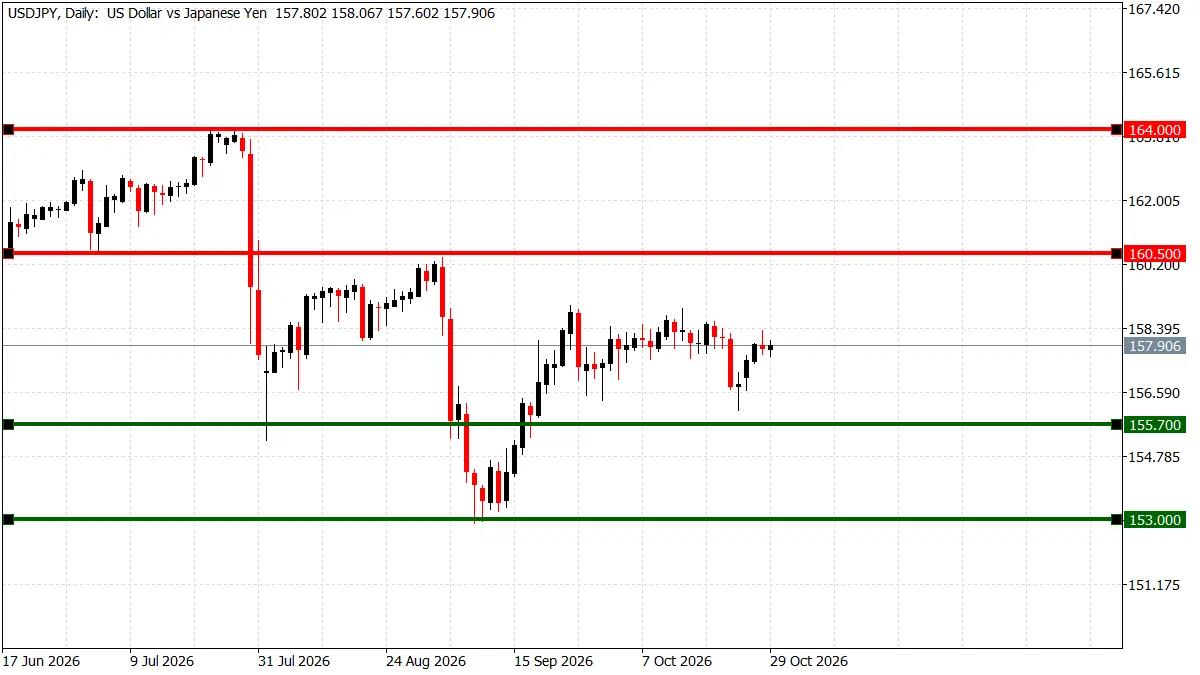
USD/JPY shows how many yen one US dollar buys, so a falling pair means a stronger yen. The pair climbed to near 164 in July before dropping sharply, then fell to the 153 area in early September. It recovered to around 159 in late September and has since traded mostly between 156 and 159.5, standing around 158 at the time of writing.
USD/JPY has traded within a broad 153–164 range since July. Reference levels traders are watching:
- 164.00: the July high area
- 160.50: the late-August high and the top of the recent trading area
- 155.70: the support area below the October lows
- 153.00: the early-September low area
A more hawkish BOJ could strengthen the yen and push USD/JPY toward 155.70 and 153.00. A more dovish outcome could weaken the yen and lift the pair toward 160.50 and possibly 164.00. Traders also watch for warnings from Japan's Ministry of Finance when the yen weakens quickly, as it has intervened in the currency market in the past.
How the BOJ interest rate decision could move the Nikkei 225
The Nikkei 225 tracks 225 major companies listed in Tokyo, many of them large exporters whose overseas earnings are worth more in yen when the currency is weak. That makes the index sensitive to BOJ signals: a stronger yen can weigh on exporters, while higher rates can support bank shares.
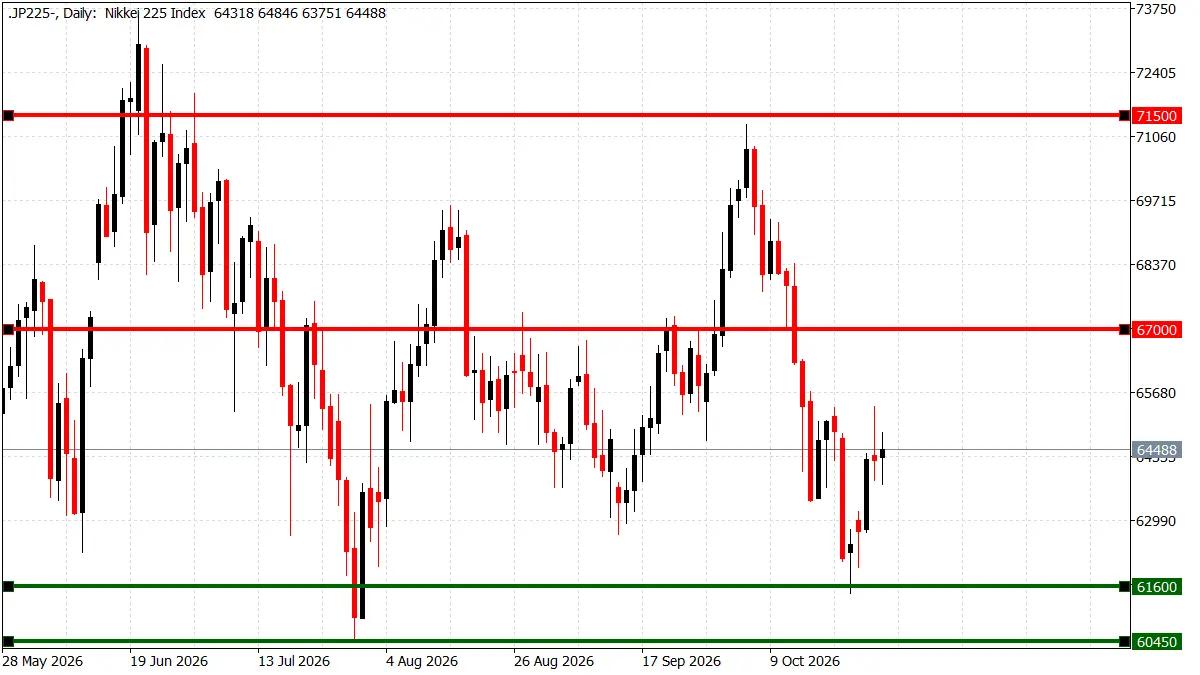
The index rose from around 56,000 in April to a peak near 73,000 in June, then fell to the 60,500 area in late July. It traded mostly between 62,000 and 69,000 in August and September, rallied to near 71,500 in early October, then dropped sharply in the second half of the month to around 61,600. It has since rebounded to around 64,600.
The Nikkei 225 has traded within a broad 60,000–71,500 range since July. Reference levels traders are watching:
- 71,500: the early-October high area
- 67,000: the mid-October area where the decline accelerated
- 61,600: the late-October low area
- 60,450: the late-July low area
A more hawkish BOJ that lifts the yen could weigh on the index and push it back toward 61,600 and 60,450. A more cautious tone that keeps the yen weak could support a recovery toward 67,000 and possibly 71,500. You can learn more about trading the Nikkei 225 (JP225) with TIOmarkets.
Trade USD/JPY and the Nikkei 225 with TIOmarkets
Take your position on major currencies and global indices via CFDs. Enjoy tight spreads, fast execution, and fast, flexible funding options.
Trading is risky
Three scenarios: better than expected, as expected or worse than expected
In this table, "better" means a softer, more dovish outcome than markets expect, and "worse" means a tighter, more hawkish one, from the perspective of borrowing costs. A more hawkish outcome tends to support the yen, which means a lower USD/JPY, and can weigh on Japanese exporters.
| Scenario | What it could look like | Possible market reaction | What could change the reading |
| Better than expected (more dovish) | A unanimous hold, with cautious language and no hint about the timing of the next rise | The yen could weaken as December hike bets shift toward January; USD/JPY could rise toward 160.50–164.00 and the Nikkei 225 could recover toward 67,000 | Warnings from Japanese officials about rapid yen weakness, or a sharp fall in US yields |
| As expected | A hold at 1.25%, with the Outlook Report and Ueda keeping a December or January rise in view | First moves may be limited; USD/JPY could stay within 155.70–160.50 and the Nikkei 225 within 61,600–67,000 as attention shifts to US data and the December meetings | A strong Tokyo inflation reading or dissents in favour of a rise |
| Worse than expected (more hawkish) | A surprise rise to 1.50%, or a hold with clear signals that December is likely | The yen could strengthen sharply as carry positions are reduced; USD/JPY could fall toward 155.70–153.00 and the Nikkei 225 toward 61,600–60,450 | Strong US data that lifts Treasury yields, or broad gains in the US dollar |
A mixed message may create the hardest reaction
The most difficult BOJ interest rate decision to read is a split signal, such as a hold with hawkish dissents but a cautious press conference. Because the BOJ's announcement time is not fixed and the decision comes during Asian trading hours, liquidity can be thinner, spreads can widen and prices can move sharply in either direction before settling.
Key events to watch
- Thursday 29 October, 23:30 UTC: Tokyo inflation data for October
- Friday 30 October, around 03:00 UTC: BOJ interest rate decision and Outlook Report
- Friday 30 October: Governor Ueda's press conference, later the same day
- Tuesday 3 November: US midterm elections
- Friday 6 November, 13:30 UTC: US jobs report for October
- Wednesday 9 December: the next Fed rate decision
- Friday 18 December: the next BOJ decision, at the end of its 17–18 December meeting
Risks and uncertainties
With a hold widely expected, the reaction may depend mainly on the BOJ's guidance and the tone of the press conference. Oil prices remain highly sensitive to developments in the Middle East, and a sharp move in energy could change Japan's inflation outlook quickly. US data, the Fed's path, global stock-market sentiment and possible official warnings about the yen can all outweigh the BOJ's influence on USD/JPY and the Nikkei 225.
Market direction is not mechanical. Positioning, liquidity and global risk sentiment can outweigh the usual relationship between central-bank signals and markets, and a rapid unwinding of carry trades can cause sudden, large moves in both the yen and Japanese stocks.
Conclusion
A hold on 30 October is widely expected, so the real test of this BOJ interest rate decision lies in its signal for December. Inflation above target, oil above $100 and expiring fuel subsidies support further rises, while the BOJ wants more time to assess its September move. A clear hint toward December could support the yen, pressure USD/JPY and weigh on Japanese exporters, while a cautious tone could keep the pair near the top of its range and help the Nikkei 225 extend its rebound, especially with the Fed still leaning toward tighter policy.

FAQ
Risk disclaimer: CFDs are complex instruments and come with a high risk of losing money rapidly due to leverage. You should consider whether you understand how CFDs work and whether you can afford to take the high risk of losing your money. Never deposit more than you are prepared to lose. Professional client’s losses can exceed their deposit. Please see our risk warning policy and seek independent professional advice if you do not fully understand. This information is not directed or intended for distribution to or use by residents of certain countries/jurisdictions including, but not limited to, USA & Countries included in the OFAC sanction list. The Company holds the right to alter the aforementioned list of countries at its own discretion.
TIOmarkets offers an exclusively execution-only service. The views expressed are for information purposes only. None of the content provided constitutes any form of investment advice. The comments are made available purely for educational and marketing purposes and do NOT constitute advice or investment recommendation (and should not be considered as such) and do not in any way constitute an invitation to acquire any financial instrument or product. TIOmarkets and its affiliates and consultants are not liable for any damages that may be caused by individual comments or statements by TIOmarkets analysis and assumes no liability with respect to the completeness and correctness of the content presented. The investor is solely responsible for the risk of his/her investment decisions. The analyses and comments presented do not include any consideration of your personal investment objectives, financial circumstances, or needs. The content has not been prepared in accordance with any legal requirements for financial analysis and must, therefore, be viewed by the reader as marketing information. TIOmarkets prohibits duplication or publication without explicit approval.
Join us on social media


Authors BIO

An experienced financial analyst and educator with over 8 years of expertise covering gold, forex, and global financial markets. Ahmed specializes in blending price action analysis with macroeconomic data to accurately interpret market movements, providing readers with comprehensive educational insights into trading and the financial world.