

PCE Inflation Preview: Will Core PCE Rise to 3.2%?
BY Ahmed Osama
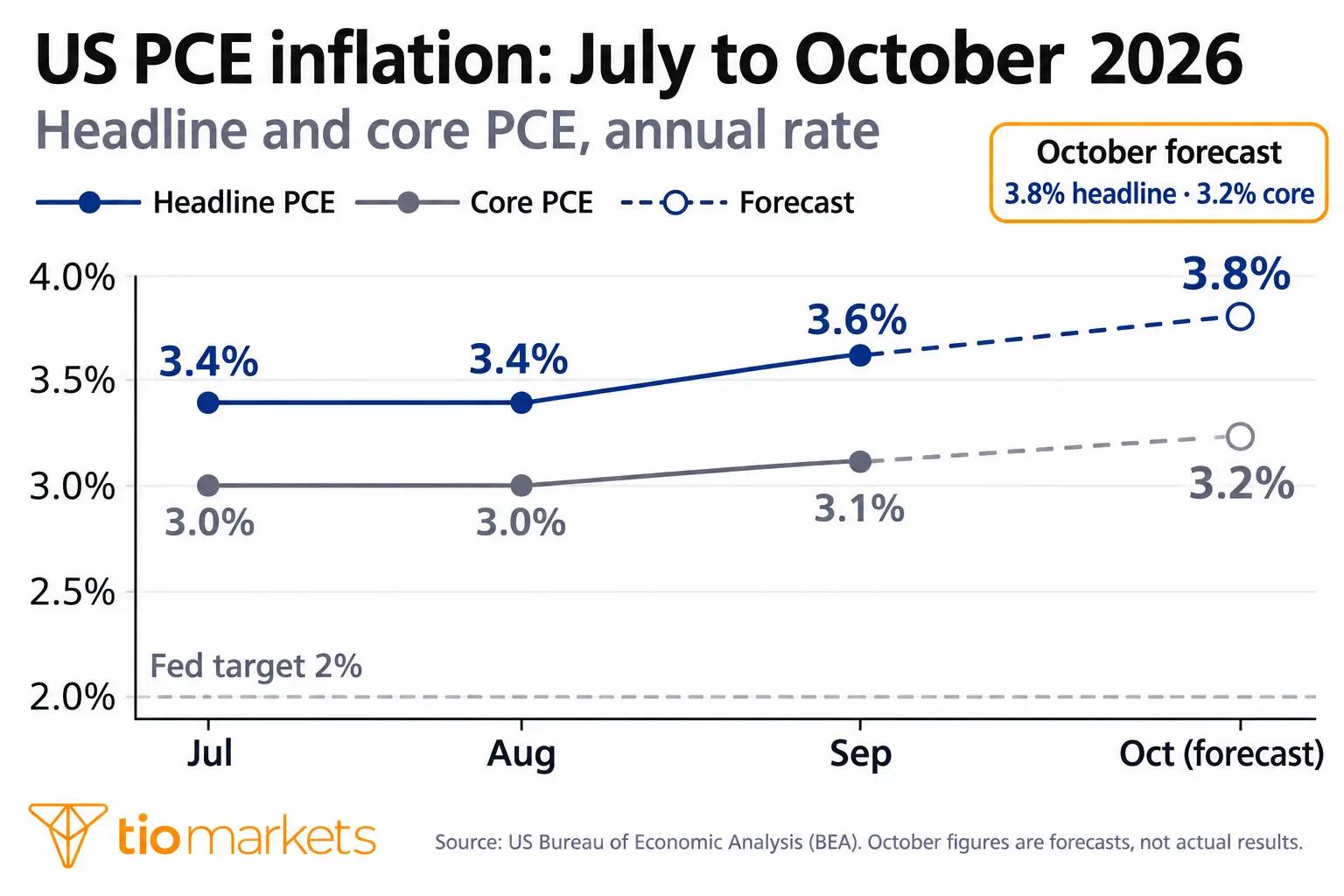
|November 24, 2026The US PCE inflation report for October is due at 13:30 UTC on Wednesday 25 November. Forecasts point to a 0.3% monthly rise in both headline and core PCE prices, which would lift annual PCE inflation to 3.8% from 3.6% and annual core PCE inflation to 3.2% from 3.1%. It is the last major inflation report before the Federal Reserve's 9 December decision, where markets widely expect a rate rise. After gold's sharpest weekly fall in eight months and a drop in EUR/USD below 1.1000, the data could set the tone for both into December.
PCE inflation report in brief
- The October PCE report is due at 13:30 UTC on Wednesday 25 November, together with personal income and spending data and an updated estimate of third-quarter GDP.
- Forecasts point to a 0.3% monthly rise in headline and core PCE prices. On an annual basis, PCE inflation is forecast at 3.8% and core PCE inflation at 3.2%.
- In September, PCE prices rose 0.5% on the month and 3.6% on the year, while core PCE rose 0.3% and 3.1%.
- The Fed's target range is 3.75% to 4.00%. CME FedWatch put the chance of a quarter-point rise on 9 December at about 95% on 24 November.
- Gold fell to about $3,514 on 20 November, its lowest level since September 2025, before rebounding toward $3,650. EUR/USD dropped to around 1.0900 on 23 November.
What is the PCE price index and when is it released?
The Personal Consumption Expenditures (PCE) price index measures the change in prices of goods and services bought by US households, or bought on their behalf, such as health care paid for by employers. It is published monthly by the Bureau of Economic Analysis (BEA) in its personal income and outlays report. Like the CPI, it has a headline figure covering all items and a core figure that excludes food and energy.
PCE inflation matters because it is the Fed's preferred inflation gauge: the Fed defines its 2% inflation goal using the annual change in the PCE price index. The October report is due at 13:30 UTC on Wednesday 25 November, as shown on our economic calendar.
What the forecasts show for October PCE inflation
| Indicator | Forecast (October) | Previous (September) |
| PCE price index, monthly | 0.3% | 0.5% |
| Core PCE price index, monthly | 0.3% | 0.3% |
| PCE price index, annual | 3.8% | 3.6% |
| Core PCE price index, annual | 3.2% | 3.1% |
Forecasts vary by source and may change before the release.
In simple terms: monthly price growth is expected to slow from September's 0.5%, but annual inflation is still forecast to rise, because October 2026 is being compared with a month last year when prices rose more slowly. A core reading of 3.2% would be above each of the previous three months and well above the Fed's 2% goal.
Why this PCE report matters for the Fed
The Fed raised its target range to 3.75%-4.00% in September and held it there on 28 October in a 10-2 vote, with two officials preferring a further rise. Since then, the case for a December rise has grown. Employers added 165,000 jobs in October, and the October CPI report showed consumer prices up 0.4% on the month against a 0.3% forecast, with core CPI up 0.3% for a third straight month. Our US CPI preview and NFP preview covered the expectations before those releases.
The minutes of the October meeting, released on 18 November, showed broad support among officials for further rate rises. Markets now widely expect a quarter-point rise on 9 December, while bets on a larger half-point move faded after last week's sharp fall in global stock markets. Our Fed interest rate decision preview explains the background.
With a December rise largely priced in, the PCE report matters most for what comes after. A higher-than-expected reading could revive talk of a bigger move or further rises in 2027, while a clear slowdown in core PCE could support the view that December may be the last rise for a while.
How PCE inflation differs from CPI
The two measures usually move in the same direction, but PCE inflation tends to run below CPI. PCE covers a wider range of spending, gives less weight to housing costs, and adjusts more quickly when households switch to cheaper products. This is one reason the Fed prefers it. Our guide on how CPI is calculated explains the CPI side in detail.
The October CPI report also carried no official annual inflation rate, because data from October 2025 were not collected during last year's government shutdown. That may give this PCE report, which includes annual rates, extra attention from markets.
Four things to watch in the PCE report
1. Core PCE on the month
The monthly change in core PCE is likely to matter most. A rise of 0.4% or more would suggest underlying inflation is speeding up, while 0.2% or less would point to some easing.
2. Headline PCE and energy
Headline PCE rose 0.5% in September as fuel prices climbed. A smaller rise is expected in October, so a headline figure above 0.3% would suggest price pressure is not easing.
3. Income, spending and savings
In September, personal income rose just 0.2%, income after taxes and inflation fell 0.3%, and the saving rate dropped to 3.8%, its lowest since October 2022. Weak spending would suggest high prices are starting to squeeze households.
4. Other data at the same time
The updated third-quarter GDP estimate (first estimate: 3.4% annualised growth) and weekly jobless claims are also due at 13:30 UTC. With US markets closed on Thursday for Thanksgiving, trading may be thinner than usual.
How the PCE report could move gold
Gold tends to react to inflation data through its effect on US interest rate expectations and the dollar. Higher-than-expected inflation can lift expectations of higher rates, strengthening the dollar and weighing on gold, which pays no interest. Lower-than-expected inflation can have the opposite effect.
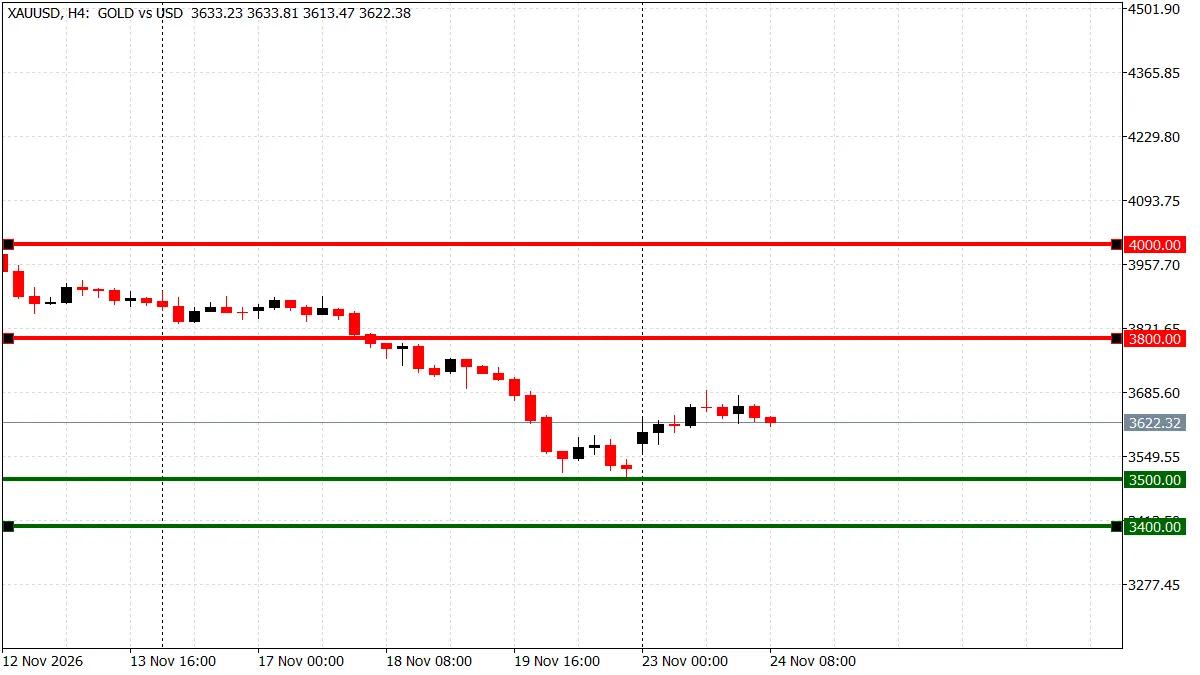
Gold has fallen sharply this month. It traded around $4,100 in early November, then dropped below $3,800 on 18 November as the Fed minutes, rising Treasury yields and a stronger dollar pushed investors out of the metal. On 20 November it touched about $3,514, its lowest level since September 2025, and posted its worst week in eight months. It rebounded more than 3% on 23 November as the dollar's rally paused, and on 24 November it was trading around $3,640 to $3,660.
Gold has been trading in a broad $3,400 to $4,000 range. Reference zones traders are watching:
- $3,980 to $4,000: the round-number resistance zone below the early-November highs
- $3,780 to $3,800: the zone where the sell-off accelerated on 18 November
- $3,500 to $3,520: the 20 November low zone, the lowest since September 2025
- $3,380 to $3,400: the next support zone below
A higher-than-expected PCE reading could push gold back toward $3,500 and $3,400. A lower-than-expected reading could support a further rebound toward $3,800 and possibly $4,000.
How the PCE report could move EUR/USD
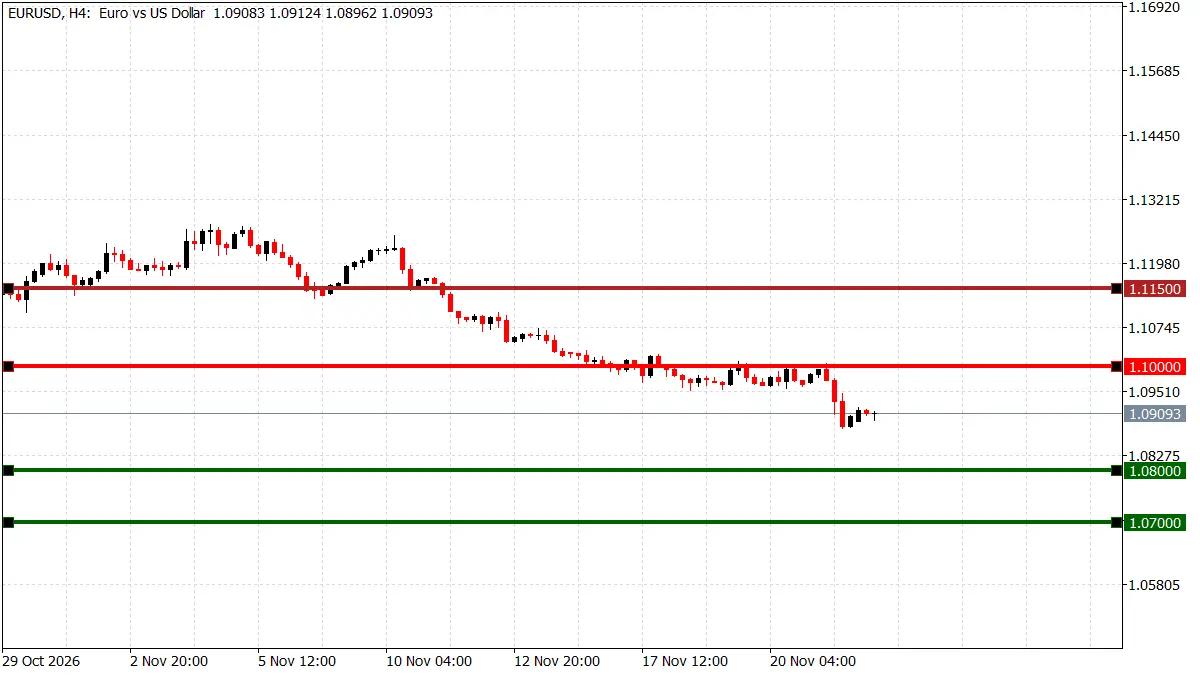
EUR/USD shows how many US dollars one euro buys, so a falling pair means a stronger dollar. The pair traded mostly between 1.1100 and 1.1300 in October and was still near 1.1140 in early November. It then slid as US rate expectations rose and the dollar climbed to its strongest level since April 2025, falling to around 1.0900 on 23 November, down about 2.5% over the past month. The European Central Bank kept its deposit rate at 2.50% in October, and its next decision is due on 17 December. Our ECB rate decision preview covers the euro side.
EUR/USD has been trading in a broad 1.0700 to 1.1150 range. Reference zones traders are watching:
- 1.1140 to 1.1150: the early-November resistance zone
- 1.1000 to 1.1010: the round-number zone near last week's highs
- 1.0800 to 1.0820: the first support zone below the current price
- 1.0700 to 1.0720: the next support zone below
A higher-than-expected PCE reading could lift the dollar and push EUR/USD toward 1.0800 and 1.0700. A lower-than-expected reading could lift the pair back toward 1.1000 and possibly 1.1150.
All levels are context markers, not entry or exit points, and should be checked against a live price feed.
Trade Gold and EUR/USD with TIOmarkets
Take your position on major currencies and metals via CFDs. Enjoy tight spreads, fast execution, and fast, flexible funding options.
Trading is risky
Three scenarios: better than expected, as expected or worse than expected
In this table, "better than expected" means lower inflation than forecast, and "worse than expected" means higher inflation than forecast, from the perspective of consumers and the Fed's inflation goal. Higher-than-expected inflation tends to support the US dollar, which often means a lower gold price and a lower EUR/USD.
| Scenario | What it could look like | Possible market reaction | What could change the reading |
| Better than expected | Core PCE up 0.2% or less on the month, or annual core PCE at 3.1% or lower, with annual PCE inflation at 3.7% or lower | The dollar and US yields could ease as talk of further rises after December fades; gold could rebound toward 3,800 to 4,000 and EUR/USD toward 1.1000 to 1.1150 | Strong spending or an upward revision to GDP |
| As expected | Headline and core PCE up about 0.3% on the month, with annual rates near 3.8% and 3.2% | First moves may be limited, with a December rise still widely expected; gold could stay within 3,500 to 3,800 and EUR/USD within 1.0800 to 1.1000 | The details: services prices, spending and the GDP update |
| Worse than expected | Core PCE up 0.4% or more on the month, or annual core PCE at 3.3% or higher, with annual PCE inflation at 3.9% or higher | The dollar and US yields could rise as talk of a larger rise or further rises returns; gold could fall toward 3,500 to 3,400 and EUR/USD toward 1.0800 to 1.0700 | A rise driven only by volatile items, or a sharp fall in spending |
Scenario thresholds are editorial guideposts, not forecasts or trading recommendations.
A mixed report may create the hardest reaction
The most difficult outcome to read is a mixed one, for example a slower headline figure because of energy prices but a faster rise in core PCE, or inflation in line with forecasts alongside weak spending. In that case, the first move in the dollar may reverse as traders look at all the details together. Liquidity can thin around 13:30 UTC, and even more so ahead of the Thanksgiving holiday, which can widen spreads and cause slippage.
Key events to watch
- Wednesday 25 November, 13:30 UTC: US PCE inflation, personal income and spending for October, the updated third-quarter GDP estimate and weekly jobless claims
- Thursday 26 November: US markets closed for Thanksgiving
- Friday 4 December, 13:30 UTC: US jobs report for November
- Wednesday 9 December, 19:00 UTC: the Fed's rate decision
- Thursday 10 December, 13:30 UTC: US CPI report for November
- Thursday 17 December, 13:15 UTC: the ECB's rate decision
Risks and uncertainties
Inflation data can be volatile from month to month, especially when energy prices are moving sharply. Oil remains sensitive to developments in the Middle East, and a sudden move in crude could change the inflation outlook, and with it the Fed's view. Stock market swings have also been unusually large this month, and further sharp moves in risk sentiment could outweigh the market's first reaction to the PCE report.
Market direction is not mechanical. Positioning, liquidity and global risk sentiment can outweigh the usual relationship between inflation data and individual assets, and prices can gap or reverse rapidly around the release.
Conclusion
The October PCE report is expected to show slower monthly inflation than September's 0.5%, but annual PCE inflation is forecast to rise to 3.8% and annual core PCE inflation to 3.2%. With a December rate rise widely expected, the report may shape expectations for what the Fed does next. A higher-than-expected reading could support the dollar and weigh on gold and EUR/USD, while a lower-than-expected one could extend gold's rebound and lift EUR/USD. Core PCE is likely to matter more than the headline figure.

FAQ
Risk disclaimer: CFDs are complex instruments and come with a high risk of losing money rapidly due to leverage. You should consider whether you understand how CFDs work and whether you can afford to take the high risk of losing your money. Never deposit more than you are prepared to lose. Professional client’s losses can exceed their deposit. Please see our risk warning policy and seek independent professional advice if you do not fully understand. This information is not directed or intended for distribution to or use by residents of certain countries/jurisdictions including, but not limited to, USA & Countries included in the OFAC sanction list. The Company holds the right to alter the aforementioned list of countries at its own discretion.
TIOmarkets offers an exclusively execution-only service. The views expressed are for information purposes only. None of the content provided constitutes any form of investment advice. The comments are made available purely for educational and marketing purposes and do NOT constitute advice or investment recommendation (and should not be considered as such) and do not in any way constitute an invitation to acquire any financial instrument or product. TIOmarkets and its affiliates and consultants are not liable for any damages that may be caused by individual comments or statements by TIOmarkets analysis and assumes no liability with respect to the completeness and correctness of the content presented. The investor is solely responsible for the risk of his/her investment decisions. The analyses and comments presented do not include any consideration of your personal investment objectives, financial circumstances, or needs. The content has not been prepared in accordance with any legal requirements for financial analysis and must, therefore, be viewed by the reader as marketing information. TIOmarkets prohibits duplication or publication without explicit approval.
Join us on social media



Authors BIO

An experienced financial analyst and educator with over 8 years of expertise covering gold, forex, and global financial markets. Ahmed specializes in blending price action analysis with macroeconomic data to accurately interpret market movements, providing readers with comprehensive educational insights into trading and the financial world.