

Anthropic IPO: How to Read the Listing
BY TIOmarkets
|November 20, 2026The Anthropic IPO is the initial public offering through which Anthropic, PBC sold Class A common stock to the public and listed it on the Nasdaq Global Select Market under the symbol ANT, after pricing at $83 a share on November 18, 2026. For listed markets, the headline valuation matters less than two sets of dates: when locked-up shares become tradable, and when index funds must buy the stock.
The article is written for experienced investors who judge a listing on neutral criteria rather than on headlines. It explains how the offering worked and what the Anthropic IPO prospectus disclosed about valuation, governance and float, compares the routes to exposure, and follows how lock-ups and index rules move money through listed technology stocks.
Is Anthropic Publicly Traded? Where the Anthropic IPO Stands
Anthropic has been publicly traded since November 19, 2026, when its Class A shares opened on Nasdaq; at the close of that first session its market capitalisation stood at $1.8 trillion. The process began on June 1, 2026, when the company announced that it had confidentially filed its prospectus with the Securities and Exchange Commission (SEC), stating: "This gives us the option to go public after the SEC completes its review." The public S-1 registration statement followed on October 26, and the Anthropic IPO date, counted as the first trade, was November 19. Before then there was no public market for the Class A stock, and a retail investor could hold Anthropic only indirectly, through a private vehicle or a listed backer such as Amazon, or not at all.
For traders of listed AI stocks, the practical question is whether the IPO itself creates buying or selling pressure. It moves money in stages rather than in one direction. Buyers fund new shares partly by selling other holdings, each lock-up release adds supply, and index inclusion obliges passive funds to buy the new member while trimming existing ones. The filing and the index rules publish the size and timing of each stage, and it is those two variables that decide the net effect.
How Does an IPO Work? From Registration to First Trade
An initial public offering converts privately held shares into a listed security. The issuer registers the offer with the SEC, and investment banks acting as underwriters buy the shares and resell them to investors; Goldman Sachs and Morgan Stanley led Anthropic's underwriters. A US listing typically passes through six stages:
- Confidential filing. The issuer submits a draft registration statement for non-public SEC review.
- Public S-1. The registration statement and prospectus appear on SEC EDGAR, disclosing finances, risks, share classes and governance.
- Quiet period. The issuer's communications are restricted, so investors rely on the prospectus.
- Roadshow and bookbuilding. Management presents to institutions while the underwriters record orders by size and price.
- Pricing and allocation. The issuer and underwriters set the offer price and allocate shares, often scaling orders back.
- First trade. The exchange opens the stock once buy and sell orders are matched.
This sequence carries a specific limitation for a first-day buyer. The offer price is negotiated against a book of mainly institutional orders, whereas the opening price reflects every buyer and seller in the open market, so the two can diverge widely in either direction. Anthropic priced at $83, above its marketed range, while a buyer at the open bore the full price risk from the market price onwards, not from the offer.
For a reader of the Anthropic S-1 filing, what to look for can be checked in four steps, each tied to a section of the registration statement:
- Price range. The cover page gives the estimated range; Anthropic's amended filing estimated $70.00 to $78.00 per Class A share.
- Share counts. The offering summary and capitalisation table give the shares offered and outstanding by class, the base for any valuation.
- Governance terms. The description of capital stock sets out each class, its voting power and who elects the board.
- Float terms. The underwriting and future-sale sections give the shares sold to the public, any concurrent placement and the lock-up schedule.
The filing records terms, not outcomes: it sets out the supply calendar but says nothing about where the price will trade. In the Anthropic public offering, the company planned to sell 825 million shares at $70 to $78 each, including shares sold by existing shareholders, to raise up to $64.4 billion. Its EEA prospectus, a separate offering document filed with the SEC, described the offering as up to 299 million shares of Class A common stock, so the number actually sold is a figure to confirm in the closing filings. Alongside the offering, a $26 billion concurrent private placement of non-voting Class N shares at the IPO price went to seven technology companies, among them Nvidia and AMD. Placed shares enlarge the share count but would not normally count as tradable float, which is why the placement matters as much as the headline raise.
Anthropic Valuation: What Private Funding Rounds Measure
A post-money valuation is the value implied for a whole company immediately after a funding round: the amount invested divided by the percentage the new investors receive. How Anthropic valuation is calculated starts with that formula, and its weakness lies in what the formula leaves out.
If investors pay $5 billion for 5% of a company, the implied post-money valuation is $5 billion divided by 0.05, or $100 billion. That figure is not the price of a common share multiplied by the share count. Private investors usually buy preferred stock, which can carry a liquidation preference (the right to be repaid before common holders in a sale) and anti-dilution protection. Applying a protected preferred price to every share therefore overstates what the common equity would fetch.
Anthropic's announced rounds trace how far the headline figure moved: $13 billion at $183 billion post-money in September 2025, $30 billion at $380 billion on February 12, 2026, and a $65 billion Series H at $965 billion in May 2026, its last private valuation. Setting that against the $1.8 trillion first-day close compares a preferred-stock price agreed in May with a common-stock price formed in November, by different buyers on different terms. Both are historical marks, and past performance is not a reliable indicator of future results.
For loss-making growth companies, analysts commonly use the price-to-sales ratio, market capitalisation divided by annual revenue, often substituting a revenue run-rate (the latest month or quarter annualised) for reported sales. The ratio is only as sound as the share count behind it. Anthropic's EEA prospectus gave 7,427,991,791 Class A and 5,658,680,800 Class N shares outstanding after the offering, so a capitalisation that counts every class far exceeds the value of the shares offered.
Anthropic Shares and Governance: The Public Benefit Corporation Structure
A public benefit corporation (PBC) is a for-profit company whose directors must weigh a stated public benefit alongside shareholders' financial interests. Anthropic was incorporated in Delaware as a PBC in January 2021. It must balance stockholders' financial interests, the interests of those materially affected by its conduct, and "the responsible development and maintenance of advanced AI for the long-term benefit of humanity." Section 366 of the Delaware General Corporation Law requires it to report on that benefit at least every two years. For outside holders, the practical consequence is that the board may cite the benefit to justify a decision that does not maximise near-term returns.
The Anthropic public benefit corporation structure adds a second layer of control. The Long-Term Benefit Trust (LTBT), set up in 2023, is designed as an independent body of five financially disinterested voting trustees. Through Class T common stock, it elects and removes the Class T directors, who form a majority of the board. Class F stock, held by the co-founders' Founder LLC, carries 50.1% of total voting power on general stockholder matters. Anthropic describes the arrangement as having "no direct public company precedent."
Dual-class shares separate economic ownership from voting control; Anthropic's four classes take the principle further. Together, the LTBT and the Founder LLC can elect every board member, while Class A holders generally cannot affect the outcome of a stockholder vote. Set against a single-class company, the four classes divide control as follows:
| Share class | Held by | Voting rights |
| Class A | Public investors and existing Class A holders | Votes on stockholder matters, but holders generally cannot affect outcomes |
| Class F | The co-founders' Founder LLC | 50.1% of total voting power on general stockholder matters |
| Class T | The Long-Term Benefit Trust | Elects and removes the Class T directors, a board majority; no other voting rights |
| Class N | Strategic investors, including the concurrent placement | Non-voting |
| Single class (comparison) | All shareholders | One vote per share; outside holders together can decide board elections |
Governance also bears on index eligibility. Because the LTBT controls the board, Anthropic may opt out of some Nasdaq governance requirements. The S&P indices require an investable weight factor (IWF), the proportion of a company's shares available to public investors, of at least 0.10, so the stakes held by founders, the trust and strategic investors count directly against that floor.
Anthropic Stock and Other Routes to Exposure Compared
The question of how to invest in Anthropic before IPO had only indirect answers. Anthropic pre-IPO shares were reached through private vehicles buying on the secondary market, listed backers carried exposure inside larger businesses, and an IPO allocation required access to the underwriters' book. Since November 19, Class A shares have traded on the exchange. Where a provider offers one, a share CFD (contract for difference), a derivative that settles the change in a price without ownership of the asset, can track that price. The routes differ in what each holds and in the risk that dominates:
| Route | What the chart or market shows | The approach traders use for it | Main risk |
| Pre-IPO vehicle (before November 19, 2026) | No exchange price; marks inferred from rounds, last $965 billion post-money | Units in a vehicle holding private shares | Fees, illiquidity and stale marks; a claim on the vehicle, not the shares |
| Listed backer, such as Amazon | The backer's share price across all its businesses | Holding or trading the backer's shares | Other businesses drive most of the price |
| IPO allocation | Offer price from bookbuilding: $83 against a $70–$78 range | An indication of interest through the syndicate | Orders scaled back; the open can differ widely from the offer |
| Class A shares after listing | A live Nasdaq price for ANT from November 19, 2026 | Buying listed shares through a broker | Swings around lock-up and index dates; little voting influence |
| Share CFDs after listing | The ANT price, tracked without ownership | Long or short positions opened with margin | Losses magnified as well as gains, can build quickly and can take the whole deposit |
A $10,000 exposure, with proportions assumed for the arithmetic, shows how much of each route actually tracks Anthropic. A pre-IPO vehicle holding 90% of its assets in Anthropic would give about $9,000 of exposure before fees. A backer whose stake was 5% of its market value would give about $500, with $9,500 tracking its other businesses. Amazon indicates the scale: at the $83 offer price it was due to hold 1.92 billion non-voting shares, 14.7% of the company, worth $159 billion. Its share price nonetheless answers to its own operating results, and that historical valuation of the stake is no reliable guide to future results. A full allocation or an exchange purchase would place the whole $10,000 in Class A shares, at the offer or the market price, without leverage, although allocations are often scaled back.
A share CFD alters the arithmetic through margin, the deposit required to keep a position open. If a $10,000 position required $2,000 of margin, a 10% fall in the share price would cost $1,000, half the deposit, and a 20% fall would cost all of it: leverage magnifies losses in the same proportion as gains. In a newly listed stock, with price discovery under way and lock-up and index dates within weeks, losses can build quickly, at times between one close and the next open, and a trader can lose all the money deposited. A CFD also carries overnight financing charges and confers no vote. The contract mechanics behind these figures, margin, financing and contract size, are explained for an established listing in trading Amazon share CFDs and in lot size and position sizing for Amazon shares.
Anthropic IPO Lock-Up Period, Float and Index Inclusion
Free float is the portion of a company's shares available to trade in the public market, excluding stakes held by insiders, founders and strategic investors. A lock-up period is an undertaking by existing shareholders not to sell for a set time after the IPO, typically 180 days. Combined with underwriters' anti-flipping policies, it keeps early tradable supply narrow. Expiry reverses the restriction: if a large block of stock becomes saleable on a single date, the added supply can push the price down sharply.
Anthropic's lock-ups depart from that convention. They open in stages at 27, 48, 62 and 76 days after the IPO, so existing holders' supply arrives in four tranches within 76 days rather than in one block at 180. The first release also falls close to the window for a fast-entry index decision.
Under the Nasdaq 100 methodology in force since May 1, 2026, a newly listed issuer can be added on a fast-entry basis if it meets all eligibility criteria and its market capitalisation ranks within the top 40 current constituents. The ranking is taken on the seventh trading day, a qualifying stock enters after the 15th day of trading, and no other security has to be removed; previously, rankings were reviewed once a year. The link between the Anthropic IPO and Nasdaq 100 inclusion therefore runs through a single-day test. Index weights sum to the whole, as set out in how the Nasdaq 100 is built, so a newcomer would shrink every existing member's weight and change the index shown on the Nasdaq NAS100 chart.
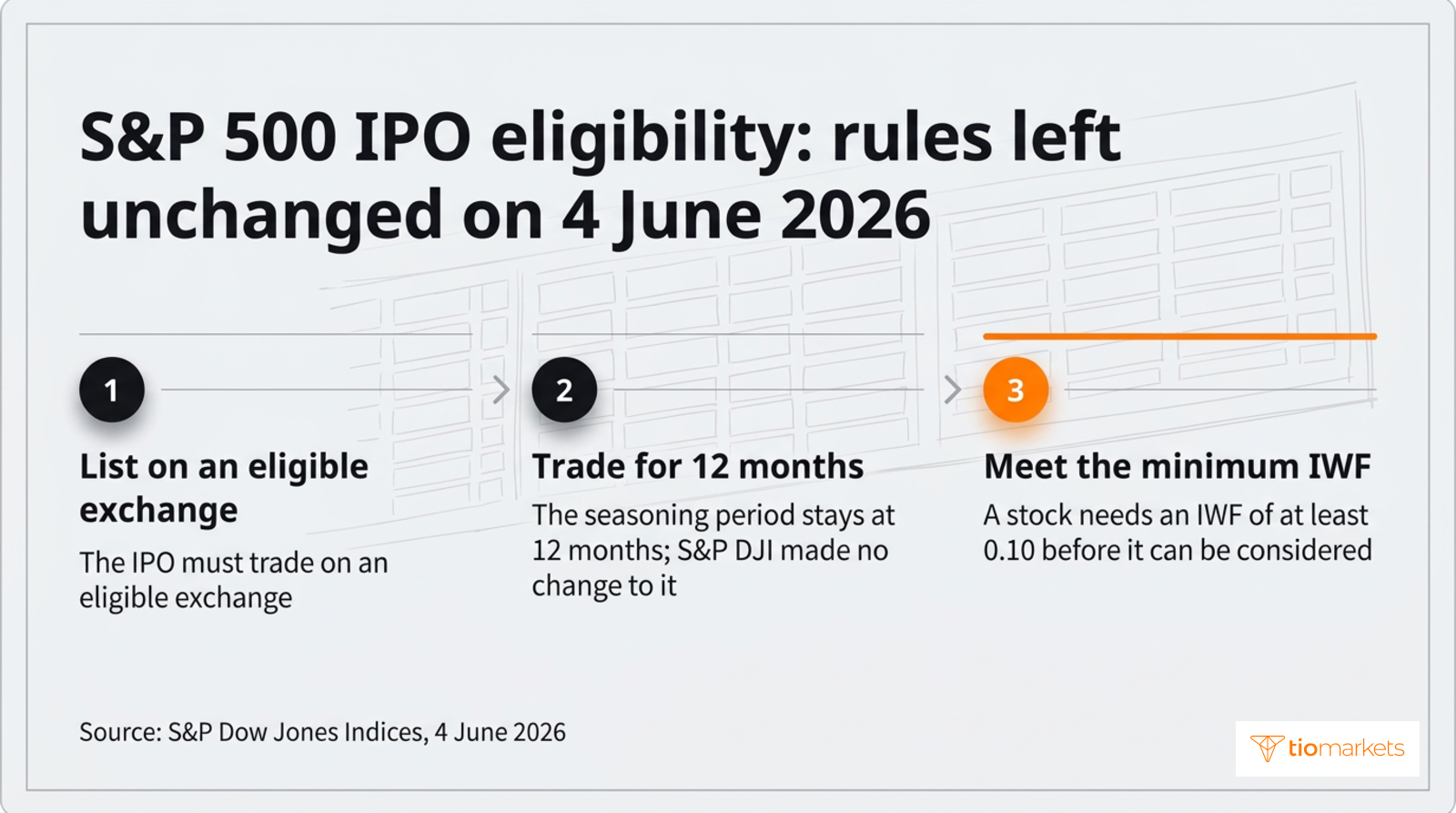
The S&P 500 eligibility rules move more slowly. A consultation published on April 30, 2026 proposed cutting the IPO seasoning period from 12 months to six, with no fast-track entry. The results of June 4, 2026 left the criteria unchanged: an IPO must trade on an eligible exchange for at least 12 months before it can be considered, with a minimum IWF of 0.10. That requirement extends the differences between the Nasdaq 100 and the S&P 500 to the treatment of new listings.
Each source of flow has a direction. Money flows in from buyers of new primary shares at listing and from index funds after inclusion; it flows out when early holders sell at lock-up expiry and when index funds trim other megacaps to make room. A listing valued at $300 billion with a 10% float shows why timing matters: at listing, only $30 billion of shares can trade, and the remaining $270 billion waits on lock-ups.
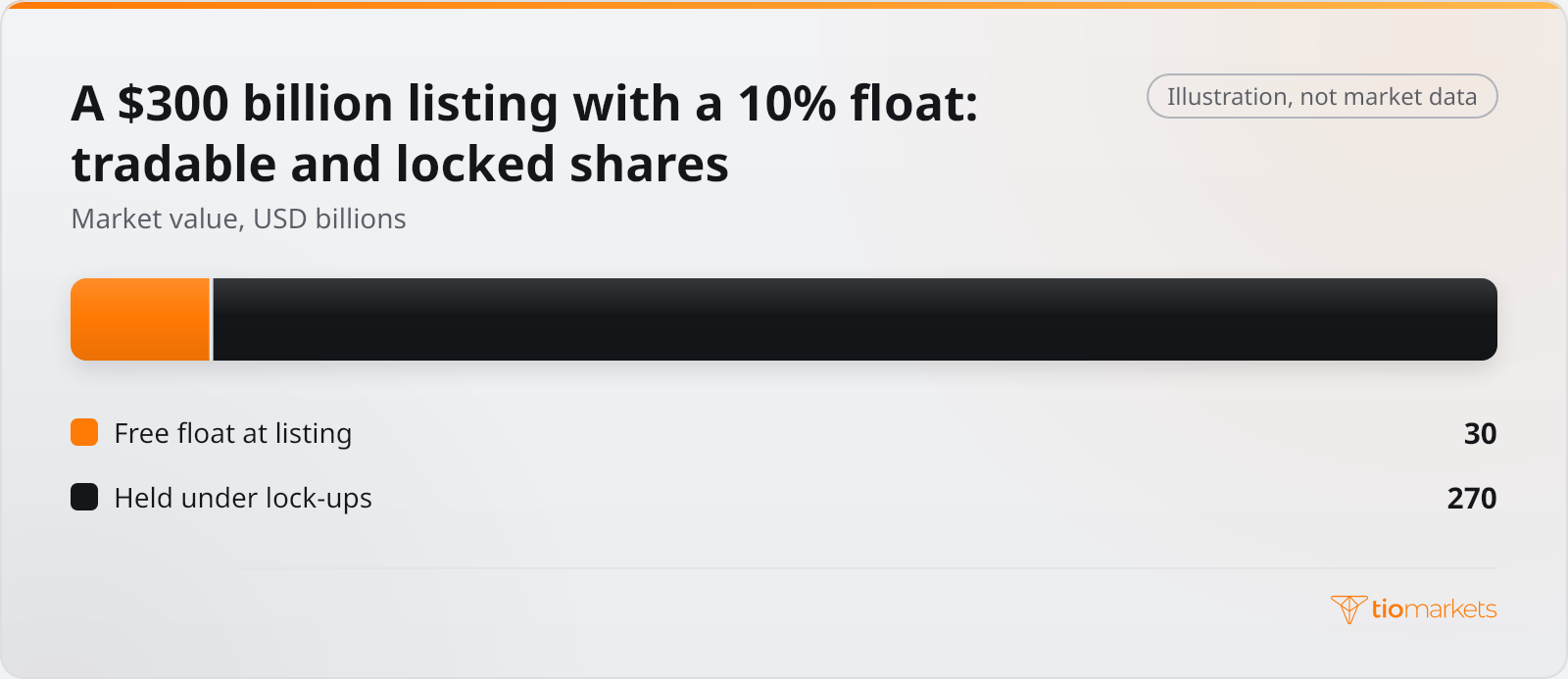
Carried further, the example shows what each stage releases. If lock-up expiry freed a further 20% of the company, $60 billion of shares would become eligible for sale, tripling the float to $90 billion at an unchanged price. Suppose, as a further assumption, that index inclusion then required passive funds to buy $15 billion of the stock, funded by trimming other members. That buying would equal half the tradable supply before the releases but only a sixth of it afterwards. Sequence therefore matters as much as size: index buying before the lock-ups lapse meets thin supply, while lock-up selling before inclusion meets no forced buyer.
Anthropic Going Public: How the Flows Can Reach Listed Stocks
The flows reach listed AI stocks and the Nasdaq 100 through four channels. Each rests on terms that filings and index notices make public, so each can be tested against data rather than assumed:
| If this happens | Channel | Effect on demand for listed AI stocks or the Nasdaq 100 | Data that would confirm it |
| A large float at listing | Buyers fund new shares partly by selling other holdings | Would add AI supply on day one and could draw cash from listed peers | The final share count and first-day volume |
| A small float with staged lock-ups | Supply arrives at each release date | Little change at listing; each release would add shares for sale | The lock-up dates in the prospectus and release-day volume |
| Fast-entry Nasdaq 100 inclusion | Index funds buy the new member and trim existing members | Would add demand for the new stock and cut other members' weights | The seventh-day ranking and the inclusion notice |
| A backer's stake is revalued | Fair value marks on the backer's balance sheet | Changes reported equity, not cash flow or index weights; no direct buying or selling | The backer's next quarterly filing |
Amazon's holding gives the last channel a concrete case. Amazon invested $8.0 billion in Anthropic convertible notes between the third quarter of 2023 and the fourth quarter of 2025, and $5.0 billion in Series G non-voting preferred stock in the second quarter of 2026. The notes are classified as available-for-sale and carried at fair value as Level 3 assets, valued from unobservable inputs rather than a quoted price. Unrealised gains sit in accumulated other comprehensive income (AOCI), a component of shareholders' equity rather than net income. The notes' estimated fair value was about $45.8 billion at December 31, 2025, $42.2 billion at March 31, 2026, $97.9 billion at June 30, 2026 and $146.2 billion at September 30, 2026.
Over the same span, the related unrealised gain in AOCI rose from $39.5 billion to $140.3 billion, none of it cash. A mark of this kind alters the balance sheet and comprehensive income, leaves operating cash flow unaffected unless a stake is sold, and moves no index weight. These quarter-end values record past measurement only and indicate nothing reliable about future marks; a lower mark would reduce equity through the same line.
Anthropic IPO vs the Drivers That Usually Matter More
Against the drivers that usually move listed technology stocks, a single listing is a one-off influence, and its size can be set against the offering terms and the first day of trading. The offering was planned to raise up to $64.4 billion, with the $26 billion placement alongside, against a first-day market capitalisation of $1.8 trillion. Accounting marks on a single backer's stake moved by a comparable amount without any sale: the estimated fair value of the convertible notes described above rose by $55.7 billion between March 31 and June 30, 2026. Federal Reserve decisions, by contrast, reset the policy rate at scheduled meetings through the year; a higher rate raises the discount rate applied to future earnings and lowers their present value, and a lower rate does the reverse.
The drivers also differ in how often they recur. The raise and the placement occurred once, at pricing and the first trade. Lock-up releases are confined to four dates, 27, 48, 62 and 76 days after the IPO, and a Nasdaq 100 fast entry rests on a single ranking on the seventh trading day, with entry after the 15th day of trading. Rate decisions, by comparison, return through the year, Treasury yields reprice the discount rate in every session, and backers' marks and megacap results arrive each quarter. An IPO therefore supplies a short sequence of dated flows, whereas the rate and earnings drivers return on a fixed cycle and their effects accumulate.
Timing separates the drivers as much as size. A rate decision is known on the day and a yield move within the session, whereas an IPO's effect is spread across pricing, the first trade, each lock-up release and any index entry. The $55.7 billion change in the notes' fair value is a past measurement that sets no pattern for later marks. Where an IPO stage coincides with a rate decision or a cluster of megacap results, the larger driver can dominate the price record. Attributing a move to the listing therefore requires checking each event's date against the data.
Conclusion: What to Watch Around the Anthropic IPO
The Anthropic IPO matters to listed markets through its calendar more than through its valuation. Demand came first from buyers of the shares sold at the $83 offer price and of the $26 billion placement; further demand depends on Nasdaq 100 fast entry and, after at least 12 months of trading, on the S&P 500 criteria. Supply arrives at each lock-up stage, at 27, 48, 62 and 76 days, so the dates rather than the headline figure decide which way the flows push. The final share counts, each release, the index providers' decisions and the backers' next quarterly filings are the data that would confirm or contradict this reading.
The method has limits. Flow analysis explains timing pressure, not value, and a rate decision, a yield move or a megacap earnings release on the same dates can overwhelm it. A newly listed stock with a short trading record can also move sharply on limited information. A leveraged position on it magnifies losses as well as gains, those losses can build quickly around release and index dates, and traders can lose all the money they deposit.
Symbols in this article
- Nasdaq 100NAS100
- AmazonAMZN
- S&P 500SP500
- Goldman SachsGS
- Morgan StanleyMS
- NVIDIANVDA
- AMD Advanced Micro DevicesAMD



Trade from anywhere with the TIOmarkets Trading and Investing Mobile App
Trade over 950 instruments with built-in TradingView charts and competitive spreads, all from your phone, in real time.
Trading is risky
FAQ
Risk disclaimer: CFDs are complex instruments and come with a high risk of losing money rapidly due to leverage. You should consider whether you understand how CFDs work and whether you can afford to take the high risk of losing your money. Never deposit more than you are prepared to lose. Professional client’s losses can exceed their deposit. Please see our risk warning policy and seek independent professional advice if you do not fully understand. This information is not directed or intended for distribution to or use by residents of certain countries/jurisdictions including, but not limited to, USA & Countries included in the OFAC sanction list. The Company holds the right to alter the aforementioned list of countries at its own discretion.
TIOmarkets offers an exclusively execution-only service. The views expressed are for information purposes only. None of the content provided constitutes any form of investment advice. The comments are made available purely for educational and marketing purposes and do NOT constitute advice or investment recommendation (and should not be considered as such) and do not in any way constitute an invitation to acquire any financial instrument or product. TIOmarkets and its affiliates and consultants are not liable for any damages that may be caused by individual comments or statements by TIOmarkets analysis and assumes no liability with respect to the completeness and correctness of the content presented. The investor is solely responsible for the risk of his/her investment decisions. The analyses and comments presented do not include any consideration of your personal investment objectives, financial circumstances, or needs. The content has not been prepared in accordance with any legal requirements for financial analysis and must, therefore, be viewed by the reader as marketing information. TIOmarkets prohibits duplication or publication without explicit approval.
Join us on social media


Authors BIO

Behind every blog post lies the combined experience of the people working at TIOmarkets. We are a team of dedicated industry professionals and financial markets enthusiasts committed to providing you with trading education and financial markets commentary. Our goal is to help empower you with the knowledge you need to trade in the markets effectively.