


Best Forex Pairs to Trade: A Complete Guide for Traders of All Levels
BY Maria K.
|July 30, 2026The vast majority of the forex market trades concentrates in just a handful of currency pairs. The best forex pairs to trade are widely considered to be EUR/USD, USD/JPY, GBP/USD, AUD/USD, USD/CAD, USD/CHF, and NZD/USD. The right pair for you depends on your experience, trading style, and the hours you trade.
This guide covers top forex pairs, forex pair types, individual pair breakdowns, session timing, beginner vs. advanced pairs, and common mistakes to avoid.
Quick Answer: Top 5 Best Forex Pairs to Trade
- EUR/USD: Highest liquidity, tightest forex spreads
- USD/JPY: Clean trends, rate-sensitive
- GBP/USD: High volatility, active London session
- AUD/USD: Commodity-linked, clear fundamentals
- USD/CAD: Oil correlation, North American session
What Are Forex Currency Pairs and How Do They Work?
A currency pair shows how much one currency is worth compared to another. In forex trading, currencies are always traded in pairs.
Base Currency vs. Quote Currency Explained
In every forex pair, the base currency is listed first, and the quote currency is listed second. In EUR/USD = 1.1000, means that one euro buys 1.10 US dollars.
Three Categories of Forex Pairs
There are three currency pair types.
- Major forex pairs, such as EUR/USD, USD/JPY, and GBP/USD, always include the US dollar, account for approximately 85% of daily trading volume, and offer the tightest spreads.
- Minor pairs (also called cross pairs) exclude the USD and instead pair two major currencies together; examples include EUR/GBP, GBP/JPY, and EUR/JPY, and they typically carry moderate spreads.
- Exotic pairs combine one major currency with one emerging market currency (such as USD/ZAR, USD/TRY, and USD/MXN) and tend to have wider spreads and lower forex liquidity compared to majors and minors. They are some of the most volatile forex pairs.
How to Choose the Best Forex Pairs to Trade: A 5-Step Framework
Before diving into specific pairs, use this framework to identify which pairs fit your trading approach. Matching currency pairs to your trading style may help create a more consistent trading process than randomly selecting popular options.
Step 1: Match the Pair to One of the Forex Trading Sessions
Forex operates 24 hours, but liquidity varies dramatically by session. EUR/USD and GBP/USD peak during the London and New York overlap (12:00–16:00 UTC), USD/JPY is most active during the Tokyo session (00:00–09:00 UTC), and AUD/USD and NZD/USD are most active during the Sydney/Tokyo sessions. Trading a pair outside its active session typically results in wider spreads, thinner liquidity, and higher costs.
Step 2: Assess Liquidity and Spread Costs
Higher liquidity generally produces tighter spreads and lower trading costs. EUR/USD consistently offers the tightest spreads (often 0.1–0.5 pips), while exotic pairs can carry spreads 10–50x wider than majors. Spread costs compound over many trades, so factoring them into strategy calculations is essential.
Step 3: Understand the Pair's Forex Volatility Profile
Some pairs move steadily (EUR/USD, EUR/GBP), while others swing aggressively (GBP/JPY, USD/TRY). Matching volatility to your risk tolerance and stop-loss strategy is important.
Step 4: Know What Drives the Best Forex Pairs to Trade
Each pair has primary fundamental drivers: EUR/USD is influenced by European Central Bank policy vs. Fed policy, AUD/USD responds to commodity prices and China data, and USD/CAD correlates strongly with oil prices.
Step 5: Start With One or Two Pairs and Master Them
Focusing on 2–4 pairs is often a preferred practice by some traders. Many traders find that focusing on a small number of pairs helps them become more familiar with typical market behaviour.
The 7 Major Forex Pairs: The Most Traded Currency Pairs in the World
The 7 major forex pairs form the foundation of the global currency market. Major forex pairs all include the US dollar, reflecting its status as the world's primary reserve and vehicle currency, and together account for the majority of daily forex turnover. Because they are the most traded forex pairs, they generally provide relatively high liquidity and tighter spreads compared with many other currency pairs.
EUR/USD: The World's Most Traded Forex Pair
EUR/USD represents the euro versus the US dollar, the two largest economic blocs. It offers the deepest liquidity globally, tightest spreads, and most analytical coverage available. Key drivers include ECB and Federal Reserve interest rate decisions, along with Eurozone/US inflation and GDP data. Many traders view EUR/USD as easier to analyse because of its liquidity and extensive market coverage.
USD/JPY: The Rate-Sensitive Trend Pair
USD/JPY pairs the US dollar against the Japanese yen. It offers high liquidity, clear trending behavior, and strong correlation with US bond yields. Key drivers include the Fed vs. Bank of Japan rate differential, US Treasury yields, and risk sentiment. The volatility profile is low-to-moderate, often exhibiting sustained directional moves during some market conditions.
GBP/USD: The Cable, High Volatility with Active Price Movement
GBP/USD pairs the British pound against the US dollar. It offers large daily ranges, strong reaction to UK economic data, and deep liquidity during the London session. Key drivers include Bank of England policy, UK inflation and employment data, and US dollar sentiment. Volatility is high, with daily ranges frequently exceeding 100 pips.
USD/CHF: The Safe-Haven Pair
USD/CHF pairs the US dollar against the Swiss franc. It attracts safe-haven flows during risk-off periods, serves as a useful hedge, and exhibits moderate volatility. Key drivers include global risk sentiment, Swiss National Bank policy, and USD strength/weakness.
AUD/USD: The Commodity-Linked Pair
AUD/USD pairs the Australian dollar against the US dollar. It’s one of the commodity currencies tied heavily to Australia's exports of raw materials like gold, iron ore, and coal. Many traders interested in macroeconomic analysis monitor AUD/USD because of its links to commodities and Chinese economic data.
USD/CAD: The Oil Pair
USD/CAD pairs the US dollar against the Canadian dollar. It offers strong oil price correlation and is active during the North American session. Key drivers include crude oil prices (Brent and WTI), Bank of Canada policy, and US economic data. Volatility can be unpredictable when US and Canadian forces conflict.
NZD/USD: The Kiwi, Steady Commodity Exposure
NZD/USD pairs the New Zealand dollar against the US dollar. It offers clear agricultural commodity drivers and decent liquidity during Asia-Pacific hours. Key drivers include dairy prices, RBNZ policy, and global risk appetite.
Major Forex Currency Pairs to Trade Summary Table
| Pair | Volatility | Best Session | Best For | Key Driver |
| EUR/USD | Low-Medium | London/NY | Beginners | ECB vs. Fed |
| USD/JPY | Low-Medium | Tokyo/NY | Trend followers | Rate differential |
| GBP/USD | Medium-High | London/NY | Intermediate | BoE vs. Fed |
| AUD/USD | Medium | Tokyo/London | Beginners | Commodities/China |
| USD/CAD | Medium | New York | Intermediate | Oil prices |
| USD/CHF | Medium | London/NY | Risk-aware | Safe-haven flows |
| NZD/USD | Medium | Tokyo/London | Beginners-Int | Dairy/Risk appetite |
Best Forex Pairs to Trade for Beginners
If you're new to forex trading, starting with one or two pairs that offer tight spreads, deep liquidity, and plenty of educational resources is a common approach. Major currency pairs tend to have lots of market data, react well to technical analysis, and experience fewer sudden price spikes.
EUR/USD: The Best Starting Point for New Traders
EUR/USD is often regarded as one of the easier pairs for beginners to follow because of its liquidity and broad market coverage. It’s ideal as it’s the most liquid pair in the world, has the tightest spreads and most educational content available.
- Practical tip: Starting by trading only during the London-New York overlap maximizes liquidity exposure
USD/JPY: Clean Trends, Lower Noise
Why it's ideal: Tends to trend clearly; lower intraday noise than GBP/USD; good for learning trend-following strategies
- Practical tip: US 10-year Treasury yields often serve as a directional guide
AUD/USD: Learn Fundamental Analysis in Practice
Why it's ideal: Clear commodity and macro drivers make it easier to connect fundamentals to price action
- Practical tip: Monitoring Chinese PMI data and iron ore prices alongside RBA announcements can provide context
EUR/GBP: The Slow and Steady Cross Pair
Why it's ideal: Lower volatility than most majors; tends to range-trade; good for learning support/resistance
- Practical tip: London session hours typically offer the best liquidity and price discovery
Beginner Rule: Pick ONE pair, demo trade it for 30 days, track every setup, then evaluate before adding a second pair.
Best Forex Pairs to Trade for Experienced Traders
Once you've developed proficiency with forex major pairs, the best currency pairs for forex trading if you are an expert are the below. These pairs may experience larger price movements but also involve higher risk and greater complexity.
GBP/JPY: Maximum Volatility, Maximum Discipline Required
GBP/JPY combines GBP volatility with JPY safe-haven behavior, producing extreme daily ranges. It requires wide stops and precise position sizing for experienced momentum traders.
EUR/JPY: The Global Carry Trade Barometer
EUR/JPY reflects global risk appetite and rate differential themes. ECB vs. BOJ policy divergence creates directional opportunities. Best suited for macro-focused traders and carry trade strategists.
USD/CAD: Deeper Oil Market Knowledge Required
USD/CAD requires tracking oil markets, Bank of Canada policy, and US data simultaneously. It can move counterintuitively. Best for traders comfortable with cross-market analysis.
Exotic Pairs: High Risk, Specialist Knowledge Required
Pairs like USD/TRY, USD/ZAR, and USD/MXN offer large moves but carry wider spreads, lower liquidity, higher slippage, and political risk. Caution is essential.
Best Forex Pairs to Trade by Session: When to Trade Each Pair
Forex liquidity is not constant, the best forex pairs to trade change depending on which of the global forex trading sessions is active. Trading a pair during its peak session typically means tighter spreads, deeper liquidity, and price action that many traders find easier to analyse due to higher liquidity.
- London Session (07:00–16:00 UTC)
- Best forex pairs to trade during London session: EUR/USD, GBP/USD, EUR/GBP, GBP/JPY
- Why: European data releases; largest single-session volume globally; sets the tone for the day
- Tip: The first 2 hours of London often produce the day's key directional moves
- New York Session (12:00–21:00 UTC)
- Best pairs: EUR/USD, GBP/USD, USD/CAD, USD/CHF
- Why: US economic releases (NFP, CPI, FOMC) drive major USD moves; London-NY overlap is the most liquid window of the week
- Tip: NFP Fridays can create extreme volatility — adjusting position size or standing aside may be appropriate if your strategy isn't built for news trading
- Tokyo/Asian Session (00:00–09:00 UTC)
- Best pairs: USD/JPY, AUD/USD, NZD/USD, AUD/JPY
- Why: Japanese economic data; BOJ signals; regional commodity flows
- Tip: Spreads on European pairs widen significantly during this session — sticking to Asia-Pacific pairs tends to reduce costs
- Session Overlap: London-New York (12:00–16:00 UTC)
- Best pairs: EUR/USD, GBP/USD
- This window consistently offers the tightest spreads and fastest execution
Best Forex Pairs to Trade by Trading Session Table
| Session | Hours (UTC) | Best Pairs | Why |
| Tokyo/Asian | 00:00–09:00 | USD/JPY, AUD/USD, NZD/USD | JPY and Pacific flows |
| London | 07:00–16:00 | EUR/USD, GBP/USD, EUR/GBP | Highest volume; European data |
| New York | 12:00–21:00 | EUR/USD, USD/CAD, USD/CHF | US data releases |
| London-NY Overlap | 12:00–16:00 | EUR/USD, GBP/USD | Maximum global liquidity |
Top Forex Currency Pairs Compared: The Ultimate Comparison Table
Use this comparison table to evaluate the most traded forex currency pairs side by side across key metrics like typical spread, volatility, liquidity, best session and key drivers.
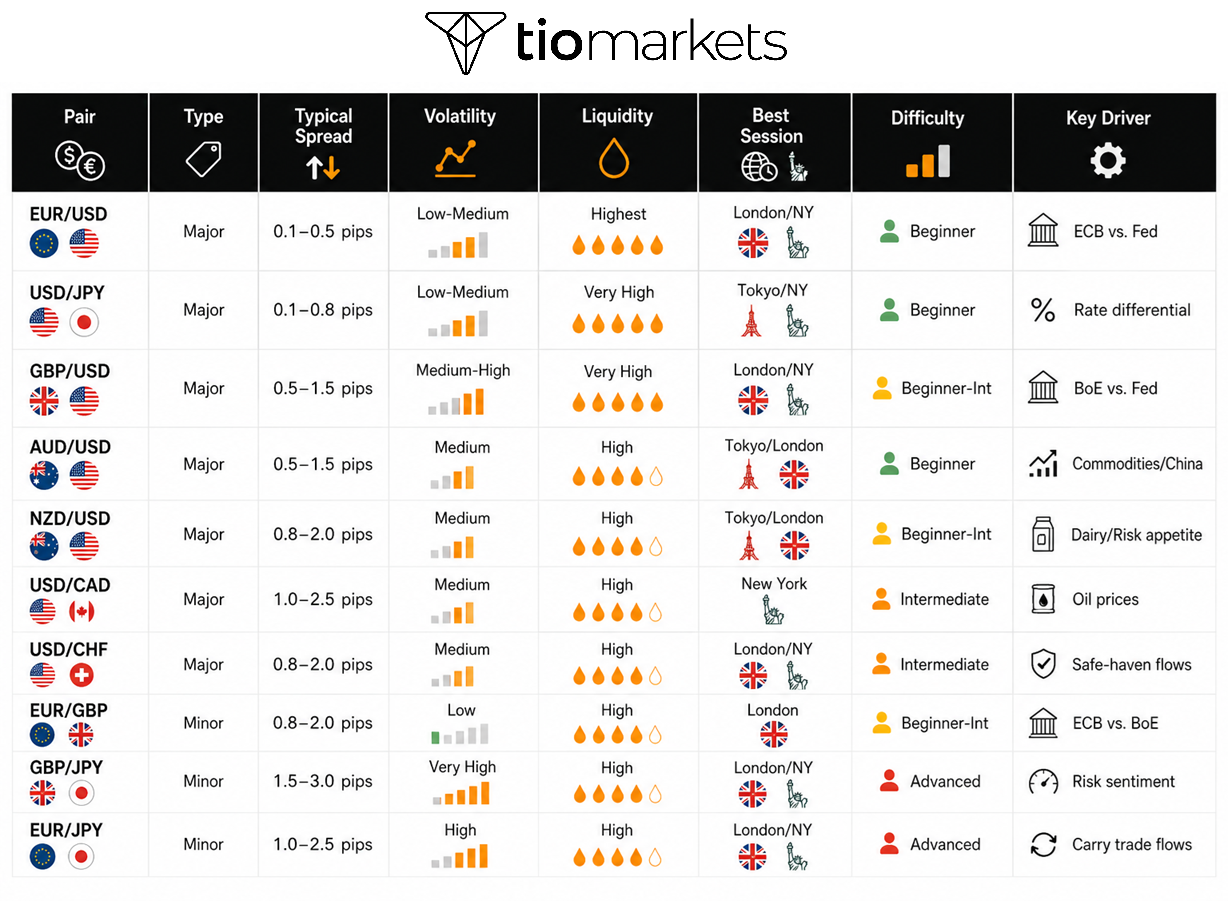
*Spreads are indicative and vary by broker and market conditions.
5 Common Mistakes When Choosing Best Forex Pairs to Trade
Even experienced traders make avoidable errors when selecting the best forex pairs to trade. Here are five common mistakes.
- Trading too many pairs at once: Fragments attention, increases decision fatigue, and makes risk management harder.
- Ignoring trading session timing: Trading EUR/USD during the Tokyo session means wider spreads and thinner liquidity.
- Underestimating spread costs on exotic pairs: A 50-pip spread on USD/TRY means the market must move 50 pips in your favor before breaking even.
- Ignoring pair correlations: Trading EUR/USD and GBP/USD simultaneously is effectively doubling your USD directional exposure.
- Chasing volatility without appropriate risk management: GBP/JPY and exotic pairs can appear exciting but require wider stops, smaller position sizes, and faster decision-making.
Conclusion: Choosing the Best Forex Pairs to Trade for Your Strategy
The best forex pairs to trade are those that match your experience level, trading session, risk tolerance, and strategy, not simply the ones with the biggest moves.
For most traders, EUR/USD, USD/JPY, and GBP/USD represent a logical starting point because of their liquidity, tight spreads, and depth of market coverage. Many traders prefer focusing on fewer pairs to build familiarity before expanding their watchlist - than a scattered approach across many markets.
Key takeaways:
- Best currency pairs to trade for lowest trading costs: EUR/USD offers the tightest spreads and deepest liquidity
- Most liquid forex pairs: EUR/USD, USD/JPY, and GBP/USD
- For clean, trending price action: USD/JPY tends to trend clearly with less intraday noise
- For traders good at fundamental analysis: AUD/USD and USD/CAD have clear commodity drivers that connect news to price
- For higher volatility: GBP/USD and GBP/JPY offer larger daily ranges but require stronger risk management
Always remember to match pairs to your active trading session and factor spread costs and volatility into your strategy. If you are ready to start trading the world's best forex pairs, open an account today and practice your strategy.

FAQ
Risk disclaimer: CFDs are complex instruments and come with a high risk of losing money rapidly due to leverage. You should consider whether you understand how CFDs work and whether you can afford to take the high risk of losing your money. Never deposit more than you are prepared to lose. Professional client’s losses can exceed their deposit. Please see our risk warning policy and seek independent professional advice if you do not fully understand. This information is not directed or intended for distribution to or use by residents of certain countries/jurisdictions including, but not limited to, USA & Countries included in the OFAC sanction list. The Company holds the right to alter the aforementioned list of countries at its own discretion.
TIOmarkets offers an exclusively execution-only service. The views expressed are for information purposes only. None of the content provided constitutes any form of investment advice. The comments are made available purely for educational and marketing purposes and do NOT constitute advice or investment recommendation (and should not be considered as such) and do not in any way constitute an invitation to acquire any financial instrument or product. TIOmarkets and its affiliates and consultants are not liable for any damages that may be caused by individual comments or statements by TIOmarkets analysis and assumes no liability with respect to the completeness and correctness of the content presented. The investor is solely responsible for the risk of his/her investment decisions. The analyses and comments presented do not include any consideration of your personal investment objectives, financial circumstances, or needs. The content has not been prepared in accordance with any legal requirements for financial analysis and must, therefore, be viewed by the reader as marketing information. TIOmarkets prohibits duplication or publication without explicit approval.
Join us on social media



Authors BIO

Maria is a writer and content strategist with over 10 years of experience in the finance industry. She specializes in developing research-backed articles that help financial professionals navigate complex market topics with confidence. Her expertise spans forex, stocks, CFDs and global markets, creating insightful content that educates readers and supports informed decision-making.