Canada Unemployment Rate Preview: Three Tests for the Loonie
BY Ahmed Osama
|October 7, 2026Canada's September jobs report is due at 12:30 UTC on Friday 9 October. Economists expect the unemployment rate to edge up to 6.5% after August's surprise loss of 41,700 jobs. With markets debating whether the Bank of Canada's next move could be a rate rise, the quality of hiring and the wage signal may matter as much as the headline numbers for the Canadian dollar.
Canada Jobs Preview in Brief
- Statistics Canada publishes the September Labour Force Survey at 12:30 UTC on Friday 9 October.
- Economists expect the Canada unemployment rate to rise to 6.5% from 6.4%, with a small employment gain after August's 41,700 decline.
- The Bank of Canada has held its rate at 2.25% since October 2025, and markets have been weighing the chance of a rate increase as gasoline keeps headline inflation at 3.0%.
- USD/CAD was trading near 1.4250 at the time of writing, after reaching about 1.4300 on 5 October. A stronger report could support the Canadian dollar and push USD/CAD lower.
- This is the final jobs report before the Bank of Canada's decision at 13:45 UTC on 28 October.
What is the Canadian jobs report and when is it released?
The Labour Force Survey, Canada's monthly jobs report, shows how many people gained or lost work, the unemployment rate, the share of people working or looking for work (the participation rate), and average hourly wages. It is one of the most closely watched releases for traders of the Canadian dollar.
The September report is due at 12:30 UTC on Friday 9 October, as shown on our economic calendar, a time slot also used for many major US releases. It covers the reference week of 13 to 19 September.
One point matters for interpreting the numbers: the unemployment rate only counts people actively looking for work. If fewer people look for work, the unemployment rate can stay flat even when jobs are lost, which is exactly what happened in August.
What economists expect from the September report
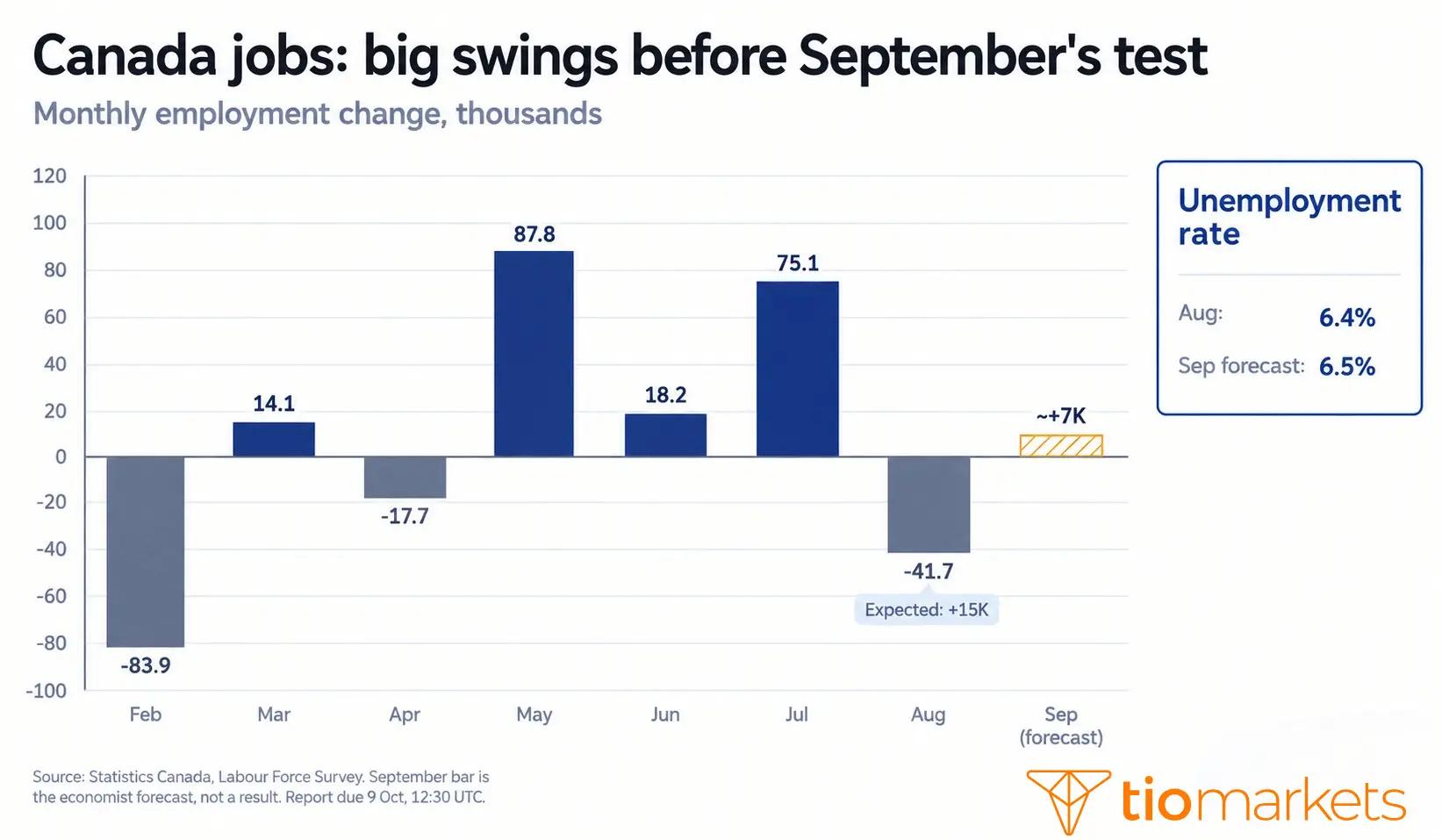
Economists expect the Canada unemployment rate to edge up one-tenth of a percentage point to 6.5%. Calendar estimates point to a small employment gain of roughly 7,000. Forecasts can change before the release, and the size of the August miss is a reminder of how far results can stray from expectations: economists had expected a gain of about 15,000 jobs in August, and the report showed a loss of 41,700.
| Friday release dashboard | August actual | September consensus | What it tests |
| Employment change | -41,700 | +7,000 approx. | Whether August's decline begins to reverse |
| Unemployment rate | 6.4% | 6.5% | Slack, but only when read with participation |
| Participation rate | 65.0% | No robust consensus | Whether labour-force entry lifts unemployment |
| Average hourly wages, y/y | 2.0% | No robust consensus | Domestic cost pressure and household income |
Why August was weaker than the unemployment rate suggested
Employment fell by 41,700 in August, reversing part of the 181,000 jobs added between May and July. The unemployment rate held at 6.4% largely because the participation rate fell to 65.0% from 65.1%, meaning fewer people were working or looking for work. The employment rate slipped to 60.8%.
The losses were concentrated in full-time work, which fell by 35,900, and among young people, where employment fell by 19,000. Business, building and other support services lost 20,000 jobs, and public-sector employment fell by 20,000 for a third straight month, taking the decline since May to about 78,000. Quebec lost 19,000 jobs, mostly in Montréal. Manufacturing was a notable exception, adding jobs during the month.
Wage growth also cooled. Average hourly wages were 2.0% higher than a year earlier, down from 2.8% in July and 3.3% in June.
US tariffs of 50% on a range of Canadian goods, covering roughly 5% of Canada's exports to the US, took effect on 22 August, and Canada's counter-tariffs followed on 8 September. Because August's survey week (9 to 15 August) came before the tariffs took effect, September is the first report to capture them.
Why this jobs report matters for the Bank of Canada
The Bank of Canada held its overnight rate at 2.25% on 2 September, its seventh consecutive hold. It said labour demand remains subdued and that the economy still has excess supply, even though GDP grew at a 3.3% annualised rate in the second quarter.
The complication is inflation. Headline CPI rose 3.0% year on year in August, held up by gasoline prices that were 22.8% higher than a year earlier amid the conflict in the Middle East. Excluding gasoline, inflation was 2.4%, and the Bank's preferred core measures stayed close to 2%. Before the August CPI release in mid-September, market pricing pointed to roughly a 58% chance of a rate increase in October, a probability that eased after the data.
In simple terms: a strong jobs report with firmer wages could revive expectations of a Bank of Canada rate rise. A weak report could make a hike harder to justify and keep the Bank on hold for longer.
Three tests behind the headline
1 Is hiring broad and full-time
A modest rebound led by full-time positions and spread across several private-sector industries would look more durable than a gain concentrated in part-time or volatile categories. Manufacturing deserves attention after its 22,000 increase in August, as do business support services and natural resources after declines. Provincial breadth matters too, especially in Ontario and Quebec, which together lost 37,000 jobs in August.
2 Why did unemployment move
A rise to 6.5% would not automatically be bearish for the Canadian outlook. If employment grows but participation rises faster as more people enter the labour force, the higher unemployment rate would contain a healthier underlying signal. If unemployment rises because employment contracts again while participation is flat or lower, the signal would be more clearly soft.
3 Are wages still losing momentum
August's 2.0% annual wage growth was a sharp slowdown from July. One month does not establish a trend, and the LFS wage measure can be affected by changes in the mix of workers. Still, another weak reading would strengthen the case that labour-related inflation pressure is easing. A rebound in wage growth alongside full-time hiring would complicate that conclusion.
Put Your Market Analysis into Action
Reading about the markets is just step one. Whether you expect the CAD to strengthen or weaken, execute your strategy seamlessly. Download the TIOmarkets app for a smooth, intuitive trading experience. Access live charts, tight spreads, and fast execution on USD/CAD.
Trading is risky
How the jobs report could move the Canadian dollar
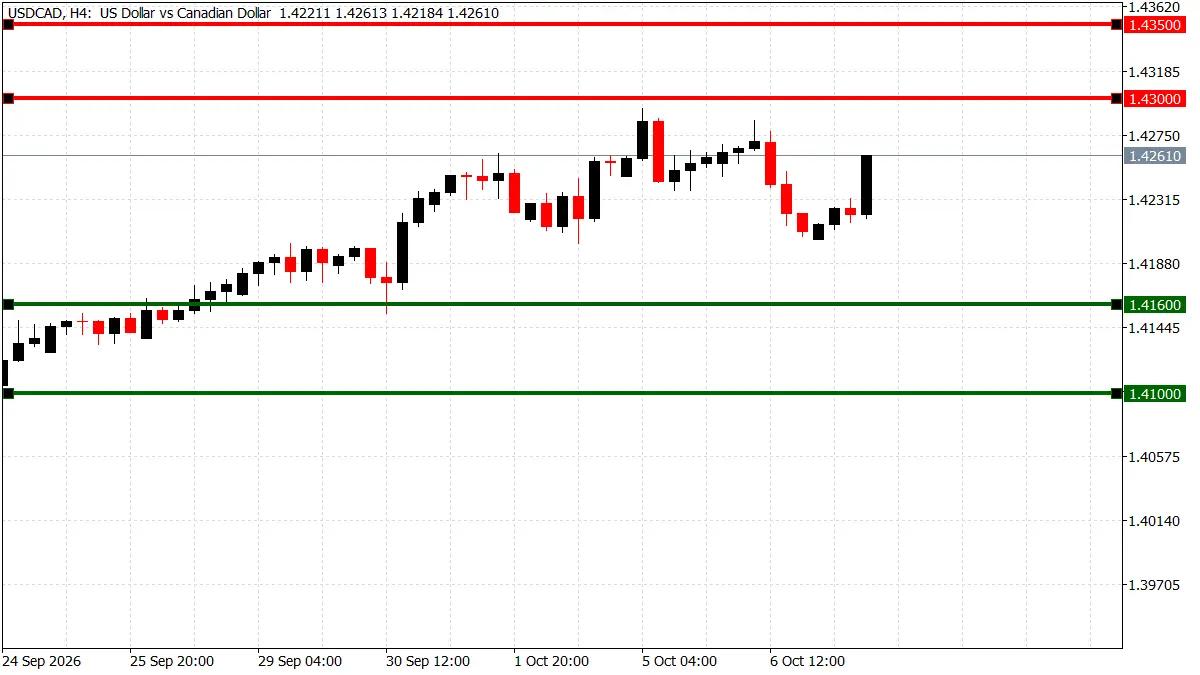
USD/CAD climbed steadily from about 1.4110 on 24 September to a high near 1.4300 on 5 October, before easing back to the 1.4200 area. Because USD/CAD shows how many Canadian dollars one US dollar buys, a rising pair means a weaker Canadian dollar.
USD/CAD has been trading in a broad 1.4150–1.4300 range. Reference levels traders are watching:
- 1.4200: the recent low area, near the current price
- 1.4160: the late-September consolidation zone
- 1.4100: the starting point of the late-September rise
- 1.4280: the 5–6 October highs
- 1.4300: the 5 October high
- 1.4350: the next round-number level above
A better-than-expected report could support the Canadian dollar and pull USD/CAD back toward 1.4160 and 1.4100. A worse-than-expected report could weaken the Canadian dollar and lift USD/CAD toward 1.4300 and 1.4350. Oil prices and US economic data can outweigh the Canadian jobs report on the day, because the Canadian dollar is closely linked to crude.
All levels are context markers, not entry or exit points, and should be checked against a live price feed.
The scenario map for the Canadian dollar
| Scenario | What it could look like | Possible market reaction | What could change the reading |
| Better than expected | Employment above 30,000, unemployment at 6.4% or lower, full-time gains and firmer wages | The Canadian dollar could strengthen as rate-hike expectations rise; USD/CAD could move toward 1.4160–1.4100 | Gains concentrated in part-time work, falling participation or weak wages |
| As expected | Employment between about -10,000 and +25,000, unemployment around 6.5%, mixed details | First moves may fade as attention shifts to inflation, oil and the 28 October decision | A large change in participation or a big wage surprise |
| Worse than expected | Employment falls by more than 10,000, unemployment at 6.6% or higher, weak full-time hiring and soft wages | The Canadian dollar could weaken as rate-hike expectations fade; USD/CAD could move toward 1.4300–1.4350 | Rising participation, upward revisions or firmer wages |
Scenario thresholds are editorial guideposts, not forecasts or trading recommendations. Monthly changes in the Labour Force Survey are volatile and subject to sampling variability.
Key dates to watch
- Friday 9 October, 12:30 UTC: Canada September Labour Force Survey
- Monday 19 October, 14:30 UTC: Bank of Canada Business Outlook Survey and Canadian Survey of Consumer Expectations
- Wednesday 28 October, 13:45 UTC: Bank of Canada rate decision and Monetary Policy Report
Risks and uncertainties
Monthly employment changes in Canada are estimates from a household survey and can swing sharply from month to month. Wage measures can move because of changes in the mix of jobs rather than actual pay rises. The release also often coincides with US data at the same time, which can make the Canadian dollar's reaction harder to read. Prices can jump and spreads can widen around 12:30 UTC.
Conclusion
Friday's Canada unemployment rate will deliver the quickest headline, but not necessarily the clearest answer. The more useful question is whether Canada produces a broad, full-time hiring rebound with steady participation and wages. That combination could revive the debate about a Bank of Canada rate rise and could support the loonie. Another decline in jobs with weak wages could make a hike harder to justify. Either way, the report is best read as a package rather than a single number.

FAQ
Risk disclaimer: CFDs are complex instruments and come with a high risk of losing money rapidly due to leverage. You should consider whether you understand how CFDs work and whether you can afford to take the high risk of losing your money. Never deposit more than you are prepared to lose. Professional client’s losses can exceed their deposit. Please see our risk warning policy and seek independent professional advice if you do not fully understand. This information is not directed or intended for distribution to or use by residents of certain countries/jurisdictions including, but not limited to, USA & Countries included in the OFAC sanction list. The Company holds the right to alter the aforementioned list of countries at its own discretion.
TIOmarkets offers an exclusively execution-only service. The views expressed are for information purposes only. None of the content provided constitutes any form of investment advice. The comments are made available purely for educational and marketing purposes and do NOT constitute advice or investment recommendation (and should not be considered as such) and do not in any way constitute an invitation to acquire any financial instrument or product. TIOmarkets and its affiliates and consultants are not liable for any damages that may be caused by individual comments or statements by TIOmarkets analysis and assumes no liability with respect to the completeness and correctness of the content presented. The investor is solely responsible for the risk of his/her investment decisions. The analyses and comments presented do not include any consideration of your personal investment objectives, financial circumstances, or needs. The content has not been prepared in accordance with any legal requirements for financial analysis and must, therefore, be viewed by the reader as marketing information. TIOmarkets prohibits duplication or publication without explicit approval.
Join us on social media



Authors BIO

An experienced financial analyst and educator with over 8 years of expertise covering gold, forex, and global financial markets. Ahmed specializes in blending price action analysis with macroeconomic data to accurately interpret market movements, providing readers with comprehensive educational insights into trading and the financial world.