


Exotic Currency Pairs: A Guide to Emerging Markets Forex
BY Maria K.
|September 28, 2026In the world of online trading, exotic currency pairs are those that combine one major currency with another currency from an emerging or smaller economy. These pairs represent a distinct segment of the foreign exchange - or so-called forex - market, sitting alongside major and minor pairs as one of three primary forex categories.
This article examines what exotic currency pairs are within the realm of online forex trading, explains how they function, and compares their characteristics to major and minor pairs. The content also covers factors that influence exotic pair prices, associated trading costs, potential opportunities and risks, and considerations for traders evaluating these instruments.
What Are Exotic Currency Pairs?
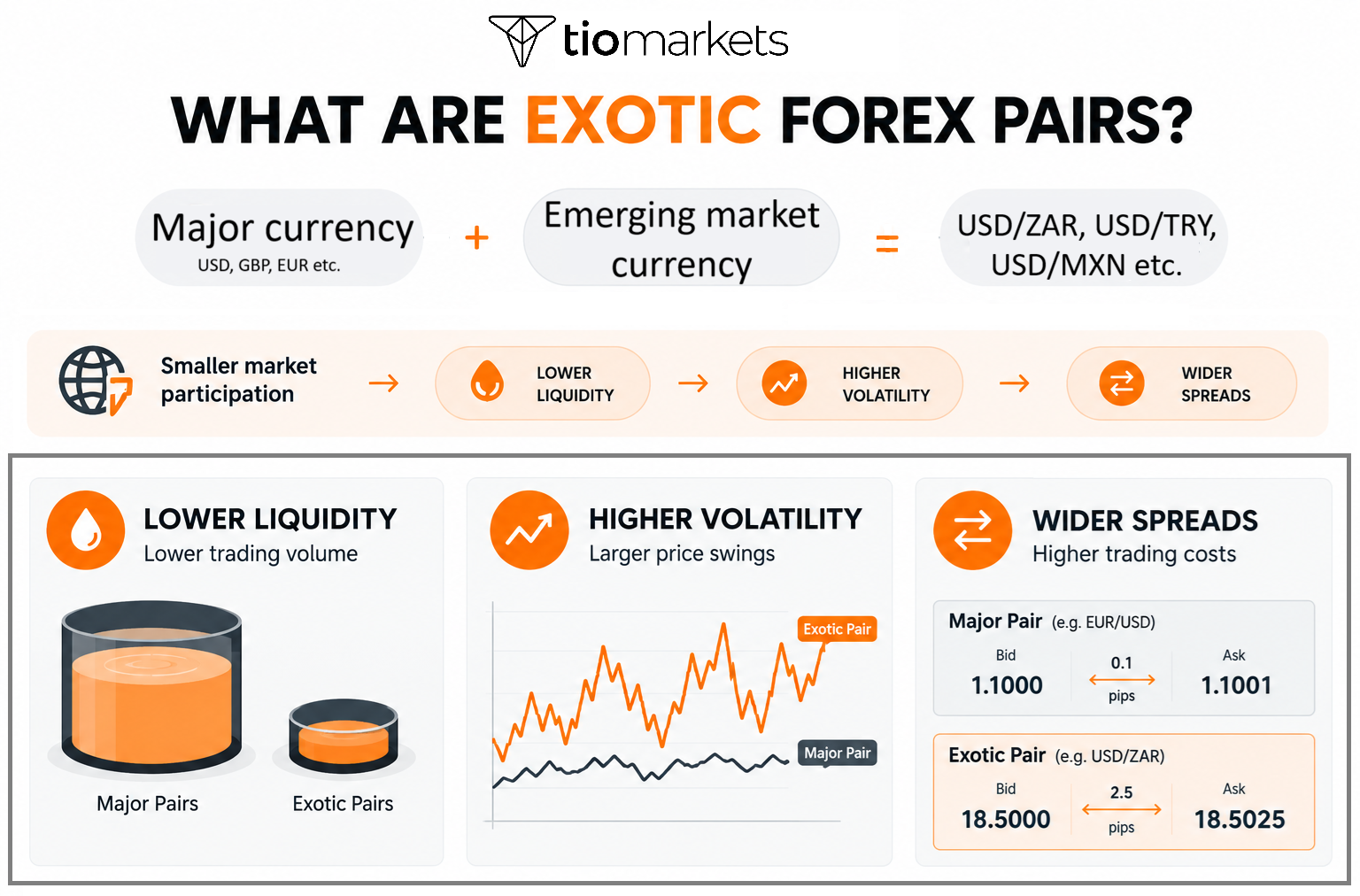
Exotic currency pairs defined: Exotic currency pairs combine one major currency (like USD or EUR) with a currency from an emerging or developing economy (like the Mexican peso, Turkish lira, or South African rand). They typically feature wider spreads, higher volatility, and lower liquidity than major pairs.
How Exotic Forex Pairs Differ from Major and Minor Pairs
Major currency pairs comprise seven combinations that all include the US dollar paired with another major currency: EUR/USD, USD/JPY, GBP/USD, USD/CHF, USD/CAD, AUD/USD, and NZD/USD. These pairs account for the majority of global forex trading volume and feature the highest liquidity levels in the market.
Minor pairs, also called cross pairs, combine major currencies without including the US dollar: examples include EUR/GBP, EUR/JPY, and GBP/JPY. While less liquid than majors, minor pairs still see substantial trading activity due to the economic significance of both currencies involved.
Exotic currency pairs make up the third category, combining a major currency with emerging or developing economy currencies. The key distinction lies in the economic development level and trading volume of the second currency, which creates different market dynamics compared to majors and minors.
What Makes a Currency "Exotic" in Forex Trading?
Several characteristics define exotic currencies within the forex market. Lower global trading volume represents the primary distinguishing factor, with exotic pairs typically accounting for a small fraction of daily forex turnover. According to the Bank for International Settlements (BIS) Triennial Survey, the Mexican peso, Chinese yuan, and Indian rupee each represented between 1% and 4% of total forex turnover, compared to 88% for the US dollar.
Emerging or developing economy origin characterizes exotic currencies, as they come from countries with smaller, less diversified economies compared to the G10 nations. Limited convertibility applies to some exotic currencies, where governments impose restrictions on how freely the currency can be exchanged.
Thinner market depth means fewer market participants are actively trading these currencies at any given time, affecting price stability. Additionally, exotic currencies are typically not held as reserve currencies by other nations' central banks, reducing their global financial importance.
Common Examples of Exotic Currency Pairs by Region
Frequently cited exotic pairs include USD/MXN, USD/TRY, USD/ZAR, EUR/TRY, and USD/BRL, representing emerging markets across Latin America, Asia, Africa, and Eastern Europe.
Latin American Pairs
USD/MXN is among the most actively traded exotics, benefiting from US-Mexico trade ties. USD/BRL connects to South America's largest economy, influenced by commodity exports and interest rates. USD/CLP correlates with copper prices given Chile's mining exports, while USD/ARS experiences significant volatility due to Argentina's economic challenges. All share sensitivity to commodity prices and US Federal Reserve decisions.
Asian Pairs
USD/THB offers exposure to Thailand's tourism and manufacturing economy. USD/SGD represents Singapore's financial hub, though its "exotic" status is debated. USD/IDR connects to Indonesia's commodities, while USD/INR reflects India's technology sector and consumption growth. USD/MYR and USD/PHP respond to regional manufacturing and remittance flows.
African and Middle Eastern Pairs
USD/ZAR ranks among the most traded emerging market pairs, correlated with gold and platinum prices. USD/EGP reflects Egypt's tourism and Suez Canal revenues. USD/SAR and USD/AED maintain dollar pegs, limiting volatility.
European Pairs
USD/TRY has become extremely volatile due to Turkey's monetary policy. USD/PLN, USD/HUF, and USD/CZK represent EU members without euro adoption. EUR/NOK and EUR/SEK cover Scandinavian currencies, though their exotic classification varies. USD/RUB tradability has been significantly restricted since 2022.
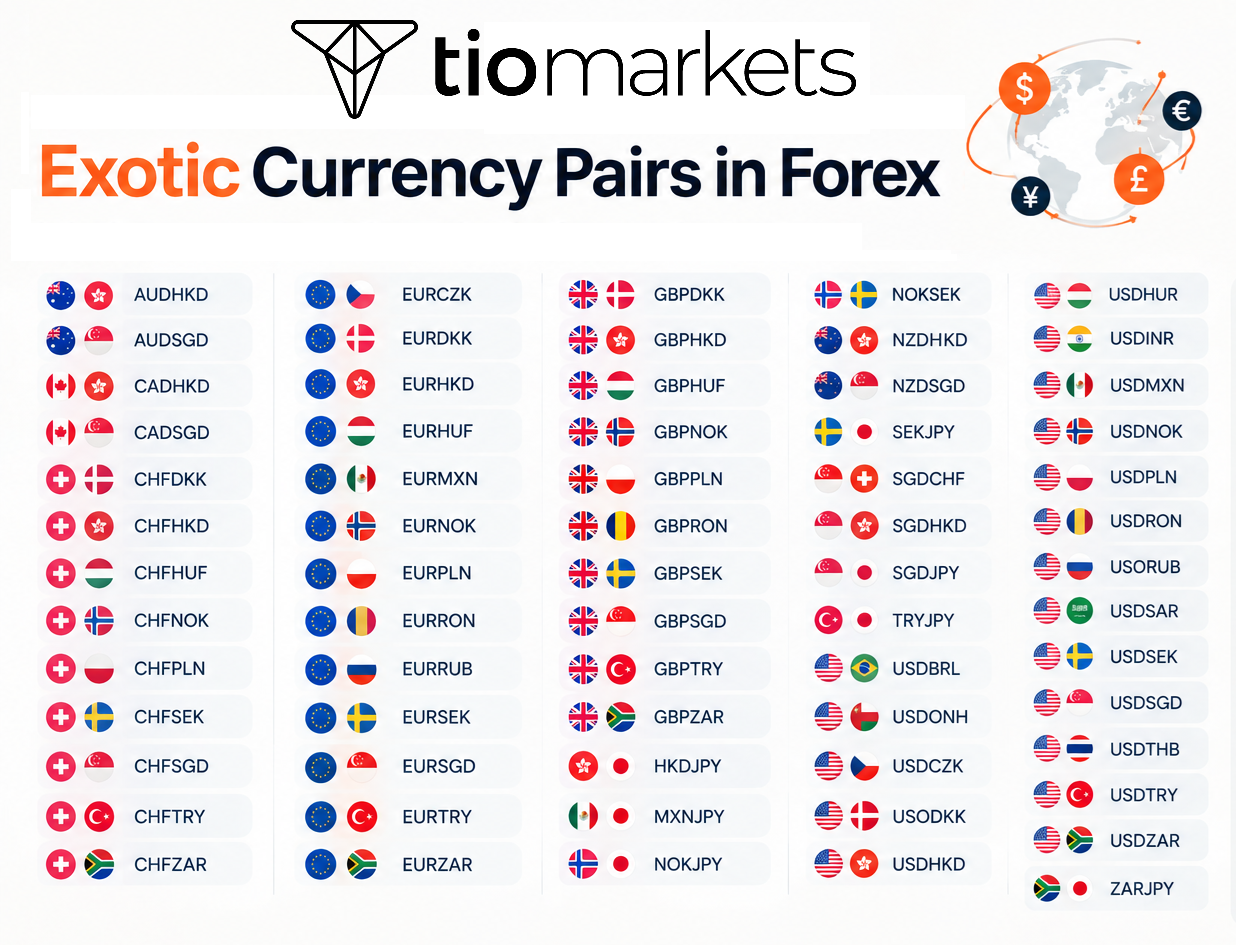
Exotic currency pairs span emerging markets across the globe. The following table provides a list of exotic currency pairs frequently available for trading.
How Do Exotic Currency Pairs Work?
Exotic currency pairs function like other forex pairs, displaying how much of the quote currency is needed to purchase one unit of the base currency, but their prices are influenced more heavily by local economic and political factors rather than global market dynamics.
How Are Exotic Pair Exchange Rates Determined?
Local market forces play a larger role in exotic pair pricing. Central bank policies can move these pairs significantly, particularly interest rate decisions and foreign exchange intervention. Capital controls affect some exotic currencies, creating differences between official and offshore market prices. Non-deliverable forward (NDF) markets exist for currencies with conversion restrictions.
Key Characteristics of Exotic Currency Pairs
Exotic currency pairs typically feature wider bid-ask spreads (often 10-50 pips or more), lower liquidity compared to majors, higher price volatility, and greater sensitivity to local political and economic events.
How Does Liquidity Differ in Exotic FX Pairs?
Liquidity refers to how easily a currency pair can be bought or sold without significantly affecting its price. Higher liquidity generally means tighter spreads, faster execution, and reduced slippage.
Average daily trading volumes for exotic pairs fall far below majors. EUR/USD accounts for roughly 23% of daily forex turnover according to BIS data, while individual exotic pairs typically represent less than 0.5% each. This lower liquidity impacts order execution; traders may experience partial fills, delayed execution, or slippage, particularly with larger positions.
Why Do Exotic Pairs Have Wider Spreads?
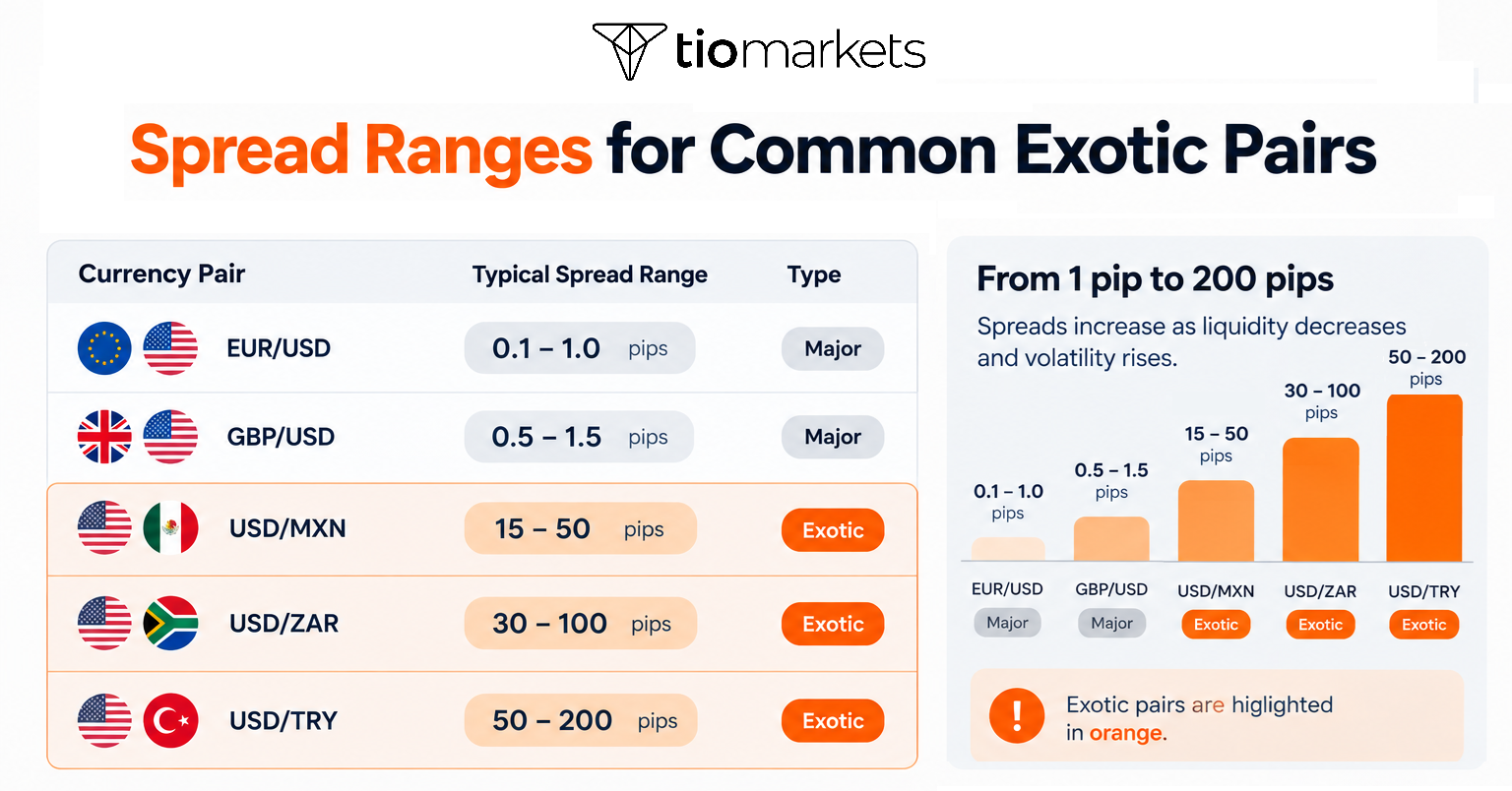
Lower trading volume means market makers assume more risk and compensate through wider bid-ask differences. Exotic pairs like USD/MXN and USD/TRY typically show spreads significantly wider than major pairs like EUR/USD.
At TIOmarkets, for example, USD/MXN spreads can start from around 5.2 pips during liquid trading hours, while USD/ZAR spreads from approximately 3 pips. These prices vary based on market conditions and liquidity. Traders can view real-time spreads directly in the MT4 or MT5 platform before placing trades.
What Causes Higher Volatility?
Smaller economies and shallower markets mean capital flows have proportionally larger impacts. Political instability - elections, policy changes, geopolitical tensions - creates uncertainty. Commodity price dependencies add volatility for resource-exporting nations; falling copper prices often weaken the Chilean peso, while rising oil can strengthen the Russian ruble.
How Do Exchange Controls Affect Trading?
Some nations restrict currency conversion to manage stability. Non-deliverable forward (NDF) markets allow exposure to restricted currencies without physical delivery, settling in US dollars based on rate differences.
What Factors Influence Exotic Currency Pair Prices?
Exotic currency pairs respond to local interest rates, inflation data, political developments, commodity prices, foreign investment flows, and central bank policies more significantly than global market sentiment.
How Do Interest Rate Differentials Impact Exotic Pairs?
Carry trade dynamics occur when traders borrow in low-interest-rate currencies to invest in higher-yielding ones. Many emerging market currencies offer substantially higher interest rates than major currencies, creating potential carry trade flows.
Central bank policy divergence between the Federal Reserve or European Central Bank and emerging market central banks influences exotic pair movements. When an emerging market central bank raises rates while the Fed holds steady, the exotic currency may strengthen against the dollar.
Real interest rates (nominal rates minus inflation) matter more than nominal rates alone. For example, a 15% interest rate loses its attractiveness if inflation runs at 20%, as the real return becomes negative.
Why Do Commodity Prices Affect Some Exotic Currencies?
Resource-dependent economies derive significant export revenue from commodity sales, creating correlations between commodity prices and currency values. When commodity prices rise, these economies earn more foreign currency, potentially strengthening their domestic currency.
South Africa's rand correlates with gold and platinum prices. Chile's peso moves with copper. Brazil's real responds to iron ore, soybeans, and coffee prices. Russia's ruble has historically tracked oil and natural gas prices closely.
Correlation patterns can break down during broader market stress, when risk aversion drives capital out of emerging markets regardless of commodity price movements.
What Role Does Political Stability Play in Exotic Forex Trading?
Election cycles in emerging markets often generate currency volatility as outcomes remain uncertain and policy implications unclear. Markets may react to polling data, candidate statements, and election results with significant price movements.
Policy uncertainty encompasses changes to tax policy, trade agreements, foreign investment rules, and central bank independence. A new government pursuing policies perceived as economically risky may see its currency weaken substantially.
Historical examples include the Turkish lira's sharp declines following interest rate policy disputes between the government and central bank, and the Mexican peso's movements during trade agreement negotiations.
How Does Economic Data Move Emerging Market Currency Pairs?
GDP growth rates influence perceptions of economic health and investment attractiveness. Stronger-than-expected growth typically supports a currency, while disappointing figures may weaken it.
Inflation reports affect interest rate expectations and purchasing power considerations. High inflation often leads to currency weakness unless accompanied by proportional interest rate increases.
Trade balance data shows whether a country exports more than it imports (surplus) or vice versa (deficit). Persistent deficits may pressure a currency over time. Employment figures and manufacturing indices provide additional economic health indicators.
Trading Costs for Exotic Currency Pairs
Trading exotic currency pairs involves higher costs than majors, including wider spreads (typically 10-100 pips), possibly higher commission rates, larger overnight financing charges, and potential conversion fees.
How Much Do Spreads Cost on Exotic Forex Pairs?
Typical spread ranges vary considerably by pair and market conditions. At TIOmarkets, for example, USD/MXN spreads start from around 5.2 pips during liquid trading hours, while USD/ZAR spreads start from approximately 3 pips. Variable spreads like those offered at TIOmarkets can widen during periods of high volatility or low liquidity.
Comparing with major pairs illustrates the cost differential: trading one standard lot (100,000 units) of EUR/USD at TIOmarkets' tight spread of 0.1 pips costs significantly less than exotic pairs. The same lot size on USD/ZAR at a 3-pip spread costs approximately $18 in spread alone.
TIOmarkets offers variable spreads sourced from liquidity providers. These spreads are narrow during normal market conditions and times when liquidity is high, but can widen during periods of abnormal market conditions, high volatility, or low liquidity.
What Are Overnight Financing Costs for Exotic Pairs?
Swap rates represent the cost paid - or received - when holding positions overnight. Central banks set interest rates for their respective countries, and these rates can differ significantly, which is why swaps vary between different currency pairs.
Higher swap rates for exotic positions result from the larger interest rate differentials involved. Holding a long position in a high-yield exotic currency against a low-yield major can generate positive swap payments, while the reverse position incurs costs. For example, pairs like USD/ZAR, USD/MXN, and USD/TRY involve currencies with significantly different interest rates set by their respective central banks.
Do Brokers Charge Different Commissions for Exotic Currency Trading?
Commission structures vary across brokers and account types. Some brokers charge higher commissions for exotic pairs to compensate for the additional execution complexity and risk.
At TIOmarkets, the commission per round turn lot does not vary between markets, including exotic currency pairs. This means you pay the same commission whether you're trading major pairs like EUR/USD or exotic pairs like USD/ZAR or USD/MXN.
Advantages of Trading Exotic Currency Pairs
Exotic currency pairs offer larger price movements that can create trading opportunities, portfolio diversification beyond major markets, exposure to emerging economy growth, and potential carry trade benefits from higher interest rates.
Greater Profit Potential from Volatility: Exotic pairs experience larger daily price movements than majors. While EUR/USD might move 50-80 pips daily, pairs like USD/TRY or USD/ZAR can move several hundred pips. This creates enhanced profit opportunities, but the same volatility also increases the potential for significant losses.
Portfolio Diversification: Exotic currencies often move independently of major pairs, providing diversification benefits when majors are range-bound. They offer exposure to different economic cycles and regional markets, though these markets can also carry heightened political and economic risks.
Carry Trade Income: Substantial interest rate differentials exist between emerging market currencies and majors. Currencies like the Turkish lira, Brazilian real, and South African rand have historically offered high yields. However, currency depreciation can quickly offset interest gains, and high yields often reflect higher underlying risks.
Risks of Trading Exotic Currency Pairs
Exotic currency pairs carry significantly higher risks that traders must carefully consider.
Liquidity Risks: Lower market depth creates execution challenges where orders may not fill at expected prices. Gap risk is more frequent and severe, with prices jumping between levels without trading at intermediate prices, particularly over weekends. Stop-loss orders may be filled at significantly worse prices than specified during volatile periods.
Political and Economic Risks: Emerging markets are susceptible to regime changes, unexpected policy reversals, and capital controls that can trap traders in positions. Currency crises can cause dramatic devaluations within days when foreign investment flees and confidence collapses. Central bank interventions or abandoned currency pegs often result in sharp, sudden losses.
Capital and Margin Risks: Wider stop-loss requirements to accommodate larger price swings mean more capital at risk per trade. Rapid whipsaw movements can trigger stops before markets move in the anticipated direction. The combination of leverage and high volatility increases margin call risks and can deplete account equity quickly during adverse moves.
How to Trade Exotic Currency Pairs
Trading exotic currency pairs requires careful preparation and adjusted strategies to manage their unique characteristics.
Choosing a Broker: Traders would typically evaluate brokers based on spread competitiveness, execution quality, regulatory status, and margin requirements which can be higher for exotics than majors. TIOmarkets has been expanding its exotic pair offering, giving traders access to a growing range of emerging market instruments and offering more than 20 exotic pairs from economies across the globe, with competitive trading conditions, fast execution, and access to user-friendly platforms including MetaTrader 4 and MetaTrader 5.
Position Sizing: Some traders adjust position sizes to account for higher volatility; a size appropriate for EUR/USD may be too large for USD/TRY. Wider stop-loss distances mean the same dollar risk amount requires smaller positions.
Analysis Methods: Many traders apply technical analysis to exotic pairs, though lower liquidity may reduce pattern reliability. Fundamental analysis often takes greater importance, as economic data, political events, and central bank policies can drive significant movements.
Risk Management: Traders often place stops wide enough to avoid being triggered by normal market noise, while accepting this increases capital at risk. Some limit total exotic pair exposure as a percentage of trading capital, recognising that multiple exotic pairs may move together during risk-off events.
Tools & Resources for Exotic Currency Trading
- Economic Calendars: Standard forex calendars cover major economies, but traders focusing on exotics need calendars that include emerging market data releases like the one TIOmarkets offers with reports and releases from countries like Turkey, South Africa, and Brazil as they can move exotic pairs significantly.
- News Sources: Local financial news outlets often report market-moving information before it reaches international wire services. Traders may monitor central bank websites directly for policy statements.
- Broker Tools: TIOmarkets provides market analysis covering key events affecting also exotic currency pairs.
Trading Strategies for Exotic Currency Pairs
- Timeframe Considerations: Higher volatility and wider spreads make short-term trading challenging. Many traders prefer 4-hour, daily, or weekly charts to filter noise and reduce spread impact relative to potential gains.
- Indicator Adjustments: Standard settings may require modification. Some traders widen ATR periods, increase moving average lengths, or adjust RSI thresholds to account for larger price swings.
- Carry Trades: Borrowing in low-yield currencies to invest in high-yield currencies can generate interest income over longer holding periods. Currency depreciation can exceed interest gains, requiring ongoing monitoring.
- Breakout Strategies: Exotic pairs can produce large moves after consolidation. Wider stops may be necessary, and false breakout risks remain elevated due to lower liquidity.
- Fundamental Analysis: Economic data, central bank policies, and political events often drive exotic pairs more reliably than technical patterns alone. Tracking local developments frequently proves essential.
Exotic Currency Pairs Compared to Majors & Minors
Exotic pairs differ from majors and minors through significantly lower liquidity (often 100x less volume), spreads 5-20 times wider, higher volatility (2-3x average daily range), and stronger reactions to local events.
- Liquidity: EUR/USD trades over $2 trillion daily; most exotics trade in single-digit billions. Fewer orders at each price level mean wider bid-ask gaps and slower execution.
- Spreads: EUR/USD typically sees 1 pip spreads, EUR/GBP around 2 pips, while USD/ZAR can reach 50 pips, requiring larger price movements to reach profitability.
- Volatility: Exotic pairs routinely move 2-3 times the pip range of majors. USD/TRY daily ranges of 500+ pips compare to EUR/USD ranges of 50-80 pips.
- News Sensitivity: Global news affects majors gradually as large markets absorb information. Local news can move exotics several percent instantly, with gaps or spikes occurring before information fully processes.
Should Traders Consider Exotic Currency Pairs?
Exotic currency pairs may suit traders with forex experience, adequate capital to manage wider spreads and volatility, time for emerging market research, and tolerance for potential rapid losses.
Experience Level: Trading exotics requires understanding of order execution, risk management, and fundamental analysis beyond what major pairs typically demand. Many traders gain proficiency with majors first and use demo accounts to experience exotic pair characteristics without financial risk.
Capital Requirements: Account size should accommodate appropriate position sizes with wider stops, absorb higher spread and financing costs, and maintain margin buffers for rapid adverse movements.
Time Commitment: Research demands exceed major pairs; traders need to understand local economic conditions, monitor local news sources and central bank communications, and potentially track markets outside typical Western trading hours.
Key Considerations
- Build major pair experience before transitioning to exotics
- Ensure capital can absorb higher trading costs
- Allocate time for ongoing emerging market research
Conclusion
Exotic currency pairs combine major currencies with those from emerging economies, creating a trading environment distinct from major pairs. Their lower liquidity, higher volatility, and wider spreads mean costs exceed those of majors; including wider spreads, higher overnight charges, and potential execution challenges.
These pairs respond strongly to local factors such as central bank policies, political developments, and commodity prices. The volatility that creates potential opportunities also generates risks including sudden devaluations and liquidity gaps.
Key Takeaways
- Exotic pairs require research into specific economic and political conditions
- Each pair carries unique characteristics shaped by its underlying economy
- Trading costs and risks differ significantly from major pairs

FAQ
Risk disclaimer: CFDs are complex instruments and come with a high risk of losing money rapidly due to leverage. You should consider whether you understand how CFDs work and whether you can afford to take the high risk of losing your money. Never deposit more than you are prepared to lose. Professional client’s losses can exceed their deposit. Please see our risk warning policy and seek independent professional advice if you do not fully understand. This information is not directed or intended for distribution to or use by residents of certain countries/jurisdictions including, but not limited to, USA & Countries included in the OFAC sanction list. The Company holds the right to alter the aforementioned list of countries at its own discretion.
TIOmarkets offers an exclusively execution-only service. The views expressed are for information purposes only. None of the content provided constitutes any form of investment advice. The comments are made available purely for educational and marketing purposes and do NOT constitute advice or investment recommendation (and should not be considered as such) and do not in any way constitute an invitation to acquire any financial instrument or product. TIOmarkets and its affiliates and consultants are not liable for any damages that may be caused by individual comments or statements by TIOmarkets analysis and assumes no liability with respect to the completeness and correctness of the content presented. The investor is solely responsible for the risk of his/her investment decisions. The analyses and comments presented do not include any consideration of your personal investment objectives, financial circumstances, or needs. The content has not been prepared in accordance with any legal requirements for financial analysis and must, therefore, be viewed by the reader as marketing information. TIOmarkets prohibits duplication or publication without explicit approval.
Join us on social media



Authors BIO

Maria is a writer and content strategist with over 10 years of experience in the finance industry. She specializes in developing research-backed articles that help financial professionals navigate complex market topics with confidence. Her expertise spans forex, stocks, CFDs and global markets, creating insightful content that educates readers and supports informed decision-making.