Guaranteed Stop Loss Orders: How They Work and Cost
BY Eleni Antoniou
|September 3, 2026A guaranteed stop loss order (GSLO) closes a position at the stop price you choose, even if the market gaps beyond that level. It removes negative slippage from that specific exit, giving you more certainty about the planned loss. In return, the provider may charge a premium and impose rules on where and when the order can be placed.
That guarantee applies to the execution price of the stop, not to the outcome of the trade, the safety of your account, or the profitability of a strategy. Guaranteed stop loss orders are also not universally available. Before relying on one, check the terms for your provider, account, platform, instrument, position size, market hours, and jurisdiction.
Quick answer: A GSLO guarantees the closing price if its trigger conditions are met under the provider’s terms. A normal stop requests an exit but can fill at a worse price during a gap or fast market.
What Is a Guaranteed Stop Loss Order?
A guaranteed stop loss order is a risk-management instruction attached to an open position or entry order. For a long position, the stop is normally set below the current market price. For a short position, it is normally set above the current price.
If the relevant trigger price reaches the stop level, the provider closes the position at the guaranteed level, subject to the order’s valid terms.
The provider takes on the risk that the next available market price is worse than your stop. This matters when prices move rapidly, liquidity becomes thin, or the market reopens at a different price after a closure.
Providers usually compensate for that risk through a GSLO premium, a wider minimum distance, restricted availability, or a combination of these conditions.
The word “guaranteed” therefore needs a narrow reading: it refers to the agreed stop execution price. It does not mean the position cannot lose money. It does not protect other positions, stop a margin close-out elsewhere in the account, cover every fee, or guarantee that a requested GSLO will be accepted.
How Do Guaranteed Stop Loss Orders Work?
- Choose the invalidation level. Set the price at which the trade idea is no longer valid while respecting the provider’s minimum-distance rule.
- Calculate the position size. Size the trade from the cash amount you are prepared to lose and the distance between the entry and stop.
- Review the guarantee terms. Check the premium, trigger basis, eligible market, maximum size, amendment rules, and whether the GSLO can be added after entry.
- Place and confirm the order. Use the platform’s guaranteed-stop option rather than assuming a standard stop is guaranteed. Confirm that the position screen identifies the order as a GSLO.
- Account for the final cost. If the GSLO triggers, the position closes at the guaranteed price and any applicable premium or other trading costs are charged according to the provider’s schedule.
Why Gapping and Slippage Matter
A price gap occurs when the market moves from one price to another without trading at the levels between them. Gaps can appear after weekends, holidays, earnings announcements, unexpected geopolitical events, or major economic releases.
Fast markets can create a similar result when available liquidity is consumed before an order reaches the market.
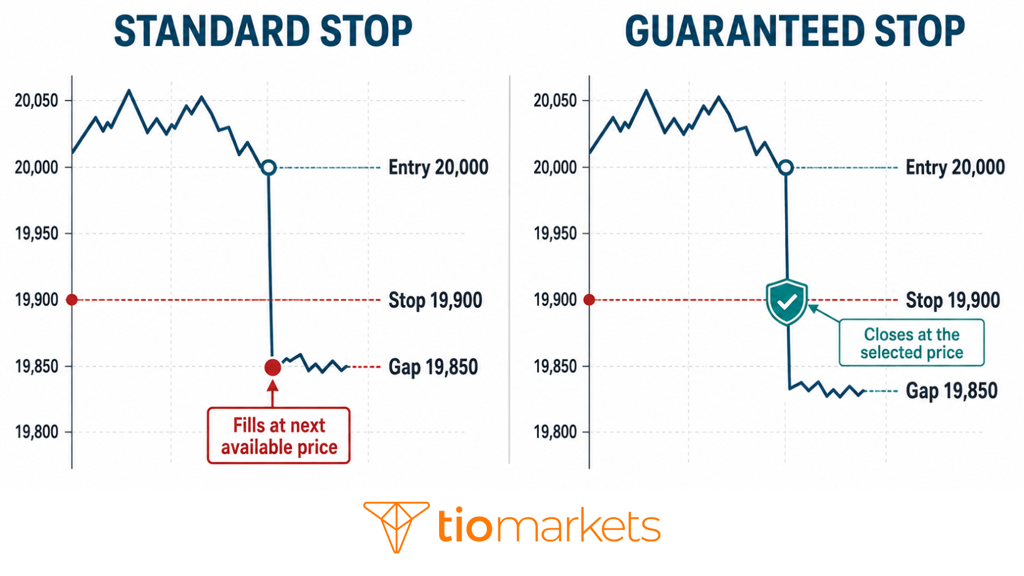
A regular stop generally becomes an instruction to trade at the best available price after its trigger is reached. The stop level is therefore a trigger, not necessarily the execution price.
The difference between the requested price and the fill is slippage. Negative slippage makes a loss larger than planned, while positive slippage can produce a better fill.
For a deeper explanation, read TIOmarkets’ guide to slippage in trading.
Guaranteed Stop Loss vs Standard and Trailing Orders
These order types solve different problems. A GSLO prioritises price certainty for an adverse exit. A stop-limit prioritises price control but may leave the position open.
A trailing stop automatically moves its trigger as the market moves in your favour, but it is normally exposed to slippage unless the provider explicitly guarantees it.
| Order type | What happens at the trigger | Price certainty | Main trade-off |
| Standard stop-loss | Closes at the best available price | No | Can slip in fast or gapping markets |
| Guaranteed stop loss | Closes at the agreed stop price | Yes, under the provider’s terms | Premium and eligibility restrictions may apply |
| Stop-limit | Becomes a limit order | Controls the acceptable price | May not execute, leaving the position open |
| Trailing stop | Trigger follows favourable price movement | Usually no | Can trigger on normal volatility and may slip |
Guaranteed Stop Loss Order Example
Suppose a trader buys an index CFD at 20,000 with a value of USD 2 per point. The trader sets a guaranteed stop at 19,900, which is 100 points below the entry.
- Planned market loss at the GSLO: 100 points × USD 2 = USD 200
- Illustrative GSLO premium if triggered: USD 12
- Illustrative total loss: USD 200 + USD 12 = USD 212, before any other charges
Now assume the market gaps from above 19,900 to 19,850. With a valid GSLO, the exit remains 19,900, so the market loss stays at USD 200.
With a standard stop filled at 19,850, the market loss would be:
150 points × USD 2 = USD 300
The prices, point value, and premium in this example are hypothetical. Actual premiums, spreads, financing, commissions, taxes, currency conversion, trigger rules, and eligible markets depend on the provider and account.
How to Calculate Risk With a GSLO
For a long position, a simplified calculation is:
Maximum planned trade cost = (Entry price − GSLO price) × value per price unit + GSLO premium + other applicable costs
For a short position, reverse the price difference.
When the contract is quoted in points, pips, ticks, or another unit, use the correct value for the chosen position size and account currency. Position sizing should be completed before the order is placed.
This’ guide to trading risk management explains how stop distance, position size, leverage, and total account exposure interact.
What Does a Guaranteed Stop Loss Cost?
There is no universal price for guaranteed stop loss orders. Some providers charge a premium only if the stop is triggered. Others may charge when the order is placed, refund it if unused, or incorporate the cost differently.
The premium may be:
- A fixed number of points multiplied by the position size
- A percentage of the notional exposure
- A flat or instrument-specific charge
- Another amount specified in the provider’s pricing schedule
The order ticket should show the charge before confirmation. If it does not, consult the market information sheet, fee schedule, product disclosure, or client agreement.
Include the premium when checking whether the trade remains inside your risk budget. Frequent use can materially affect the results of a high-turnover strategy, even when each individual charge looks small.
Common GSLO Rules and Restrictions
Guaranteed stop loss orders often come with conditions such as:
- A minimum distance between the current or entry price and the guaranteed stop
- Restrictions on eligible instruments, position sizes, platforms, account types, or jurisdictions
- A requirement to place the GSLO during market hours or when opening the position
- Limits on moving the stop closer to the market
- Restrictions on hedged positions or multiple GSLOs on the same instrument
- Premiums and minimum distances that change when volatility rises
Provider rules differ, so never transfer a rule from one platform to another. Read the current terms shown on your own order ticket and in the provider’s legal documents before trading.
Benefits and Limitations of Guaranteed Stops
Guaranteed stop loss orders trade lower execution uncertainty for a provider-defined cost and set of conditions. Their value depends on the market risk, premium, and how the order fits the wider trading plan.
Potential Benefits
- A known exit price for the protected position when the valid GSLO triggers
- Protection from negative slippage and market gaps on that exit
- Clearer pre-trade loss calculations and position sizing
- Less need to react manually during a sudden adverse move
Limitations
- The premium raises trading costs and may reduce a strategy’s net result
- Minimum-distance rules may force a wider stop than the trade setup requires
- Availability can be limited or withdrawn for particular markets and conditions
- A GSLO cannot prevent losses, poor entries, excessive leverage, overtrading, or correlated account exposure
- It does not replace a complete risk plan or protect against losses on other positions
When Might a GSLO Be Useful?
Guaranteed stop loss orders may be worth evaluating when the consequence of a market gap would exceed your risk tolerance.
Possible situations include:
- Holding a position across a market closure
- Trading an instrument prone to sharp gaps
- Maintaining a strict cash-loss limit where ordinary stop slippage would invalidate the plan
- Trading during periods when liquidity may be reduced
That does not make a GSLO automatically suitable. If the premium is high, the required stop distance is too wide, or the product is unavailable, reducing the position size or avoiding the trade may be more consistent with the risk plan.
Scheduled news is not the only source of volatility. Unscheduled events can occur at any time.
Use a GSLO only when you understand the contract, can afford the premium, and have sized the position from the total amount at risk. The guarantee is not a reason to increase leverage or position size.
How to Choose and Place a Guaranteed Stop
- Define the trade before placing the order. Identify the entry, invalidation point, target, and acceptable cash loss.
- Check availability. Confirm that your provider supports a GSLO for the exact account, platform, instrument, direction, and size you intend to use.
- Set the stop using market logic. Place it where the setup is invalidated, not at an arbitrary cash amount. If the required distance makes the potential loss too large, reduce the position size.
- Add every cost. Include the displayed premium and any relevant spread, commission, financing, or conversion cost in the risk estimate.
- Read the confirmation. Verify the stop price, trigger basis, premium, expiry, and guaranteed status before submitting the order.
- Monitor changes. If you amend the position or stop, recalculate the risk amount and confirm that the guarantee remains valid.
Common Mistakes to Avoid
- Assuming every stop-loss is guaranteed because it appears on the order ticket
- Ignoring the premium when calculating the maximum planned loss
- Using the guarantee as permission to trade a larger position
- Placing the stop so close that ordinary price movement triggers it
- Failing to check whether the guarantee can be amended, cancelled, or added after entry
- Confusing a GSLO with a stop-limit order, which can remain unfilled
Build a Risk Plan Before You Trade
Guaranteed stop loss orders can make one part of a trade more predictable: the adverse exit price. They cannot make the trade safe.
A sound trading plan still needs an appropriate position size, a valid stop level, realistic total exposure, and an understanding of leverage and execution. Use guaranteed stop loss orders as one control within that broader plan, where they are available and suitable.

FAQ
Risk disclaimer: CFDs are complex instruments and come with a high risk of losing money rapidly due to leverage. You should consider whether you understand how CFDs work and whether you can afford to take the high risk of losing your money. Never deposit more than you are prepared to lose. Professional client’s losses can exceed their deposit. Please see our risk warning policy and seek independent professional advice if you do not fully understand. This information is not directed or intended for distribution to or use by residents of certain countries/jurisdictions including, but not limited to, USA & Countries included in the OFAC sanction list. The Company holds the right to alter the aforementioned list of countries at its own discretion.
TIOmarkets offers an exclusively execution-only service. The views expressed are for information purposes only. None of the content provided constitutes any form of investment advice. The comments are made available purely for educational and marketing purposes and do NOT constitute advice or investment recommendation (and should not be considered as such) and do not in any way constitute an invitation to acquire any financial instrument or product. TIOmarkets and its affiliates and consultants are not liable for any damages that may be caused by individual comments or statements by TIOmarkets analysis and assumes no liability with respect to the completeness and correctness of the content presented. The investor is solely responsible for the risk of his/her investment decisions. The analyses and comments presented do not include any consideration of your personal investment objectives, financial circumstances, or needs. The content has not been prepared in accordance with any legal requirements for financial analysis and must, therefore, be viewed by the reader as marketing information. TIOmarkets prohibits duplication or publication without explicit approval.
Join us on social media



Authors BIO

Eleni is a financial markets enthusiast contributing to content covering forex, indices, commodities, and global market developments. She is passionate about researching market-related topics and helping make financial information more accessible to traders.