


Pip Value Calculation: How to Calculate Pip Value in Forex
BY TIOmarkets
|November 17, 2026Pip value is the amount of money that a one-pip move in a currency pair's price is worth on a given position. Pip value calculation multiplies the pip size by the position size in units, giving an amount in the pair's quote currency, and then converts it into the account currency where the two differ. The converted figure is fixed only when those currencies match. That is why $10 per pip on a standard lot holds for EUR/USD in a USD account but not for USD/JPY or EUR/GBP.
The article covers the formula, the three cases that decide the arithmetic, JPY pairs, crosses, smaller lot sizes and common errors. It is written for retail traders who want to work out a pip's worth by hand.
What Is Pip Value and Why Calculate It Yourself?
A pip is the smallest standard unit in which a currency pair's price is measured, and the name is short for "percentage in point" or "price interest point". On most pairs one pip is a move in the fourth decimal place, 0.0001, which equals 1/100 of 1%. That pip size is a distance on the price scale, and it is identical on EUR/USD and EUR/GBP.
Pip value is what that distance is worth on a particular position, and it is the figure that turns a stop distance into money at risk. A 20-pip stop on one standard lot of EUR/USD in a USD account puts $200 at risk. The same 20 pips on one standard lot of EUR/GBP put £200 at risk, about $263.97 at the euro reference rates for 16 November 2026. A trader who sets a stop loss on MT4 in pips therefore needs the conversion as well as the count.
The Pip Value Formula and Pip Sizes
The formula is: pip value in the quote currency = pip size × position size in units. The answer lands in the quote currency because an exchange rate prices one unit of the base currency in units of the quote currency. A rate change multiplied by a number of base-currency units is therefore a quote-currency amount, and the split between the base currency and the quote currency decides which currency the first answer is in.
For one standard lot of EUR/USD the terms read: 0.0001 (pip size) × 100,000 (euros, the contract size) = 10 (US dollars, the quote currency). Only the pip size changes between pair types. Forex rates were traditionally quoted to the fourth decimal, as in EUR/USD 1.3801, and in the early 2000s brokers added a fifth digit, the pipette (fractional pip), worth a tenth of a pip. Yen pairs are the exception, with two decimals plus one further digit for the pipette.
| Pair type | Example quote | Pip position | Pip size | Pipette position |
| Most pairs, such as EUR/USD | 1.38015 | Fourth decimal | 0.0001 | Fifth decimal (0.00001) |
| JPY pairs, such as USD/JPY | 103.985 (8 is the pip, 5 the pipette) | Second decimal | 0.01 | Third decimal (0.001) |
Three Cases for Pip Value Calculation
The first step always gives a quote-currency amount; the next depends on how the pair relates to the account currency. For a USD account there are three cases. On EUR/USD the quote currency is the account currency, so the $10 per lot needs no conversion and does not change. On USD/CAD the account currency is the base currency, and the Canadian dollar amount is divided by the pair's own rate. On EUR/GBP neither currency is the account currency, so the sterling amount passes through a third rate. Knowing how to convert pip value to account currency is therefore the part of the method that varies from pair to pair.
| What the chart or market shows | The approach traders use for it | Main risk |
| Quote currency is the account currency (EUR/USD in a USD account) | Pip size × units, with no conversion: 10 USD per pip on 100,000 units | Carrying the same fixed figure over to pairs quoted in another currency |
| Account currency is the base currency (USD/CAD in a USD account) | Quote-currency pip value divided by the pair's own exchange rate | The figure drifts as the pair moves, so a value worked out at entry goes stale |
| Cross pair without the account currency (EUR/GBP in a USD account) | Quote-currency pip value converted through a third pair, such as GBP/USD | A wrong conversion direction or an out-of-date third rate misstates the value |
Pip Value When USD Is the Base Currency
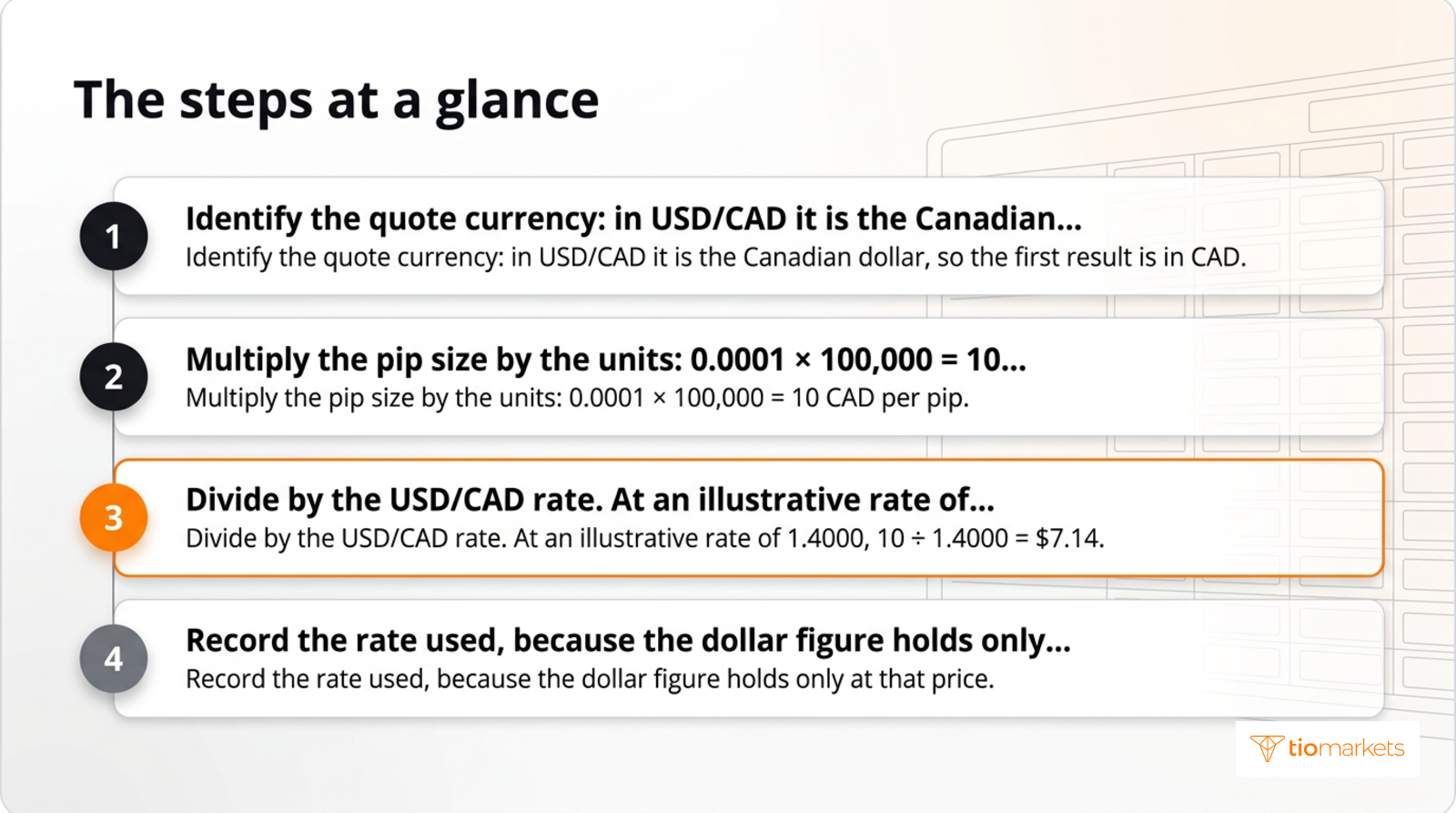
When the account currency is the base currency, the pair's own price serves as the conversion rate. For one standard lot of USD/CAD in a USD account the calculation takes four steps:
- Identify the quote currency: in USD/CAD it is the Canadian dollar, so the first result is in CAD.
- Multiply the pip size by the units: 0.0001 × 100,000 = 10 CAD per pip.
- Divide by the USD/CAD rate. At an illustrative rate of 1.4000, 10 ÷ 1.4000 = $7.14.
- Record the rate used, because the dollar figure holds only at that price.
The limitation of this case is that the answer moves with the pair itself. At an illustrative 1.3500 the same pip is worth $7.41, so a 50-pip move is worth $357.14 at 1.4000 but $370.37 at 1.3500. USD/JPY falls into the same case: its pip value in a USD account is the yen amount divided by the USD/JPY rate.
How to Calculate Pip Value for JPY Pairs
Yen pairs alter only the pip size, but by a factor of 100. The European Central Bank's euro reference rates for 16 November 2026, JPY 175.78 and USD 1.1014 per euro, imply a USD/JPY rate of about 159.60 (175.78 ÷ 1.1014). These rates are averages of buying and selling rates, published for information at around 16:00 CET, so they do not necessarily match dealing prices that day. For one standard lot in a USD account the steps are:
- Use a pip size of 0.01, since yen pairs place the pip at the second decimal and the pipette at the third.
- Multiply by the units: 0.01 × 100,000 = 1,000 JPY per pip, for USD/JPY and EUR/JPY alike.
- Convert the yen into dollars by dividing by USD/JPY: 1,000 ÷ 159.60 = $6.27.
EUR/JPY in a USD account is a cross, yet its pip value is the same $6.27, because the amount to convert is 1,000 yen in both cases. Routing the conversion through the euro gives the same answer: 1,000 ÷ 175.78 = €5.69, and €5.69 × 1.1014 = $6.27. The base currency never enters the result; only the quote and account currencies do.
How to Calculate Pip Value for Cross Pairs
A cross currency pair, one that excludes the account currency, needs a third rate, because the formula's answer is in a currency the account does not hold. For one standard lot of EUR/GBP in a USD account the method has four steps:
- Compute the quote-currency pip value: 0.0001 × 100,000 = 10 GBP.
- Find the pair that links the quote currency with the account currency, here GBP/USD.
- Multiply when the account currency is that pair's quote currency, as in GBP/USD; divide when it is the base currency, as in USD/JPY.
- Apply the conversion rate and record its date alongside the result.
The reference rates allow the conversion to be traced across dates, since GBP/USD equals the USD rate divided by the GBP rate per euro. They were USD 1.1750 and GBP 0.87260 on 31 December 2025, USD 1.1052 and GBP 0.83559 on 13 November 2026, and USD 1.1014 and GBP 0.83450 on 16 November 2026.
The implied GBP/USD rate was 1.3466 at the end of 2025, 1.3227 on 13 November 2026 and 1.3198 on 16 November 2026, so the 10 GBP pip was worth $13.47, $13.23 and $13.20. The gap of $0.27 per pip on one lot, about 2%, came from the conversion rate alone; the EUR/GBP pip stayed at 10 GBP. Pip value therefore differs between pairs that share the 0.0001 pip size. Past exchange rates are history and are not a reliable indicator of future rates.
Pip Value for a Mini Lot and Micro Lot
Pip value scales in direct proportion to position size, so a one-lot result converts to any other size by multiplication. A standard lot is 100,000 units, a mini lot 10,000 and a micro lot 1,000. The differences between standard, mini and micro lots change the money each pip carries, not the arithmetic.
| Position size | Units | EUR/USD pip value (USD) | EUR/USD pipette value (USD) |
| Standard lot | 100,000 | 10.00 | 1.00 |
| Mini lot | 10,000 | 1.00 | 0.10 |
| Micro lot | 1,000 | 0.10 | 0.01 |
Position size is also where leverage enters. Forex positions are opened on margin, a deposit that is a fraction of the position's full value, so 100,000 units can be held with far less capital. Leverage magnifies losses as well as gains: at $10 a pip, a 100-pip adverse move on one EUR/USD lot is a $1,000 loss, such losses can build quickly in a fast market, and a trader can lose all the money deposited. Position sizing for EUR/USD works backwards from this arithmetic, matching the lot size to a planned stop distance and a set amount of risk.
Common Pip Value Calculation Mistakes
Most errors in pip value misstate the money at risk rather than the price distance, and five of them recur.
- Counting pipettes as pips. On a five-digit quote, a move from 1.38015 to 1.38025 is 10 pipettes, or one pip. Read as 10 pips, it overstates the move on one EUR/USD lot as $100 rather than $10.
- Converting in the wrong direction. Multiplying where the rate should divide turns the 10 CAD pip on USD/CAD into $14.00 at 1.4000 instead of $7.14.
- Treating pip value as fixed. Unless the quote currency is the account currency, a figure worked out at entry goes stale as the conversion rate moves.
- Forgetting the account currency. The $10 pip on a standard lot of EUR/USD is about €9.08 in a euro account at the 16 November 2026 reference rate of 1.1014.
- Using 0.0001 on a yen pair. One USD/JPY lot then shows 10 yen per pip instead of 1,000, a hundredfold understatement.
Conclusion
Pip value is fixed only in the quote currency: 10 units per pip on a standard lot of a pair quoted to four decimals, and 1,000 yen on a yen pair. Whether it is also fixed in the account currency turns on one question, whether the account currency is the pair's quote currency. Where it is, the familiar $10 holds; where it is the base currency, the pair's own rate converts it; on a cross, a third rate does. Pip value therefore needs recalculating at current rates before a stop loss is set, rather than being carried over from another pair or another day.
The method converts a price distance into money but says nothing about where the price will go, and a stop can be filled through slippage, a fill at a different price from the one requested, when the market gaps. On a leveraged forex position, leverage magnifies losses as well as gains, a run of adverse pips at a full-lot pip value can build losses quickly, and a trader can lose all the money deposited in the account.
Trade EUR/USD and USD/CAD with TIOmarkets
Take your position on global markets via CFDs. Enjoy tight spreads, fast execution, and fast, flexible funding options.
Trading is risky
FAQ
Risk disclaimer: CFDs are complex instruments and come with a high risk of losing money rapidly due to leverage. You should consider whether you understand how CFDs work and whether you can afford to take the high risk of losing your money. Never deposit more than you are prepared to lose. Professional client’s losses can exceed their deposit. Please see our risk warning policy and seek independent professional advice if you do not fully understand. This information is not directed or intended for distribution to or use by residents of certain countries/jurisdictions including, but not limited to, USA & Countries included in the OFAC sanction list. The Company holds the right to alter the aforementioned list of countries at its own discretion.
TIOmarkets offers an exclusively execution-only service. The views expressed are for information purposes only. None of the content provided constitutes any form of investment advice. The comments are made available purely for educational and marketing purposes and do NOT constitute advice or investment recommendation (and should not be considered as such) and do not in any way constitute an invitation to acquire any financial instrument or product. TIOmarkets and its affiliates and consultants are not liable for any damages that may be caused by individual comments or statements by TIOmarkets analysis and assumes no liability with respect to the completeness and correctness of the content presented. The investor is solely responsible for the risk of his/her investment decisions. The analyses and comments presented do not include any consideration of your personal investment objectives, financial circumstances, or needs. The content has not been prepared in accordance with any legal requirements for financial analysis and must, therefore, be viewed by the reader as marketing information. TIOmarkets prohibits duplication or publication without explicit approval.
Join us on social media


Authors BIO

Behind every blog post lies the combined experience of the people working at TIOmarkets. We are a team of dedicated industry professionals and financial markets enthusiasts committed to providing you with trading education and financial markets commentary. Our goal is to help empower you with the knowledge you need to trade in the markets effectively.