


RBNZ Rate Decision Preview: Will the OCR Rise to 3.00%?
BY Ahmed Osama
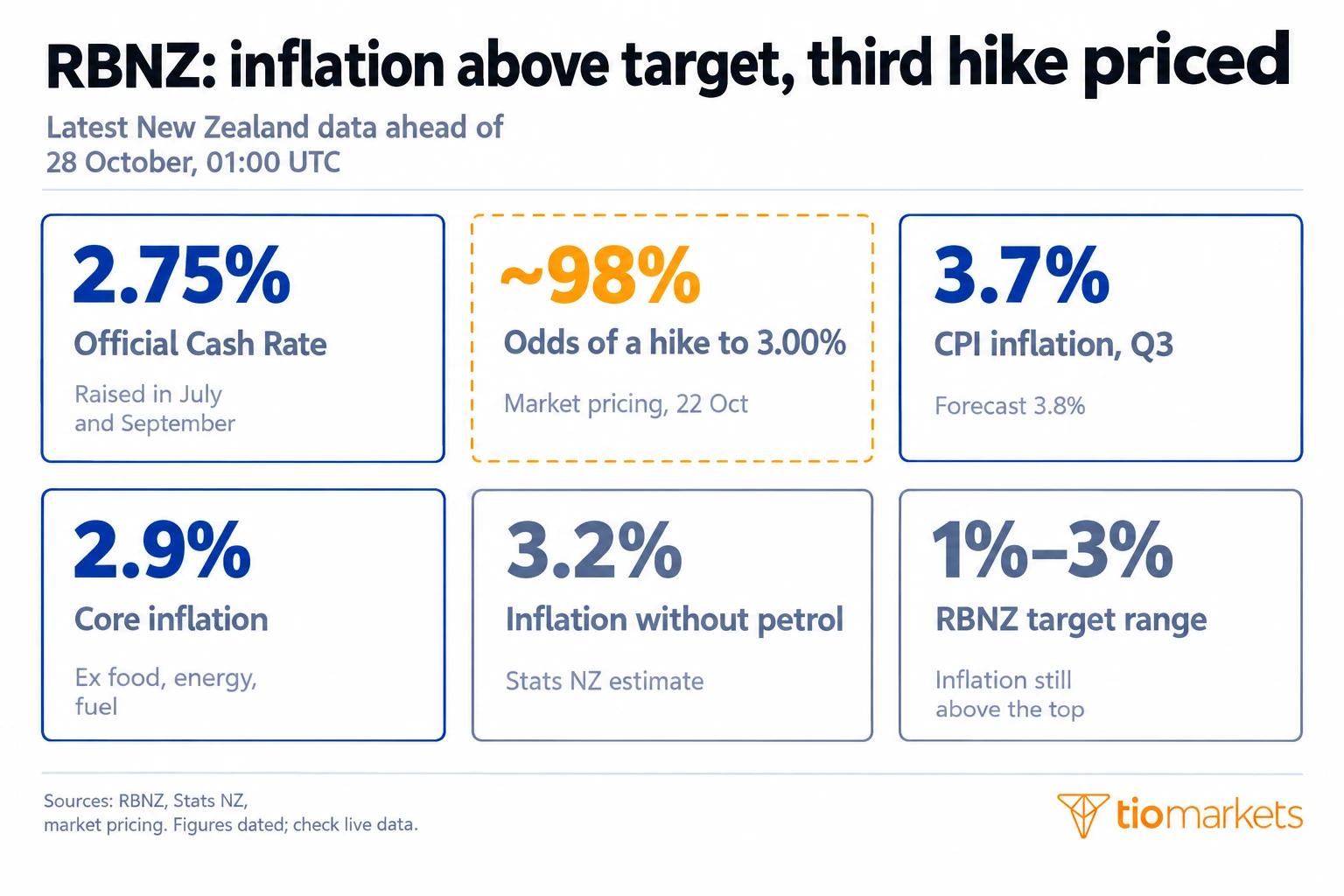
|October 26, 2026The Reserve Bank of New Zealand announces its next rate decision at 01:00 UTC on Wednesday 28 October, after raising its Official Cash Rate in July and September. Markets now price a third quarter-point rise, to 3.00%, as close to certain, even though September-quarter inflation came in slightly below forecasts. With higher fuel prices keeping inflation above target and two more central-bank decisions later the same day, the outcome could set the tone for the New Zealand dollar.
RBNZ rate decision in brief
- The RBNZ publishes its Monetary Policy Review and Official Cash Rate (OCR) decision at 01:00 UTC on Wednesday 28 October.
- Market pricing showed about a 98% chance of a quarter-point rise to 3.00% after the inflation data on 22 October, according to Reuters.
- Annual inflation eased to 3.7% in the September quarter from 4.1%, below the 3.8% forecast but still above the RBNZ's 1%–3% target range.
- Petrol was the largest contributor to inflation, and Brent crude has held above $100 a barrel, trading broadly between $105 and $120 in the second half of October.
- NZD/USD has traded in a broad 0.5550–0.5800 range since mid-September, while AUD/NZD has moved within roughly 1.2200–1.2500.
What is the RBNZ rate decision and when is it announced?
The Reserve Bank of New Zealand's Monetary Policy Committee sets the Official Cash Rate, the benchmark interest rate that influences mortgage rates, borrowing costs and the value of the New Zealand dollar. That makes the RBNZ rate decision a key event for traders of NZD/USD, AUD/NZD and other NZD pairs.
The RBNZ makes seven scheduled decisions a year. Four come with a full Monetary Policy Statement and new forecasts, while the other three, including October, are shorter Monetary Policy Reviews. The October decision is due at 01:00 UTC on Wednesday 28 October, as shown on our economic calendar, together with a summary record of the committee's meeting.
What markets and economists expect
Expectations have moved toward a rise. Before the September-quarter inflation data, market pricing already pointed to about an 80% chance of a quarter-point increase. After the data on 22 October, Reuters reported that markets saw about a 98% chance of a rise to 3.00%, and fully priced 50 basis points of increases by the end of February.
That is a shift from the RBNZ's own guidance in September. Its forecasts then implied a pause in October and a rise to 3.00% in December. Since then, higher fuel prices, firm core inflation and a weaker currency have led many economists to expect the RBNZ to bring that move forward.
Why this RBNZ rate decision matters after two hikes
The RBNZ started raising rates in July, lifting the OCR to 2.50% from 2.25% in its first increase since May 2023, and raised it again to 2.75% on 2 September. Both decisions were reached by consensus. The Bank has said it sees a neutral OCR at around 3.00%, the level that neither stimulates nor restrains the economy.
Inflation remains the main concern. Consumer prices rose 0.7% in the September quarter and 3.7% from a year earlier, down from 4.1% in the June quarter. The figure was below both the 3.8% forecast and the RBNZ's 3.9% projection, but still above the top of its 1%–3% target range. Core pressures stayed firm: excluding food, household energy and vehicle fuels, prices rose 2.9% over the year.
In simple terms: the slightly softer headline figure gives the RBNZ some room to wait, but inflation still well above target and firm underlying price pressures argue for acting now.
How oil prices are feeding New Zealand inflation
Energy is at the centre of New Zealand's inflation problem. Statistics New Zealand said petrol prices were the largest contributor to annual inflation, and estimated that inflation would have been 3.2% if petrol prices had stayed flat. Electricity prices rose 9.3% over the year and international airfares 12.5%.
As a net importer of oil, New Zealand feels higher crude prices directly at the pump and in transport costs. Brent crude has held above $100 a barrel and climbed to near six-month highs in late October, as conflict in the Middle East kept supply risks in focus. A weaker New Zealand dollar makes imported fuel even more expensive in local terms. That combination is why fuel costs could push inflation back up in the final quarter of the year.
Four things to watch on 28 October
1. The decision
A quarter-point rise to 3.00% would take the OCR to the level the RBNZ considers broadly neutral. A hold would surprise markets that have priced the move as near certain.
2. The guidance
Whether the RBNZ signals that further increases may be needed, or suggests rates are now close to where they need to be, may matter more than the decision itself. Markets are already pricing another rise by early next year.
3. The vote and the record of the meeting
Both recent decisions were reached by consensus. Any sign of disagreement, or discussion of a larger move, would add to the market reaction.
4. A busy day for central banks
Australia publishes September inflation data at 00:30 UTC, just before the RBNZ. The Bank of Canada follows at 13:45 UTC and the US Federal Reserve at 18:00 UTC. Our Fed rate decision preview and Bank of Canada preview cover those meetings.
How the RBNZ rate decision could move NZD/USD
NZD/USD shows how many US dollars one New Zealand dollar buys, so a rising pair means a stronger New Zealand dollar. The pair fell from near 0.5800 in mid-September to the 0.5550–0.5650 area in early October, where it traded for about two weeks. It then rallied in the second half of October as rate-hike expectations built, reaching the 0.5700 area before easing back to around 0.5680.
NZD/USD has been trading in a broad 0.5550–0.5800 range. Reference levels traders are watching:
- 0.5800: the mid-September high area
- 0.5750: the first resistance area above the October highs
- 0.5600: the top of the early-October trading range
- 0.5550: the October low area
A more hawkish outcome could support the New Zealand dollar and lift NZD/USD toward 0.5750 and 0.5800. A more dovish outcome, such as a surprise hold, could push it back toward 0.5600 and 0.5550. The US dollar's reaction to the Fed later the same day may also drive the pair.
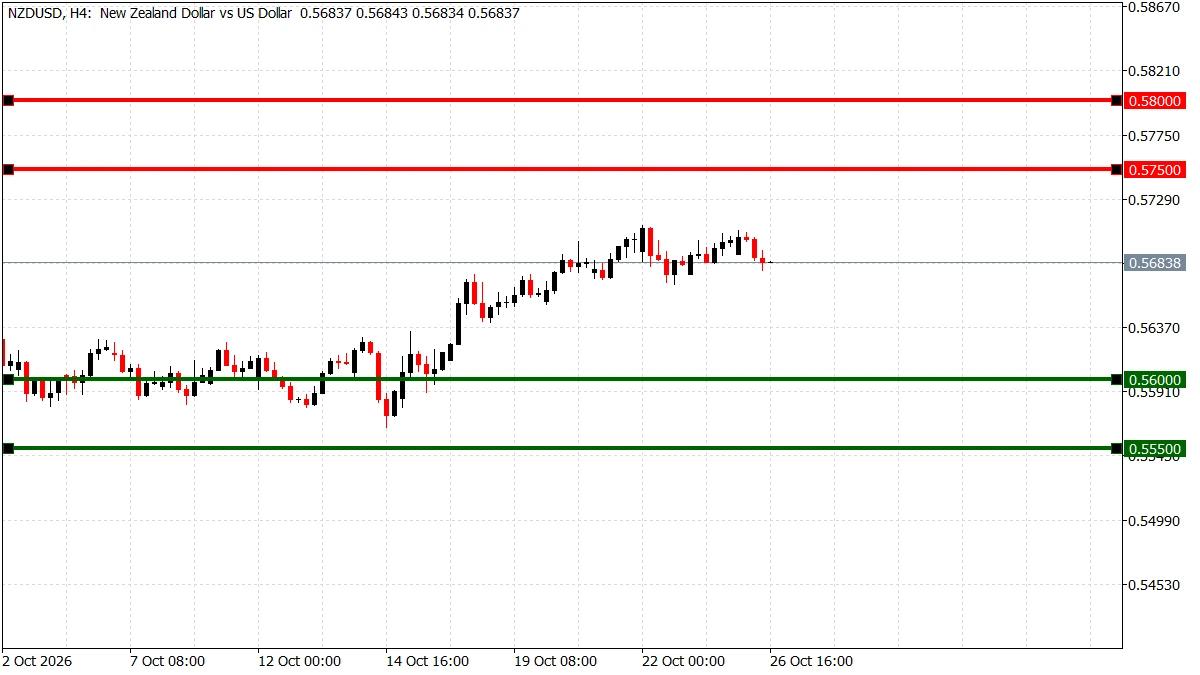
Source: TIOmarkets MT5, NZDUSD H4 chart, 26 October 2026.
How the RBNZ rate decision could move AUD/NZD
AUD/NZD shows how many New Zealand dollars one Australian dollar buys, so a falling pair means a stronger New Zealand dollar against the Australian dollar. The pair traded mostly between 1.2300 and 1.2470 from late September to mid-October, briefly reached the 1.2500 area, then dropped sharply to the 1.2270 area. It has since recovered to around 1.2370.
Interest-rate differences matter here. The Reserve Bank of Australia's cash rate is 4.60%, well above the RBNZ's 2.75%. A rise to 3.00% would narrow that gap. Australia's September inflation data at 00:30 UTC, half an hour before the RBNZ, and the RBA's own decision on 3 November add to the pair's sensitivity this week.
AUD/NZD has been trading in a broad 1.2200–1.2500 range. Reference levels traders are watching:
- 1.2500: the mid-October high area
- 1.2450: the top of the late-September to mid-October range
- 1.2270: the October low area
- 1.2200: the next support area below
A more hawkish RBNZ could strengthen the New Zealand dollar and push AUD/NZD toward 1.2270 and 1.2200. A more dovish outcome could lift the pair toward 1.2450 and 1.2500.
All levels are context markers, not entry or exit points, and should be checked against a live price feed.
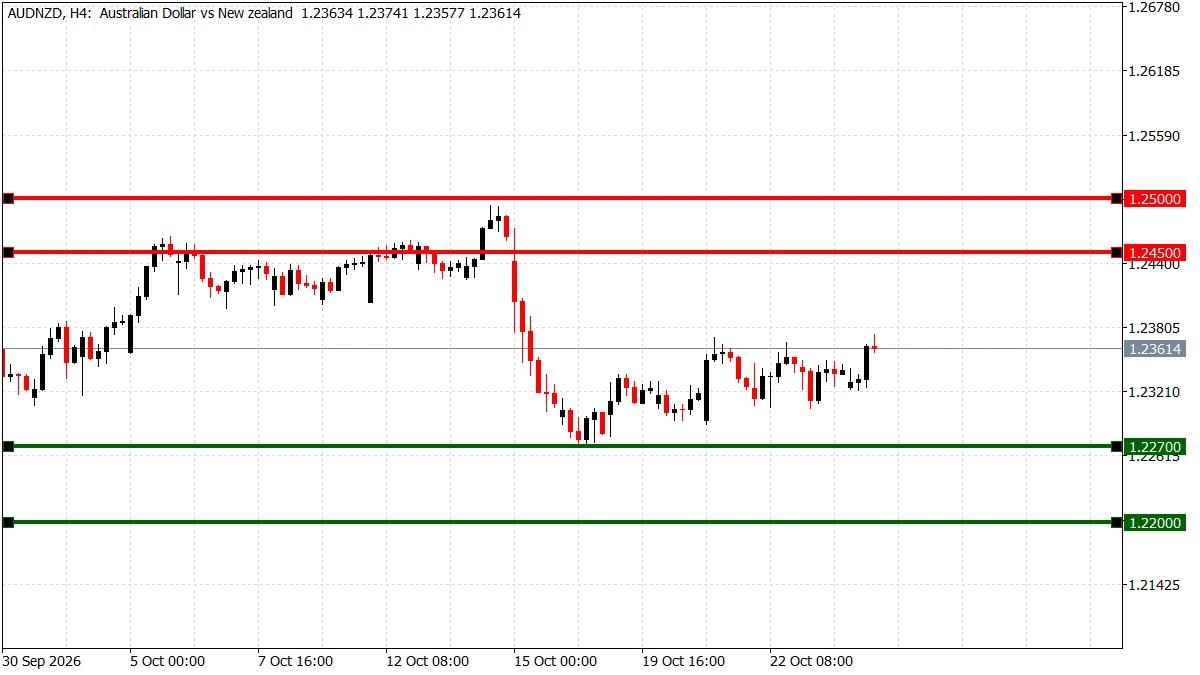
Source: TIOmarkets MT5, AUDNZD H4 chart, 26 October 2026.
Trade NZD/USD and AUD/NZD with TIOmarkets
Take your position on major and cross currencies via CFDs. Enjoy tight spreads, fast execution, and fast, flexible funding options.
Trading is risky
Three scenarios: better than expected, as expected or worse than expected
In this table, "better" means a softer, more dovish outcome than markets expect, and "worse" means a tighter, more hawkish one, from the perspective of borrowing costs. A more hawkish outcome tends to support the New Zealand dollar, which means a higher NZD/USD and a lower AUD/NZD.
| Scenario | What it could look like | Possible market reaction | What could change the reading |
| Better than expected (more dovish) | A hold at 2.75%, with the RBNZ pointing to the softer headline inflation and waiting for December | The New Zealand dollar could weaken as hike bets are priced out; NZD/USD could move toward 0.5600–0.5550 and AUD/NZD toward 1.2450–1.2500 | A clear signal of a December rise, which would soften the reaction |
| As expected | A quarter-point rise to 3.00%, with guidance that keeps further moves dependent on the data | First moves may be limited because the rise is largely priced in; NZD/USD could stay within 0.5600–0.5750 and AUD/NZD within 1.2270–1.2450 as attention shifts to the Bank of Canada and the Fed | Australia's inflation data at 00:30 UTC or a hawkish Fed later in the day |
| Worse than expected (more hawkish) | A rise to 3.00% with a clear signal of further increases, or a larger move | The New Zealand dollar could strengthen; NZD/USD could rise toward 0.5750–0.5800 and AUD/NZD could fall toward 1.2270–1.2200 | A sharp fall in oil prices, weak global risk sentiment or a strongly hawkish Fed |
Scenario thresholds are editorial guideposts, not forecasts or trading recommendations.
Three central banks in one day
The RBNZ is the first of three central-bank decisions on 28 October, followed by the Bank of Canada and the Fed. A rise in New Zealand followed by a hawkish Fed could leave NZD/USD little changed by the end of the day, while a surprise hold followed by a hawkish Fed could weigh on the pair more heavily. Liquidity can be thinner during Asian trading hours, which can widen spreads and cause slippage around the 01:00 UTC announcement.
Key events to watch
- Wednesday 28 October, 00:30 UTC: Australia's September inflation data, including quarterly figures
- Wednesday 28 October, 01:00 UTC: RBNZ rate decision and Monetary Policy Review
- Wednesday 28 October, 13:45 UTC: Bank of Canada rate decision
- Wednesday 28 October, 18:00 UTC: US Federal Reserve rate decision
- Thursday 29 October, 12:30 UTC: US PCE inflation and third-quarter GDP
- Tuesday 3 November, 03:30 UTC: Reserve Bank of Australia rate decision
- Wednesday 9 December: the next RBNZ decision, with a full Monetary Policy Statement
Risks and uncertainties
With a rise almost fully priced in, the reaction may depend more on the RBNZ's guidance than on the decision. Oil prices remain highly sensitive to developments in the Middle East, and a sharp move in fuel costs could change the inflation outlook quickly. Australia's inflation data, the Fed decision and global risk sentiment can all move NZD pairs on the same day.
Market direction is not mechanical. Positioning, liquidity and global risk appetite can outweigh the usual relationship between central-bank signals and currencies, and prices can gap or reverse rapidly around the announcement.
Conclusion
The RBNZ rate decision on 28 October looks set to deliver a third rise this year, with markets pricing a move to 3.00% as close to certain. Inflation still above target, high oil prices and a weaker currency support that view, even after a slightly softer inflation reading. Because the rise is largely priced in, the RBNZ's signal on what comes next may matter most for the New Zealand dollar, while Australia's inflation data and the Fed decision could shape how NZD/USD and AUD/NZD end the day.

FAQ
Risk disclaimer: CFDs are complex instruments and come with a high risk of losing money rapidly due to leverage. You should consider whether you understand how CFDs work and whether you can afford to take the high risk of losing your money. Never deposit more than you are prepared to lose. Professional client’s losses can exceed their deposit. Please see our risk warning policy and seek independent professional advice if you do not fully understand. This information is not directed or intended for distribution to or use by residents of certain countries/jurisdictions including, but not limited to, USA & Countries included in the OFAC sanction list. The Company holds the right to alter the aforementioned list of countries at its own discretion.
TIOmarkets offers an exclusively execution-only service. The views expressed are for information purposes only. None of the content provided constitutes any form of investment advice. The comments are made available purely for educational and marketing purposes and do NOT constitute advice or investment recommendation (and should not be considered as such) and do not in any way constitute an invitation to acquire any financial instrument or product. TIOmarkets and its affiliates and consultants are not liable for any damages that may be caused by individual comments or statements by TIOmarkets analysis and assumes no liability with respect to the completeness and correctness of the content presented. The investor is solely responsible for the risk of his/her investment decisions. The analyses and comments presented do not include any consideration of your personal investment objectives, financial circumstances, or needs. The content has not been prepared in accordance with any legal requirements for financial analysis and must, therefore, be viewed by the reader as marketing information. TIOmarkets prohibits duplication or publication without explicit approval.
Join us on social media


Authors BIO

An experienced financial analyst and educator with over 8 years of expertise covering gold, forex, and global financial markets. Ahmed specializes in blending price action analysis with macroeconomic data to accurately interpret market movements, providing readers with comprehensive educational insights into trading and the financial world.