


What Are Financial Instruments? A Guide for Traders
BY Maria K.
|September 28, 2026| What are financial instruments: Tradeable contracts that hold monetary value and can be exchanged between parties in financial markets. |
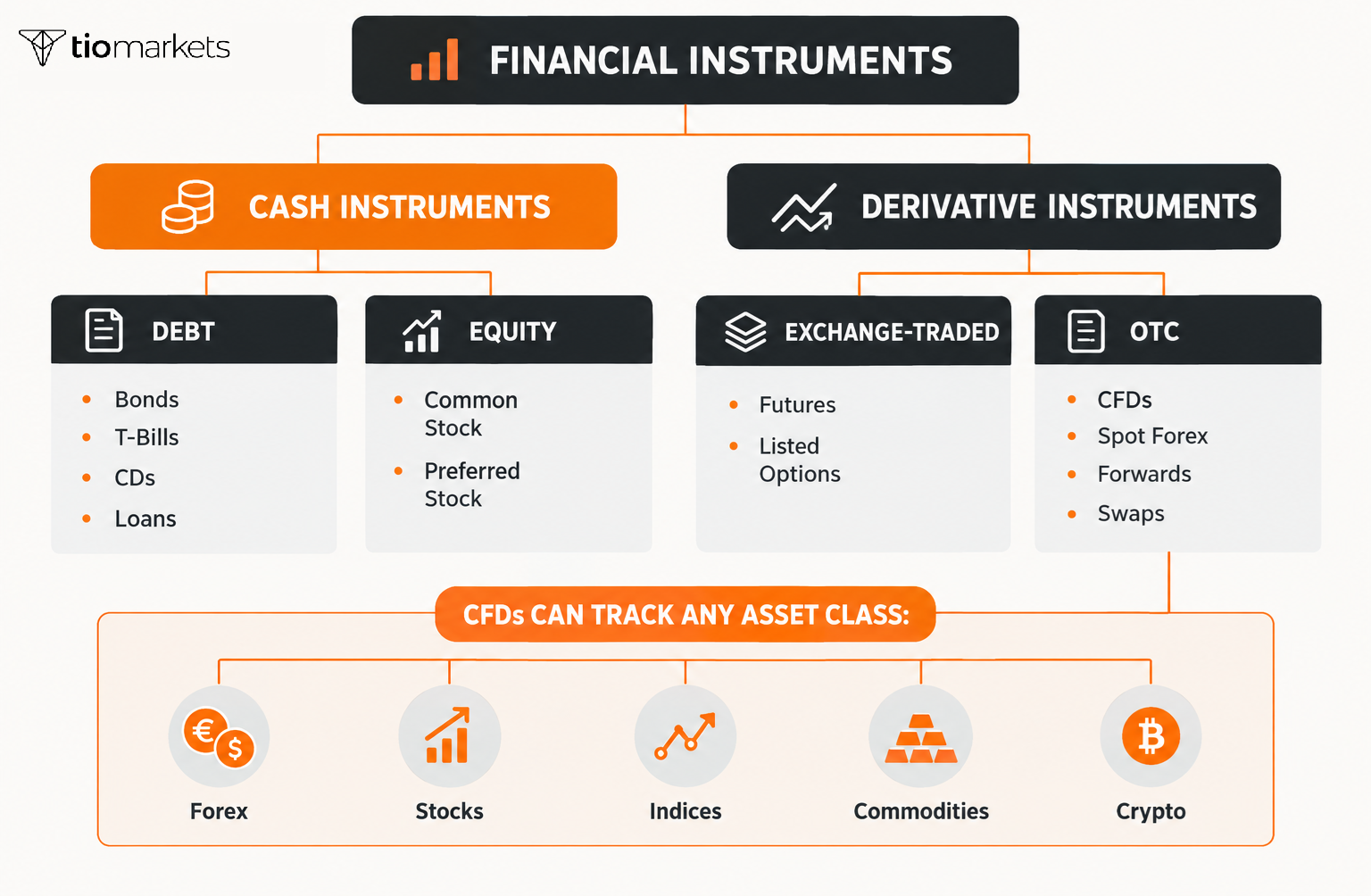
Financial instruments broadly include cash instruments (stocks, bonds, loans, bank deposits) and derivatives (futures, options, swaps, CFDs).
Traditional investors typically hold cash instruments like stocks and bonds, while online traders typically access these same markets through derivative instruments like CFDs, enabling speculation on price movements across global markets without necessarily owning the underlying assets.
This article examines what are financial instruments, how they work, the different types available, and which instruments are most relevant to online retail traders.
Definition: What Are Financial Instruments
Financial instruments are contracts representing monetary value that can be created, traded, or settled between two or more parties. These contracts establish specific terms regarding price, quantity, and settlement conditions, determining how profits or losses are calculated and when settlement occurs.
For online traders, the most relevant instruments include CFDs, futures, forex pairs, and other derivatives that allow speculation on price movements across global markets. Every trade you execute - whether buying shares, opening a forex position, or trading index CFDs -involves entering into one of these binding agreements through your broker.
Understanding financial instruments before committing capital matters because each type behaves differently under various market conditions. Some offer higher liquidity, others provide greater leverage, and each carries unique cost structures that affect overall profitability over time.
How Financial Instruments Work
Financial instruments function as legally binding contracts that establish rights and obligations between parties, enabling the transfer of capital, management of risk, and creation of investment opportunities across financial markets.
The Mechanism of Value Transfer: Financial instruments transfer value between parties through contractual agreements. When you buy a stock, you exchange capital for ownership rights. When you open a CFD position, you enter a contract that pays the difference between opening and closing prices. Each instrument type defines how value moves between buyer and seller.
Role in Capital Allocation: Financial instruments channel funds from those with surplus capital to those who need it. Corporations issue stocks and bonds to raise money for expansion. Governments issue treasury securities to fund public spending. Traders and investors provide this capital in exchange for potential returns.
Connection Between Issuers and Investors: Issuers create financial instruments to meet funding needs; investors purchase them seeking returns. Primary markets connect issuers directly with initial buyers, while secondary markets allow subsequent trading between investors. This system creates liquidity and enables price discovery.
Basic Lifecycle of a Financial Instrument: Every financial instrument follows a lifecycle with the main stages being Issuance → Trading → Settlement.
First the instrument is created (a company issues shares, a government issues bonds, a trader opens a CFD position). Then it changes hands in markets, with prices fluctuating based on supply and demand. And finally the contract concludes (shares are transferred, bonds mature, CFD positions close).
For CFDs and forex, this cycle can complete within seconds. For bonds, it may span decades.
Why Businesses and Individuals Use Financial Instruments: Businesses use financial instruments to raise capital, manage cash flow, and hedge against risks like currency fluctuations or commodity price changes. Individuals use them to build wealth, generate income, speculate on price movements, or protect existing assets.
Main Types of Financial Instruments
Financial instruments are divided into two primary categories: cash instruments, which derive value directly from markets, and derivative instruments, which derive value from underlying assets or benchmarks.
Cash Instruments
Cash instruments are financial products whose value is determined directly by markets and represent actual ownership or debt claims.
| Characteristics | Examples |
| Value reflects direct market pricing; Represent tangible ownership or lending relationships; Generally simpler to understand than derivatives; Include both primary instruments (newly issued) and secondary instruments (previously issued, now trading) | Deposits: Funds held at banks earning interest. Loans: Agreements where lenders provide capital in exchange for repayment plus interest. Securities: Stocks representing ownership; bonds representing debt |
When you buy shares through a traditional stockbroker, you become a partial owner of that company, this is a cash instrument.
Derivative Instruments
Derivatives are contracts whose value is based on an underlying asset, index, or rate without requiring ownership of that underlying item.
The "underlying" refers to the actual asset: a stock, currency pair, commodity, or index, whose price movements the derivative tracks. When trading derivatives, you're speculating on the underlying's price without owning it directly.
Derivative prices move in relation to their underlying assets. A gold CFD rises when gold prices rise. An S&P 500 futures contract falls when the index falls. This relationship allows traders to gain exposure to assets without the complications of direct ownership.
Exchange-traded derivatives like futures, listed options etc. trade on regulated exchanges with standardised contracts and centralised clearing. Over-the-counter (OTC) derivatives like CFDs, spot forex, forwards are private contracts between parties, typically between traders and their brokers.
CFDs as a Financial Trading Instrument
CFDs are among the most widely used derivative instruments for retail traders, enabling speculation on price movements across virtually any market without owning the underlying asset. As OTC instruments, your contract is directly with your broker rather than an exchange. CFD prices track underlying markets, with brokers quoting prices derived from real-time market data.
Brokers use different execution models. TIOmarkets employs a hybrid approach, combining internal liquidity matching with Straight Through Processing (STP) to external providers ensuring competitive pricing and reliable execution.
For more on how CFD trading works electronically, see our relevant guide.
What Is the Difference Between Cash and Derivative Instruments?
Cash instruments have values directly determined by markets and represent direct ownership or debt claims, while derivative instruments derive their value from underlying assets, indices, or rates without representing direct ownership of those underlying items.
| Aspect | Cash Instruments | Derivatives |
| Valuation | Direct market pricing | Derived from underlying asset |
| Ownership | Direct ownership or debt claim | Contractual rights only |
| Risk Profile | Generally lower complexity | Higher complexity, often leveraged |
| Liquidity | Varies widely | Often highly liquid |
| Common Use | Long-term investment, income | Trading, hedging, speculation |
Different Asset Classes of Financial Instruments
Financial instruments are categorised into three main asset classes: debt-based instruments (bonds, loans), equity-based instruments (stocks, ownership stakes), and foreign exchange instruments (currency contracts).
Debt-Based Financial Instruments
Debt instruments represent borrowed capital; the issuer owes the holder repayment plus interest according to defined terms.
| Characteristics | Fixed or variable interest payments; Defined maturity date; Priority over equity in bankruptcy; Credit risk dependent on issuer's ability to repay |
| Short-Term Instruments | Treasury bills (T-bills), Commercial paper, Certificates of deposit (CDs) |
| Long-Term Instruments | Bonds, Notes, Mortgages |
| Interest & Maturity | Coupon payments made periodically or at maturity; longer maturities typically offer higher yields |
| Credit Risk | Primary risk is issuer default; credit ratings assess this risk; higher-rated issuers pay lower rates |
Equity-Based Financial Instruments
Equity instruments represent ownership stakes in companies, entitling holders to share in profits and assets.
| Characteristics | Ownership claims rather than debt obligations; Potential for dividends and capital appreciation; Voting rights in corporate decisions; Subordinate to debt in bankruptcy |
| Types | Common Stock: Standard ownership shares with voting rights and variable dividends; Preferred Stock: Priority dividend payments but typically no voting rights |
| Returns | Dividends (periodic profit distributions) and capital appreciation (share price increase). Unlike debt, equity returns are not guaranteed. |
| Risk-Return Profile | Higher potential returns than debt but with greater risk. Share prices can decline significantly and dividends may be reduced. Historically, equities have outperformed debt over long periods. |
Foreign Exchange Financial Instruments
Foreign exchange instruments involve the exchange of one currency for another, forming the foundation of the world's largest financial market. Foreign exchange instruments enable international commerce by allowing businesses to convert currencies. They also allow investors to access foreign markets and manage currency exposure.
Types
- Spot transactions: Immediate currency exchange at current market rates
- Forward contracts: Agreements to exchange currencies at a future date at predetermined rates
- Currency options: Rights (not obligations) to exchange currencies at specified rates
- Currency swaps: Exchanges of currency principal and interest payments
For retail traders, forex is most commonly accessed through CFDs. Rather than physically exchanging currencies, traders speculate on exchange rate movements. Currency pairs like EUR/USD or GBP/JPY can be traded with leverage, enabling both long and short positions without currency conversion.
How Traders Access Financial Instruments
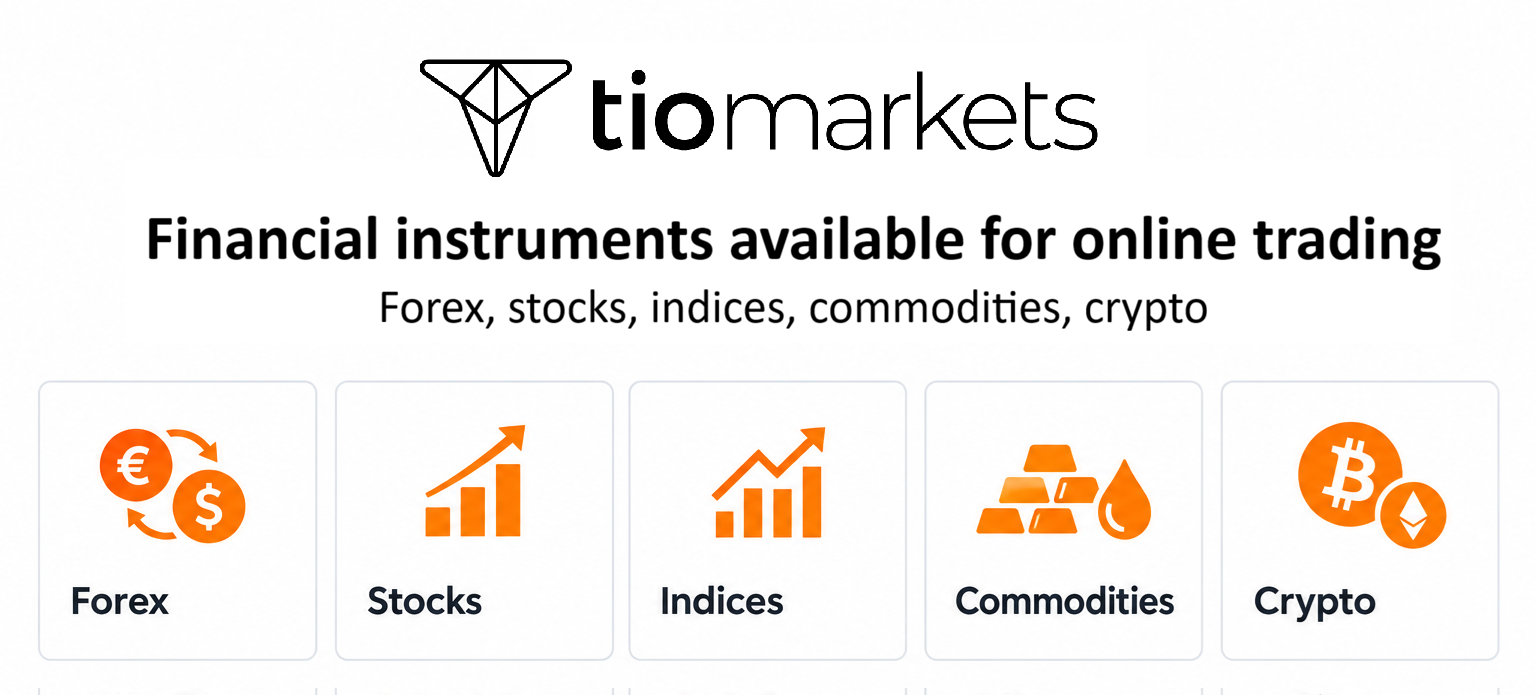
For online retail traders, most market access comes through CFDs and spot forex. These derivative instruments allow you to trade a wide range of asset classes: stocks, indices, commodities, cryptocurrencies, and futures, from a single trading account, with optional leverage and the ability to go both long and short.
Major categories include:
- Forex pairs like EUR/USD, GBP/JPY, etc.
- Stock CFDs that offer exposure to individual company shares
- Index CFDs with basket instruments like S&P 500
- Commodity CFDs such as gold, oil, agricultural products
- Crypto CFDs like Bitcoin, Ethereum, etc.
TIOmarkets offers a wide range of financial instruments for online trading, as mentioned above.
Risks Associated with Financial Instruments
Trading financial instruments carries inherent risks including market volatility, leverage amplification, counterparty risk, and liquidity risk; understanding and managing these risks is essential for sustainable trading.
- Market and Volatility: Prices can move against positions rapidly, with gap risk meaning prices can jump over stop-loss orders during fast-moving markets.
- Leverage: The same leverage that amplifies gains equally amplifies losses. Margin calls occur when account equity falls below required levels.
- Counterparty: For OTC products like CFDs, broker financial stability matters—regulatory protections including segregated funds provide important safeguards.
- Liquidity: Some instruments are harder to exit at desired prices, particularly during low market participation.
Before trading financial instruments with real money, traders should understand the products, practice on demo accounts, and verify they're using a properly regulated broker.
Key Takeaways
- What are financial instruments? Tradeable contracts representing monetary value; for online traders, derivatives like CFDs are most relevant
- Two main categories: Cash instruments (direct ownership like stocks and bonds) and derivatives (contracts based on underlying assets like CFDs and futures)
- CFDs track underlying assets without requiring ownership, enabling leverage and short-selling
- Each instrument type carries unique risks including market volatility, leverage amplification, and counterparty exposure
- CFDs are OTC products which means broker choice matters: regulation, execution quality, and fund safety are crucial
Ready to explore financial instruments in practice? TIOmarkets offers a free demo account with access to 950+ instruments across forex, indices, commodities, stocks, cryptocurrencies, and futures.

FAQ
Risk disclaimer: CFDs are complex instruments and come with a high risk of losing money rapidly due to leverage. You should consider whether you understand how CFDs work and whether you can afford to take the high risk of losing your money. Never deposit more than you are prepared to lose. Professional client’s losses can exceed their deposit. Please see our risk warning policy and seek independent professional advice if you do not fully understand. This information is not directed or intended for distribution to or use by residents of certain countries/jurisdictions including, but not limited to, USA & Countries included in the OFAC sanction list. The Company holds the right to alter the aforementioned list of countries at its own discretion.
TIOmarkets offers an exclusively execution-only service. The views expressed are for information purposes only. None of the content provided constitutes any form of investment advice. The comments are made available purely for educational and marketing purposes and do NOT constitute advice or investment recommendation (and should not be considered as such) and do not in any way constitute an invitation to acquire any financial instrument or product. TIOmarkets and its affiliates and consultants are not liable for any damages that may be caused by individual comments or statements by TIOmarkets analysis and assumes no liability with respect to the completeness and correctness of the content presented. The investor is solely responsible for the risk of his/her investment decisions. The analyses and comments presented do not include any consideration of your personal investment objectives, financial circumstances, or needs. The content has not been prepared in accordance with any legal requirements for financial analysis and must, therefore, be viewed by the reader as marketing information. TIOmarkets prohibits duplication or publication without explicit approval.
Join us on social media



Authors BIO

Maria is a writer and content strategist with over 10 years of experience in the finance industry. She specializes in developing research-backed articles that help financial professionals navigate complex market topics with confidence. Her expertise spans forex, stocks, CFDs and global markets, creating insightful content that educates readers and supports informed decision-making.